Private air defense systems appeared in Ukraine. Who operates them and what are their implications

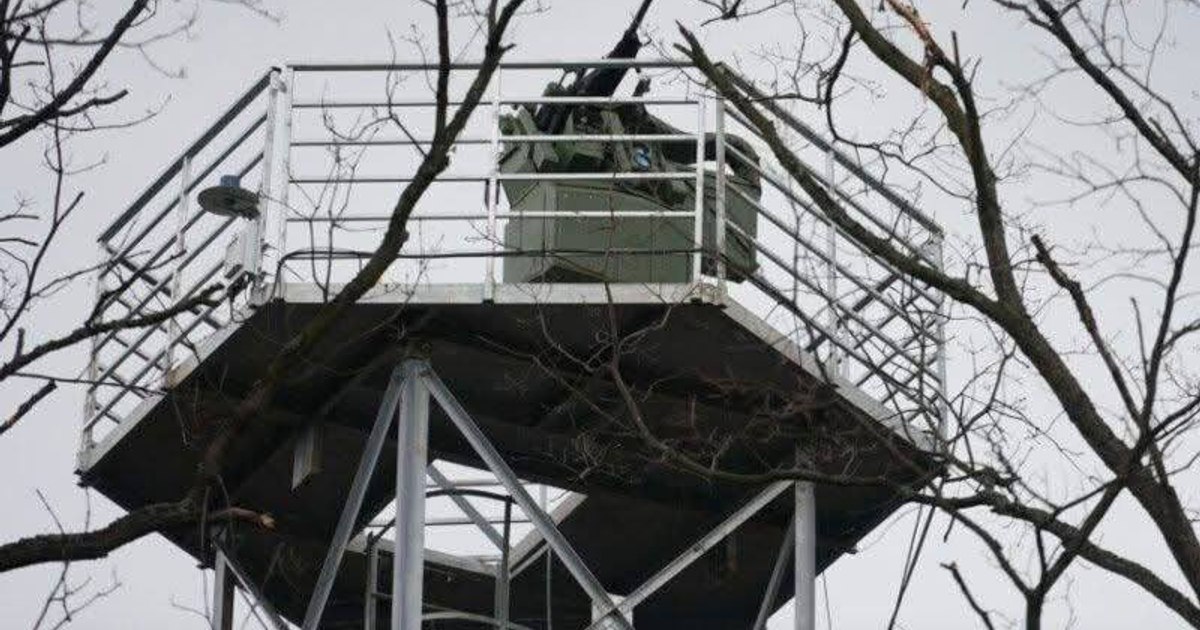
In Ukraine, a new element in the security architecture has effectively emerged: private air defense systems, which have already begun to protect critical infrastructure from Russian attacks. This evolution changes the traditional logic of national defense, through the direct involvement of the business environment. Focus publication analyzed how this model works, how effective it is and what risks it involves.
System equipped with Sky Sentinel/FOTO:X remote controlled turrets and turrets
Ukrainian authorities are gradually implementing a new approach to protecting critical infrastructure, involving private air defense companies. The goal is to create an additional layer of security for targets that remain vulnerable to frequent Russian attacks.
According to the adviser to the Minister of Defense, Serhii “Flash” Beskrestnov, private structures are already involved in projects to protect some essential energy and industrial objectives. This model is seen as a quick solution for strengthening the defense, given that the state's resources are limited and it has to cover a vast territory.
A mixed security system is thus taking shape, in which, alongside the state forces, authorized private operators also operate. Their role is to ensure local protection of specific objectives, reducing pressure on the national system and increasing overall defense efficiency.
Experts point out that similar practices exist in other states, especially in contexts of protracted conflict or threats to critical infrastructure. In Ukraine, however, this model is still in its infancy and requires clear regulations, control mechanisms and delineation of responsibilities.
One of the main challenges remains the balance between security and control: the state must ensure that access to such systems does not generate additional risks, but at the same time allows the rapid strengthening of defenses at the most vulnerable points.
In the current context, where Russia systematically targets the energy and industrial sectors, the involvement of the private sector could become an essential tool for adapting the defense system to a lasting conflict.
Private defense in response to the limits of the public system
Military expert Oleh Zhdanov believes that the involvement of the private sector in the development of air defense systems for specific objectives is a necessary step, even if forced, against the background of the slowness of the state apparatus.
According to him, Ukrainian companies now have the opportunity to protect their own facilities, including those in the defense industry sector.
“The state apparatus remains excessively bureaucratic. By the time decisions are made, the situation on the ground is already changing”explains the expert.
Zhdanov points out that these systems are particularly effective against massive drone attacks, such as those of the “Shahed” type. These are automated installations capable of detecting and neutralizing aerial targets at short distances.
Russia is violating Putin's Easter truce with a series of drone attacks on Ukraine
“It's basically a local equivalent of an 'Iron Dome', but based on large-caliber weaponry. Anything that comes into range — drones or other aerial targets — is automatically intercepted.”he says.
However, he cautions that these solutions are not universal. Against missiles, their effectiveness is limited, requiring complex anti-aircraft systems, which are few in number in Ukraine.
The expert also rejects the idea that stationary systems would be extremely vulnerable, explaining that they include self-defense mechanisms, and the risks are compensated by the speed of implementation and their usefulness.
Zhdanov also raises an essential question: why such solutions were not adopted earlier.
“The technologies have existed for a long time. They could be acquired as early as 2022. Why this did not happen remains a question for the former leadership of the ministry“, he states.
Currently, the state retains control over these systems, which are integrated into the national air defense network and coordinated by the Air Force. However, the financing and development of infrastructure is increasingly being undertaken by the private sector.
“A model is emerging where the private sector builds and finances and the state coordinates. This allows systems to be deployed much more quickly”adds the expert.
According to him, the number of these systems will increase in the coming period, as companies become more and more interested in protecting their own capabilities.
“It is important that the state does not mess up”: the nuances of private defense
For his part, Anatolii Hrapcinski, director of development at a company in the defense industry and a reserve officer of the Air Force, believes that the emergence of private air defense systems is a sign of the transformation of the entire defense system, not a risk.
He says that the involvement of private companies in the defense industry has already led to the acceleration of the development of solutions, with manufacturers reacting faster than the state in terms of financing and procurement.
“We are seeing a transition to a model where the state is no longer the only actor in defense. In today's war, those who adapt faster win,” he explains.
Ex-CIA chief: Ukraine could become the “arsenal of democracy” in the free world
However, the expert points out that, for a long time, legal uncertainty was a major problem. Private companies risked legal consequences even when they supported the defense effort. Recent legislative changes have partially reduced these risks, paving the way for private initiatives.
Hrapcinski dismisses fears of information leaks as exaggerated, pointing out that Russian drones already collect large volumes of data during attacks.
He also criticizes the efficiency of the classical model of the state defense industry, arguing that the problem lies not only in corruption but also in the rigid structure of the system.
“Massive investments in infrastructure often produce poorer results than funding nimble teams organized like startups. Modern warfare demands speed and continuous adaptation”he says.
In his opinion, the role of the state should be redefined: not as a direct administrator of enterprises, but as an investor that supports solutions already validated in real combat conditions.
“The state must finance what works, not directly manage production. Otherwise, we will always be left behind“, he concludes.
The first private air defense network has already started operating in Ukraine. The Carmine Sky company has installed such a system, equipped with Sky Sentinel remote controlled towers and turrets.