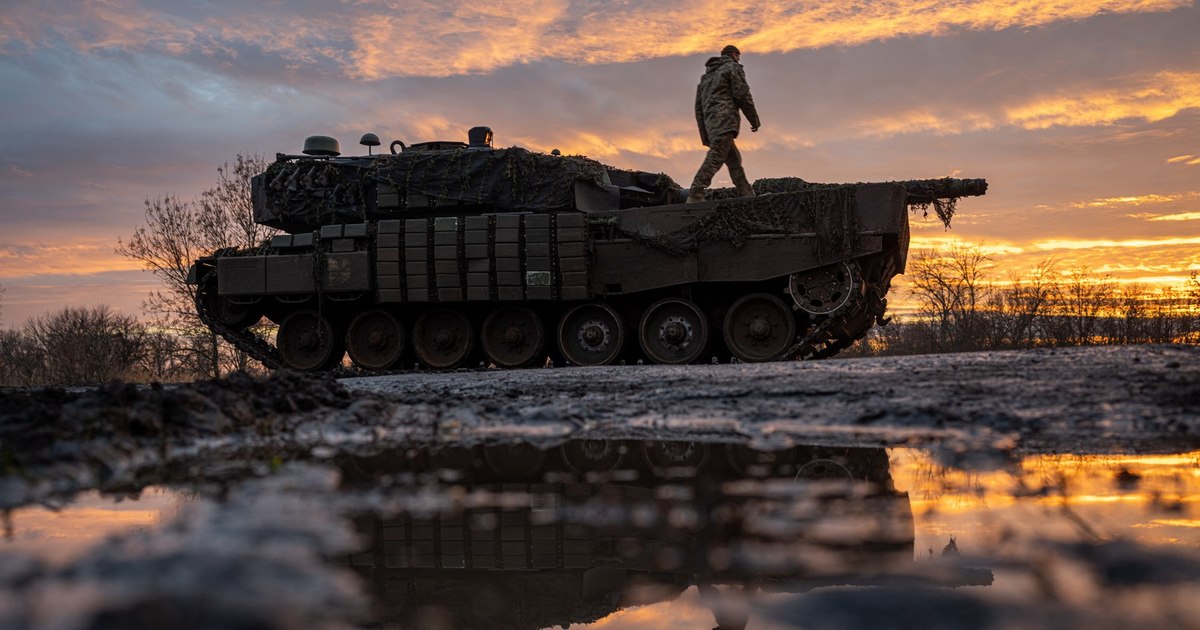
A Leopard 2A6 tank operated by the Ukrainian military reportedly destroyed a Russian T-72B3 tank in a head-on confrontation at 5.5 kilometers, well beyond typical tank-to-tank engagement distances, according to Army Recognition.
If confirmed, this hit would be among the longest confirmed hits between tanks, demonstrating remarkable accuracy of fire and control under combat conditions. Such an achievement highlights the extended range and lethality of Western-supplied armor in Ukraine, with the potential to change expectations of engagement distances and survivability in armored warfare.
Expanding the horizons of tank warfare
The reported engagement signals a growing ability to strike adversaries before they can effectively fight back, changing both the tactical calculus and the risk on the battlefield.
The Ukrainian Army's Leopard 2A6 tank, equipped with a 120mm L/55 smoothbore gun, demonstrates Western firepower and long-range combat capability during combat operations.
In early April 2026, Ukrainian forces allegedly used the German-made Leopard 2A6 tank to shoot down a Russian T-72B3 under unspecified conditions.
The claim is significant because it would demonstrate the ability of Ukrainian aircrews to harness NATO firepower and targeting systems at ranges well beyond standard engagement zones.
A successful strike at 5.5 km likely requires a stationary or slow-moving target, a highly experienced and coordinated crew, and possible external targeting support, such as drone observation, which Ukraine frequently uses to improve battlefield situational awareness and fire correction.
The integration of connected systems and drones increases the accuracy and range of strikes
The geometry of the shot is critical. A frontal destruction at this distance would most likely involve hitting a vulnerable area and not penetrating the most heavily armored sections. The target may also have been impaired, disoriented, or without effective reactive armor at the time of impact.
If confirmed, this strike will not rewrite the doctrine of tank warfare, but will illustrate the ultimate limits of performance of the Ukrainian Leopard 2A6, combining advanced Western firepower, modern ammunition and increasingly sophisticated battlefield integration.
The incident also highlights the growing role of targeted drones and connected combat systems in expanding the range of engagement in the conflict in Ukraine.
Actual conditions on the battlefield remain essential
From the perspective of specialist analysis, although the Ukrainian Leopard 2A6 tanks offer a qualitative advantage in terms of firepower and targeting ability, the effectiveness in real conditions remains limited by physics, environmental factors and tactical conditions.
Until visual or sensory data confirm the hit, the report of a frontal destruction at 5.5 km should be treated as unconfirmed and potentially exceptional, rather than a new operational milestone.