The sensational adventures of the real “Iron Man”. The feats of arms of one of Europe's most feared warriors

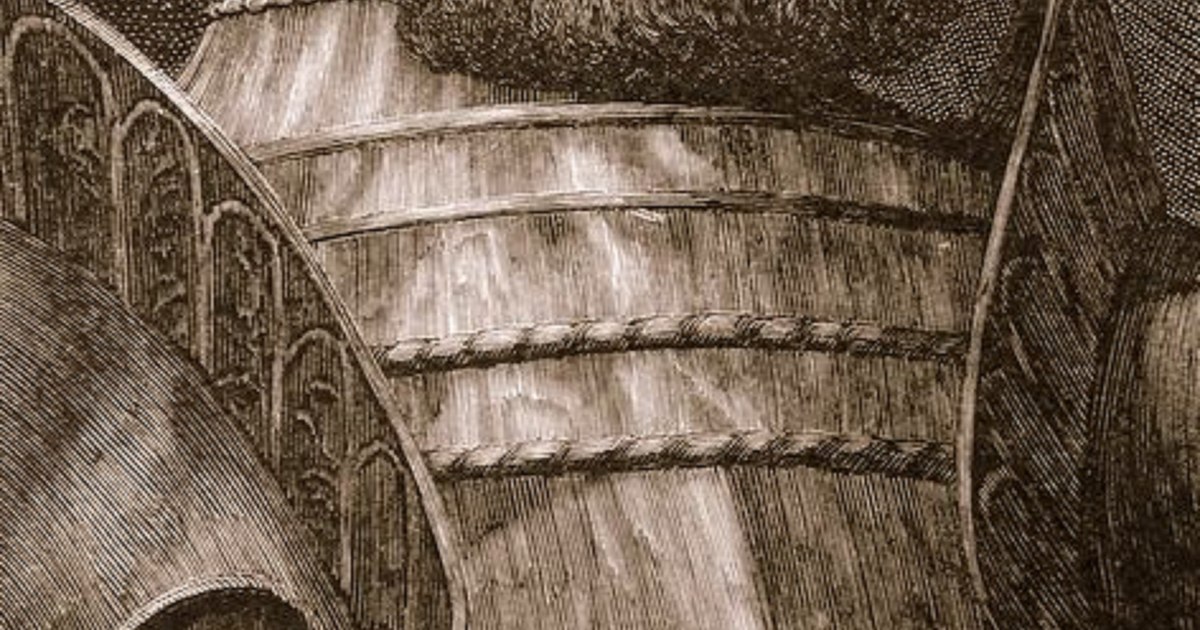
“Iron Man” really existed. His name was Götz von Berlichingen, he lived several centuries ago and was one of the most feared warriors of the Middle Ages. He spent 47 years on the battlefield and was the first fighter to benefit from a functional prosthesis.
Götz von Berlichingen PHOTO wikipedia
Throughout history there have been exceptional characters, either through feats of arms or through contributions to humanity through science, art or geographical discoveries. And to be honest, warriors have always had a special reputation. Some were overrated, others semi-legendary or outright invented.
But there were also warriors who fascinated entire generations. One of these was Götz von Berlichingen, also nicknamed the “Knight with the Iron Hand” or effectively the “Iron Man” of the Renaissance. Götz was one of the most feared fighters of the Middle Ages and the most famous German knight of the 16th century. The fame he gained during his 47 years on the battlefield as a mercenary and army commander became a source of inspiration for playwrights and novelists down the centuries. His life was adventurous and full of unexpected events. He was also the first warrior who managed to overcome a disability with the help of a prosthesis.
A teenager passionate about the trade of arms in the service of the emperor
Götz, or his full name Gottfried von Berlichingen zu Hornberg, was born in 1480 into a noble family in Württemberg, a region in the southwest of the Holy Roman Empire of Germanic descent.
Götz von Berlichingen was born in a turbulent time, when conflicts between nobles and rival cities were wreaking havoc in southern Germany. In addition, the representatives of the House of Habsburg, who practically controlled the Germanic Holy Roman Empire, were in open conflict with the Swiss. The Habsburgs wanted to take control of the cantons in the Alps and extend their rule throughout the Alpine area to connect with their possessions in northern Italy. Raised in the heat of war, Götz became a child passionate about weapons and the martial world. His physique also helped him. He was tall and strong. At the age of 17, he already had the physique of a 25-year-old. Incidentally, this was also the age at which Götz von Berlichingen received his baptism of fire.
He went to war with the men of the domain in the service of the Habsburgs, who had thrown the Holy Roman Empire into a bitter war against the Swiss Confederation. It was the so-called “Swabian War” because the German states of the Swabian League also got involved in the conflict. Practically this war arose because of the attempts of the Romano-German Emperor Maximilian I of Habsburg to impose an imperial reform (the establishment of the Supreme Court of Justice) and to extend his control over the Swiss territories, which would have limited the autonomy of the Confederation. There were also numerous local border conflicts between the population of Swabia and that of the Swiss cantons. Although only a teenager, von Berlichingen proved extraordinary qualities. Although the Germanic Holy Roman Empire suffered defeats at the hands of the Swiss Confederation, Götz distinguished himself as a great talent on the battlefield.
Precisely because of that, Frederick I, Margrave of Brandenburg-Ansbach, immediately took him into his service. In 1498 he again fought in the armies of the Romano-German Emperor Maximilian I, taking part in actions in Burgundy, Lorraine and Brabant, as well as in the Swabian War the following year. By the age of 20, Götz had already participated in dozens of battles and had become an experienced warrior. With an imposing physique, with a special skill in handling the heavy battle sword, Götz intimidated his opponents. In addition, he also had crazy courage. He would spend 47 years on the battlefields of Europe and fight hundreds of battles. It is said that he also fought in numerous duels. In his autobiography, von Berlichingen says that he gave 15 duels in his own name, for matters of honor. A few dozen others he wore for friends or to settle the outcome of battles, to avoid unnecessary bloodshed. It is said that he could decapitate his opponent with a single stroke of his sword.
A knight of fortune and company to be feared
By the time he was 20, von Berlichingen, as I mentioned, had already participated in several dozen major battles and numerous other smaller armed engagements. A rebel by nature and a young man thirsty for fame and fortune, Götz has given up serving the emperor or the nobles and waiting until they find him a new war to fight. So he started his own company of mercenaries. They were sort of The Expendables of the Renaissance, with chosen fighters on the brow. Few, but very experienced. A shock troop of sorts, capable of taking on entire armies. The giant Götz von Berlichingen, though still a youngster, was elected company commander.
The horrors of the assassination of Michael the Brave. The enemies cut off his head with their own sword and wanted to give his lifeless body to the dogs
He also had under his command warriors with 10-15 years of experience on the battlefields of Europe. Along with his mercenaries he made a real fortune selling his services to various dukes, margraves (counts who ruled border areas) and barons. Whoever gave more was served. For 12 years his life was a real adventure, lived on the edge of a knife, in sieges, robberies, attacks, duels and wars between nobles, between nobles and cities or even between German burgs. Götz did not shy away from becoming a woodcutter when he had his own disputes or interests. For example, in 1512, near the city of Forchheim, due to a long and fierce dispute with the city of Nuremberg, he attacked a group of merchants returning from the great fair in Leipzig. He killed some of them, spared others but left them without goods and money.
Hearing this, Emperor Maximilian placed Berlichingen (Goetz's domain) under an imperial ban and the German knight was declared an outcast. He was only pardoned in 1514, when he paid a “bail” of 14,000 guilders to have the ban on his domains lifted as well. However, Götz did not give up his habits. Impulsive and warlike, together with his feared company, in 1516, in a dispute with the Principality of Mainz, Berlichingen and his mercenaries organized a raid into Hesse, capturing Philip II, Count of Waldeck. They took him to safety in one of the German knight's castles and demanded a ransom of 8,400 guilders. The concerned family paid the requested amount quite quickly. His adventures took him all over the Romano-Germanic Empire and even beyond its borders. Götz was to lose his life several times. For example, in 1519, when he and his men enlisted in the service of Ulrich, Duke of Württemberg, who was at war with the Swabian League.
Von Berlichingen was part of the defenders of Möckmühl during a siege by the armies of the Swabian League, but was eventually forced to surrender the city due to a lack of supplies and ammunition (arrows, cannonballs). He was held prisoner and finally handed over to the citizens of Heilbronn, a city he had attacked several times. Obviously, he was almost torn to pieces by the rioting townspeople but was saved, in extremis, by the knights in his company, Georg von Frundsberg and Franz von Sickingen, who miraculously obtained release in 1522, after three years of captivity. Obviously, the release was paid dearly. Von Berlichingen's last great adventures were the 1542 campaign against Suleyman the Magnificent, the famous Ottoman sultan, under the leadership of the Romano-German emperor, and the imperial invasion of France in 1544.
“The Man with the Iron Arm”, the first prosthetic warrior
Götz Von Berlichingen was nicknamed “the man with the iron arm” or “the iron man” after he suffered an extremely serious wound during a battle. More specifically, in 1504, during the War of the Landshut Succession, Berlichingen and its mercenary army fought for Albert IV, Duke of Bavaria. During the siege of Landshut, a cannonball threw his sword into his right arm, severing it. To save his life, the doctors of the time had to amputate his arm from the wrist. He was only 24 years old and his military career could have stopped there.
The legendary exploits of Basil the Great, an outlaw without equal. How he made the dark days of the Habsburg oppressors
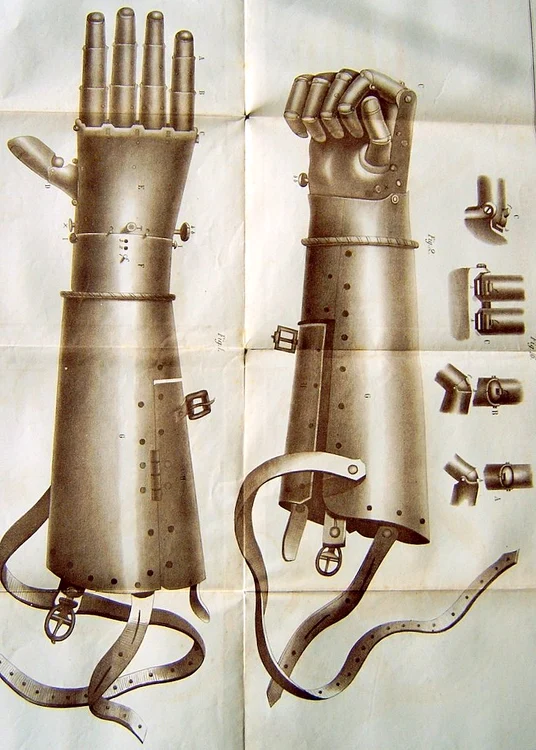
Iron arm of the German knight PHOTO wikipedia
Götz was not the man to give up. He learned to fight left-handed and also sought out blacksmiths capable of making him a functional metal arm. The first iron hand was a simpler device, said to have been made by a local blacksmith and saddle maker. Later, he found a blacksmith to make him a real work of art. With this prosthetic hand, the German knight was able to hold objects ranging from a shield or bridle to a feather. Both iron hands are on display today at Burg Jagsthausen. With an iron fist, Götz Von Berlichingen fought even better than before, gaining unparalleled fame.
After 1540 and numerous other adventures, von Berlichingen returned to his castle in Hornberg and lived the rest of his life in peace. He died on July 23, 1562, at the age of 82. Von Berlichingen was married twice and had three daughters and seven sons. Until his death, Götz Von Berlichingen was writing his autobiography.
Discovered in the 18th century, these manuscripts inspired prominent figures of world culture. Among them are Johann Wolfgang von Goethe, who dedicated a play to the character's life, but also writers such as Jean-Paul Sartre or John Arden. Also, the story was the basis of some musical compositions signed by Havergal Brian and Paul Dukas.