Grzegorz Kowalczyk, journalist of Business Insider Polska: Do you still believe in the electromobility revolution? The electric vehicle market is growing, but internal combustion engines are not disappearing as quickly as predicted a few years ago.
Marco Schubert, global head of sales and marketing at Audi: That's true. What we are seeing is a slower transformation than we expected. So we see a slowdown in the transition to electromobility, but in the long term we believe electric vehicles will gain the upper hand – especially in Europe, where regulations will continue to push the market in this direction. In the UK, for example, a target of 75% has been set. share of such vehicles by 2030. Therefore, we must shape our portfolio appropriately to meet both regulatory requirements and customer expectations.
The rest of the article below the video:
So when will combustion engines disappear completely? Maybe never?
It really depends on the region and market. In Europe, there is a proposal from the European Commission for manufacturers to reduce CO2 emissions from cars by 90 percent by 2035. At the same time, work is underway on regulations regarding the fleet market, which means that large customers will be obliged to have electric vehicles in their fleets. In China, the transformation is taking place very quickly: New Energy vehicles already account for more than half of the market. The tipping point came earlier than expected – mainly due to low electricity prices and better access to infrastructure – just like in Norway. In North America, however, we see the opposite: the disappearance of subsidies had a direct impact on customers, and the easing of CO2 emissions penalties also affected demand. Outside of California, the market is still very combustion engine driven, which means we need to be prepared for that in our portfolio.
Audi A5
How does Audi adapt its strategy to such a changing situation?
Fortunately, our portfolio covers the full spectrum: combustion engines, plug-in hybrids and fully electric vehicles. From this perspective, we tailor the offer to the demand in each region. In the long term, if we want to remain competitive, we must offer customers in each region products that they actually want to buy.
CO2 affects the climate, which is why as an industry – regardless of regulations – we want to reduce our carbon footprint and actively shape the transformation towards electromobility. At the same time, customers are price sensitive and legislation has a huge impact on their decisions.
It is often said that The European automotive industry is in crisis. Is this actually a collapse?
Geopolitical uncertainty and global competitive pressures have become the new normal. We are also looking at other regions – I was recently in Australia, where German producers still have a strong presence, but it is a market without customs barriers, so new players from China are gaining larger shares than before. In each region, we must be ready to offer exactly the product that the market requires.
You mentioned customs duties. Are trade tensions a serious problem for the industry today?
Definitely – especially in the US market. This is something that has a significant impact on our profitability. The shift from electric to combustion engines is one thing, but the tariff situation facing all U.S. manufacturers is even more challenging. This has a huge impact on us.
Against this background, how do you assess the condition of the European industry and the position of Audi itself?
We are strong in Europe – of course it depends on individual markets and circumstances, but overall Audi's position is solid. As a sales organization, we always want to grow and I see a lot of opportunities with upcoming new products. As you know, we will soon introduce the Audi A2 e-tron as a fully electric entry model. We are phasing out the A1 and Q2 models, but the A2 e-tron will help us grow volumes in Europe in a sustainable way.
A big change on the market is the growing presence of producers from China. Do you see this effect?
From a premium brand perspective, we see the impact Chinese brands entering Europe. However, much depends on how we measure it: from a customer's point of view, some brands are not perceived as Chinese, even though they belong to Chinese companies. Overall, Chinese brands are increasing share, but in the premium segment the impact is limited for now – due to pricing, positioning and customer loyalty. This is more visible at the dealership level, where dealers cooperate with Chinese brands.
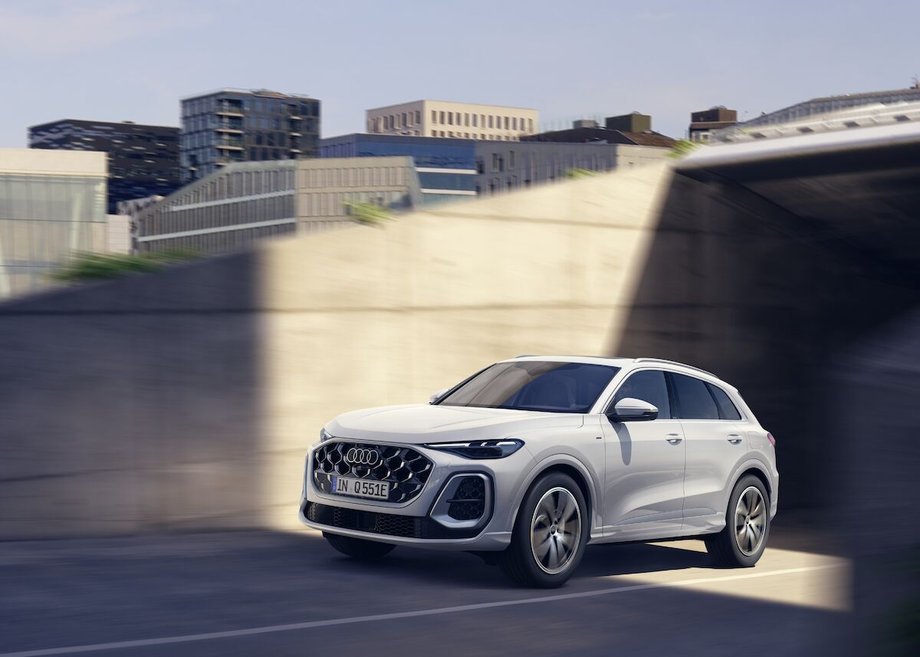
Audi Q5
Does the pace of expansion of Chinese brands in Europe surprise you?
In terms of market share – no. It is at the expected level. It was assumed that they would have an impact on the European market – and this is exactly what we are observing.
Chinese manufacturers are openly talking about entering the premium and luxury segment. Is it real?
From the customer's perspective, it's the whole package that counts. The product is only one part. The dealer network and after-sales service are also crucial. In Europe we have a very strong dealer network and good cooperation between factories and dealers. This is crucial for the functioning of the market: how dealers sell, how they solve product problems or handle warranties. For us, a strong network in Europe is the foundation.
Some predict that Chinese producers will even dominate Europe.
We live in times of increasing geopolitical and economic change. We are not afraid of competition, but the framework conditions must be fair and the same for everyone. As a manufacturer, we constantly adapt our strategies, e.g. through a local-for-local approach. The European legislator should also ensure a level playing field. The European Commission's Made in Europe strategy is a step in the right direction.
Is Europe still a good place to invest in the automotive industry?
Europe still offers many advantages. But it all depends on the framework conditions. We need to become much more flexible in vehicle development and shorten development cycles. This requires more agility than in the past. Competition from other regions is good for us – hopefully it will force the whole system to adapt so that Europe can accelerate and remain competitive.
Is Audi planning larger infrastructure investments in Europe?
As part of our agreement on the future of Audi, we plan to invest approximately EUR 8 billion in our German plants in Ingolstadt and Neckarsulm by 2029. We will also introduce several new models, such as the Audi A2 e-tron in Ingolstadt in the second half of the year and the production version of the Audi Concept C at Böllinger Höfe in Neckarsulm in 2027. These are large investments in European – and actually German – plants. We believe in “made in Europe” and count on political support that will help us maintain a strong position in the long term.
Let's move on to the Polish market. You have been experiencing impressive growth here recently, benefiting from the growing interest in premium brands [2025 r. był rekordowy dla segmentu aut premium w Polsce, a rejestracji Audi urosły o ok. o 5 proc. — przyp. red.]. What does it look like from the headquarters' perspective?
We are very pleased. Poland is among our global top 10 markets. And the ten largest markets account for up to 80%. our global volume, so Poland is very important to us. We see very strong development here, driven by cooperation with the dealer network and importer – our colleagues in Poznań work closely with dealers, which makes a huge difference. From the headquarters' perspective, we appreciate the proactiveness of the Polish team, which fully uses our portfolio. The new Audi Q3 is very well received in Poland and had a strong start; The Audi Q5 also performs well, strengthening the brand's positioning. With the new Audi Q7 and Audi Q9 SUVs, we will expand our offer in the upper segment – which will also help build the brand in Poland in the long term. In June I will be in Poland for the European Dealers Council meeting – it's a good opportunity to be close to the market.
What are Audi's plans for Poland in the coming years?
We want to continue to grow. The brand is changing significantly – we have new products and a new design philosophy, which we will start implementing from the end of next year and will apply to all subsequent models. From my perspective, the Concept C gives a very promising picture of what the future of Audi will look like – both in terms of exterior and interior design. We believe that this will help us build an even stronger position in Poland in the long term.