The truth about cheaper fuels: why the excise duty drop is avoided, even though it is the only measure with real impact


Excise duty reduction becomes the Government's main weapon against record pump prices. After the partial failure of capping the commercial addition, the specialists consulted by “Adevărul” confirm: the reduction of state taxes is the only measure that can truly protect Romanians' pockets.
A full tank costs over 100 lei more than a month ago. Archive photo
Currently, standard diesel is sold in gas stations between 10.13 and 10.26 lei per liter, about 2–2.12 lei more than a month ago, when the national average price was 8.25 lei per liter. Taking into account a fuel tank of 50 liters, it means that a full tank costs 513 lei, 100 lei more than a month ago, and of the 513 lei, the state has at least 250 lei left as taxes and excises.
The specialists consulted by “Adevărul” warn that the prices will not stop here due to the increase in the price of the oil barrel, so that the Government's interventions seem to have a rather symbolic and preventive character, the only measure that could have a significant impact on the final price is the reduction of the excise duty.
Simona Dobre: The executive must reduce the excise duty, without increasing the deficit
Energy expert Simona Dobre, told “Adevărul” that the measures taken by the authorities for fuel prices have a limited impact.
“The ceiling of the commercial addition is difficult to apply in practice and cannot lead to a significant reduction in prices. Also, the reduction of the biofuel content remains, for now, only a possibility provided in the ordinance.
A more effective solution would be to reduce the excise tax, but this requires a carefully substantiated decision, in the context of an already high budget deficit. More precisely, a team of experts should determine the optimal level of excise duty reduction, so that VAT receipts — supported by current and anticipated consumption — can compensate for this decrease, without creating additional imbalances at the budget level.”the expert declared for “Adevărul”.
She added that currently prices are very high and that “it remains to be seen to what extent this level is justified”.
“Companies in the field should also take into account the degree of affordability of consumers, given that, even in this context, they maintain their profitability, just like the state, through the collected revenues. The impact on Romanians' pockets is already significant. A second, firmer step is expected from the Executive, in the direction of reducing the excise duty“, said Dobre
Dumitru Chisăliţă: They are just pretending to take measures
For his part, the energy expert Dumitru Chisăliță declared for “Adevărul” that it would be a simple, correct measure and proposed by unions and employers “n” times in the last weeks.
“If the capping of the commercial addition plus the reduction of the excise duty is to be carried out, the impact on Romanians' pockets would be 1.2 lei, considering that the price is made up of the fuel cost plus the distribution cost to which the excise duty is added and only then is the VAT calculated, that is, we have a tax after tax.
From my point of view, the impact is insignificant compared to what awaits us (accelerated price increases due to the price of a barrel of oil – n. ed.). They pretend to do something, it's nothing concrete, they just pretend to take action. Mr. Bolojan has room to decrease (the fuel price – n. ed.), if only he wanted to“, declared Dumitru Chisăliță for “Adevărul”.
Silviu Gresoi: The impact barely reaches half of the level of price increases
Energy expert Silviu Gresoi explained to “Adevărul” that the measures barely halve the price increase, which means a slowdown in price increases rather than a consistent reduction in prices.
“Capping the commercial surcharge can reduce the price of fuel by about 30–50 bani/liter (3–5%), while a reduction in excise duty could lead to a decrease of about 60–80 bani/liter. Currently, from a price of approximately 10.2 lei/l for diesel, more than 50% represents taxes (excise duty + VAT), and the rest depends on the oil quotation and the exchange rate. Even with these measures, the total possible decrease is around 1 lei/l, well below the recent increase of over 2 lei/l, which means that the impact will be more of a slowdown in price increases than a significant decrease“, said Silviu Gresoi.
Adrian Negrescu: The measures only avoid shortages or price speculation
According to analyst Adrian Negrescu, “reducing the fuel excise duty is certainly the only effective measure in the current context, given the budgetary challenges”. “It is the duty of the state to try to moderate the increase in the price of fuels, at least from the perspective of the difference in receipts between the price taken into account when building the budget and the one at the pump, as of now. However, a very accurate calculation is needed, which correctly calibrates the budgetary effects in accordance with the evolution of the price at the pump which, to be honest, will not be greatly influenced by this decision”, Negrescu declared for “Adevărul”.
How much does the state collect from the price of a liter of diesel. Expert: A price cut of 50 pennies like in 2022 would have done a lot of good
According to him, even if the state will come up with the idea of a flexible excise tax, depending on the dynamics of prices, it is not expected that there will be a significant drop in prices, especially since, at the international level, the price of oil and diesel continues to rise.
“The rest of the measures decided by the ordinance approved by the government are more aspirational, in the sense that they only create the framework to avoid shortages at the pump and possible price speculation. What is certain is that this GEO will not actually come into force until we see the methodological rules that define very clearly what capped commercial addition means, what are the methods of reporting to the authorities, etc.“, declared Negrescu..
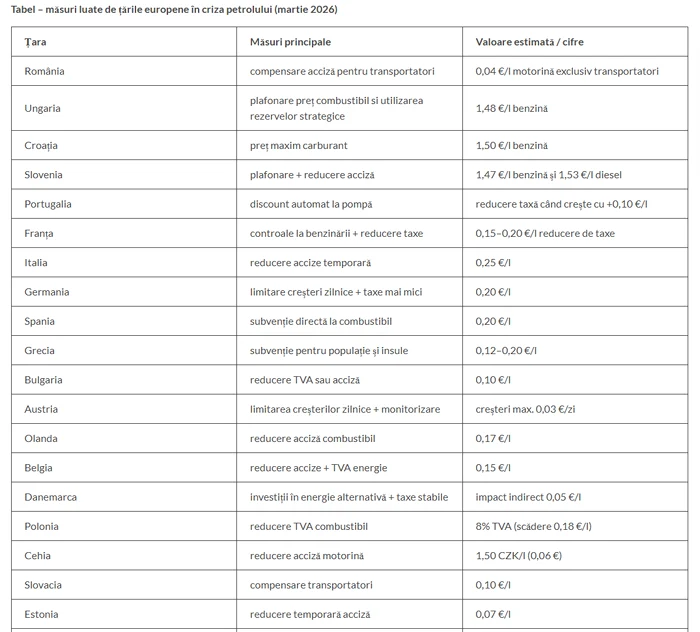
What measures have other European states taken?
A recent analysis shows that Hungary capped the price at around 1.48 euro/l and used strategic reserves, and Croatia imposed a maximum price of around 1.50 euro/l for petrol. Slovenia combined the capping with the reduction of excise duties, reaching around 1.47 euro/l for petrol and 1.53 euro/l for diesel.
Poland reduced the VAT to 8%, which led to a decrease of approximately 0.18 euro/l, and Bulgaria operated tax reductions of around 0.10 euro/l. Czechia reduced the excise duty on diesel fuel by approximately 0.06 euro/l, Slovakia granted compensations of around 0.10 euro/l, and the Baltic States — Estonia, Latvia and Lithuania — applied discounts and subsidies between 0.07 and 0.10 euro/l.
In Western Europe, Germany reduced taxes with an impact of around €0.20/l and limited daily price increases, while France granted reductions of €0.15–0.20/l and stepped up controls at petrol stations. Italy reduced excise duties by approximately 0.25 euro/l, and Spain introduced a direct subsidy of 0.20 euro/l.
Portugal implemented an automatic compensation mechanism for increases above 0.10 euro/l, Greece provided support between 0.12 and 0.20 euro/l, especially for island areas, and Austria limited daily increases to around 0.03 euro.
The unions are boycotting the fuel surcharge cap and accusing the Government of “mimicking social dialogue” in the midst of the energy crisis
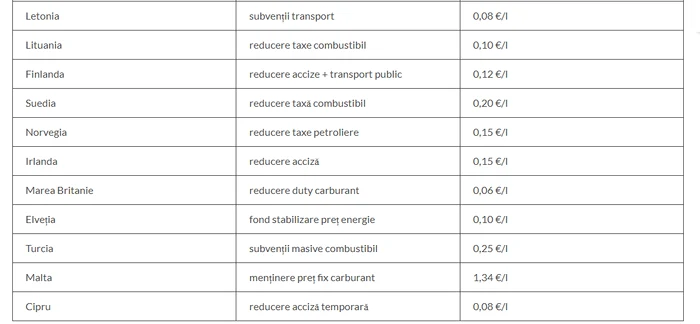
Belgium combined the reduction of excise duties with the reduction of VAT, with an impact of approximately 0.15 euro/l, and Netherlands reduced excise duties by around 0.17 euro/l. Ireland applied a discount of 0.15 euro/l, Denmark had an indirect impact of about 0.05 euro/l through energy policies, and Finland and Sweden they reduced excise duties by approximately 0.12 euro/l, respectively 0.20 euro/l.
Outside the EU core, but included in the analysis, Norway reduced taxes by approximately 0.15 euro/l, Great Britain reduced the duty by 0.06 euro/l, and Switzerland used stabilization mechanisms with an impact of around 0.10 euro/l.
In southern Europe, Malta maintained a fixed price of around 1.34 euro/l, CYPRUS reduced excise duties by about 0.08 euro/l, and Turkey granted subsidies of about 0.25 euro/l.