Fabulous cities and treasures rediscovered after thousands of years. They lay in the depths of the waters or in the jungles

With the help of modern research technology, in recent decades, fabulous cities have been brought to light, disappeared for thousands of years, either in the depths of the seas or swallowed by vegetation. Some of these belong to mysterious civilizations that have not yet revealed all their secrets.
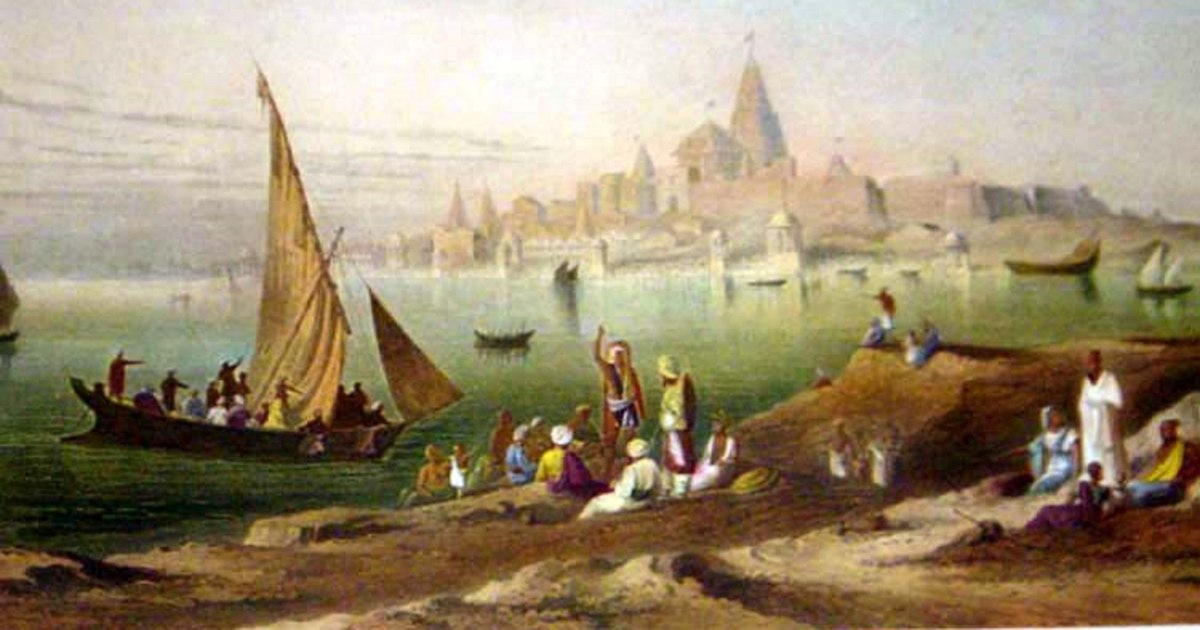
The sacred city of Dwarka in India PHOTO wikipedia
Throughout the Earth there are many fascinating locations, testimonies of ancient civilizations. Many of them are tourist places visited by millions of people, researched by numerous specialists and with artifacts present in all the great museums of the world. At the same time, however, submerged underwater, lost in the jungle or under tons of earth and ash, there are other amazing structures that have lain hidden for millennia. Thanks to new mapping technologies and archaeological research, fascinating cities have been found in recent decades, evidence of the presence of fabulous civilizations from at least two thousand years ago. Three of these are absolutely fabulous and can rewrite a part of regional history, if not an entire continent.
The sacred city in the depths of the Arabian Sea
Dwarka is a coastal city on the Indian subcontinent, located in the Devbhumi Dwarka district of the Indian state of Gujarat. It is situated on the western shore of the Okhamandal Peninsula, on the right bank of the Gomti River, at the mouth of the Gulf of Kutch, facing the Arabian Sea. This city is especially important for Hindus. Here is the Dwarkadhish Temple dedicated to Krishna, one of the four sacred Hindu pilgrimage sites. Dwarka is one of the seven oldest urban religious centers in India. It is also part of the pilgrimage circuit dedicated to the god Krishna.
What is seen today at Dwarka is only a part of the ancient city, that mythological center of India. A significant urban area lies in the depths of the Arabian Sea. But first, here's what Hindu mythology says about Dwarka. According to the Mahabharata and the Puranas, the founder of the city is the god Krishna himself. He founded the city after leaving Mathura to escape the relentless attacks of Jarasandha. The scriptures describe Dwarka as an architectural marvel built on a “tongue” of land that extended deep into the Arabian Sea. It had imposing palaces, wide boulevards, and sophisticated urban planning that rivaled any ancient metropolis. Ancient texts claim that Vishvakarma, the celestial architect, designed this city in intricate detail, from crystal clear lakes to gardens filled with parijata trees.
The city is said to have housed 900,000 royal residences, each built of gold, silver and precious stones. The Bhagavata Purana shows how Krishna ruled from this coastal kingdom for decades, making it the center of the Yadava civilization. For a long time it was considered that all these descriptions are just mythological stories. Until when. In the 1960s, systematic excavations were carried out at Dwarka by the Archaeological Survey of India project. Evidence of continuous habitation over a period of over 2500 years has been discovered. Dwarka was found to be a prosperous maritime city with extensive trade networks, advanced metallurgy and sophisticated governance systems. Well-planned residential complexes, elaborate drainage systems and evidence of maritime trade have been uncovered. Archaeologists have discovered seals, copper and pottery objects, anchors, copper ingots and fragments of foreign pottery indicating that ancient Dwarka maintained extensive trade relations with distant civilizations. Excavations have revealed impressive fortification walls. However, no trace of the legendary palaces.
Until the archaeological investigations after 1990 also continued with underwater research. New modern research methods have allowed archaeologists to also explore what was in the waters of the sea, near the coastal area. The findings were incredible. Basically, there is another city under the water. It is the upscale residential area of ancient Dwarka. According to Hindu scriptures, particularly the Vishnu Purana, Dwarka was swallowed by the sea immediately after Krishna's departure from the earthly realm. Historically, the city was swallowed by the waters probably due to the submergence of the shore, around the 1st century BC. In the depths of the Arabian Sea lie palaces, impressive statues, mega-structures and many other vestiges that are still being explored.
The mysteries of the city destroyed by the tsunami
Another sacred city of Antiquity and extinct for thousands of years was Helike, an ancient Greek city-state. It was famous for the temple and sanctuary of Poseidon, known throughout the classical world, being second only to Delphi in religious importance. It was located in the area of Achaea, in the northern Peloponnese, two kilometers from the Gulf of Corinth and near the city of Boura. Helike became a cultural and religious center of great importance 2800 years ago, minting its own currency. The ancient Greeks came to Helike on pilgrimage to receive Poseidon's blessing and to do business. Helike founded colonies including Priene in Asia Minor and Sybaris in southern Italy. However, Helike disappeared in one night without a trace. The great sanctuary of Poseidon, paradoxically, was swallowed by the waters of the sea. Ancient accounts say that the city of Helike was destroyed in 373 BC, two years before the Battle of Leuctra (between the Boeotians led by the city of Thebes and the Spartans), during a winter night.
The story of the mysterious 4,000-year-old ax discovered in Argeş and later disappeared
An earthquake was to blame, followed by a devastating tsunami that effectively swallowed the city. Ancient evidence suggests that there were several premonitory signs. For example, huge columns of fire appeared, and five days before, all animals and pests fled the city. Following the earthquake, the entire city sank into the ground and was later covered by the sea. None of the residents survived. Ten Spartan ships that were anchored in the harbor were sunk on the spot. “Helice was sunk by the sea two years before the battle of Leuctra. And Eratosthenes says that he himself saw the place, and that the Greeks say that in the strait there was a bronze Poseidon standing, holding in his hand a hippopotamus, which was dangerous to those who fished with nets. And Heraclides says that the sinking took place at night in his time, and although the city was twelve stadia from the sea, the whole the district with the city was hidden from view; and two thousand men who had been sent by the Achaeans could not recover the bodies”specified Strabo.
The waters receded after almost a century but the city was never found again. Until 2001. Helike's remains were rediscovered with the help of modern research methods, buried in an ancient lagoon near the village of Rizomylos. In an effort to protect the site from destruction, Helike was included in the list of the 100 most endangered sites. The oldest artefacts found at the Helike ruins date back to the Early Bronze Age, 5000 years ago. Researchers from the Helike Project, led by archaeologist Dora Katsonopoulou, excavated several layers dating from different periods of Greek history, including that great Bronze Age city dating from the Mycenaean era, or Trojan War. Two excavated buildings contained religious artifacts dating back to 850 BC, indicating that the buildings were once temples, possibly dedicated to the god Poseidon. Excavations and research are currently taking place at this city, rediscovered after more than two thousand years.
Turkey, in the “Golden Age of Archaeology”. Fascinating discoveries that rewrite history
The city swallowed by the jungle
One of the most fabulous discoveries with the help of advanced technology is that in the jungles of Guatemala, in Central America. Basically, through revolutionary technology called LIDAR (Light Detection And Ranging), an absolutely fascinating network of Mayan infrastructure has been discovered. They are the ruins of an interconnected, jungle-swallowed empire of nearly a millennium. A satellite or aircraft is equipped with this LIDAR system, which uses laser-based technology to measure distances to Earth.
These light beams, combined with other data recorded by the system, create a 3D image of the ground. With LIDAR, the researchers “removed” the tree canopy from the images, revealing the ruins of a vast pre-Columbian civilization far more advanced and complex than most researchers of the Mayan world thought. Over 2,100 square kilometers of Guatemala's “Mayan Biosphere Reserve” have been mapped. Research shows that the Mayan city-states were in fact interconnected by true ancient “highways,” that is, wide roads that allowed for heavy traffic and trade. LIDAR images also revealed mining areas, complex irrigation canals that supported intensive agriculture, and canals and reservoirs that collected water for periods of drought that fed those interconnected cities. Interestingly, these highways were elevated to allow easy travel even during rainy seasons. Among the most surprising discoveries is the large number of walls, ramparts, terraces and fortresses.