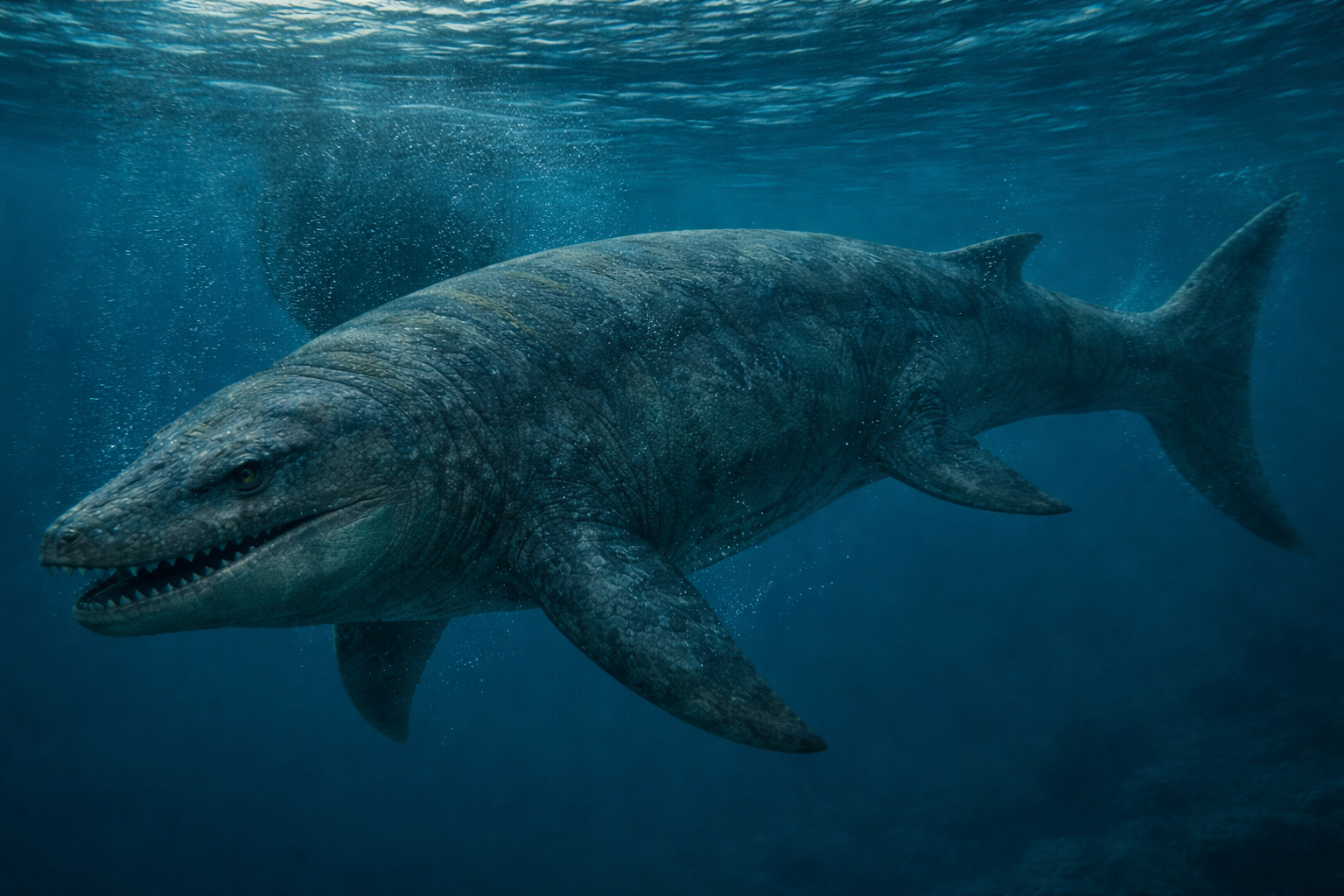
A six-meter-long sea monster with powerful jaws that allowed it to take down prey of any size is the latest prehistoric creature to be discovered among fossil deposits in northern Mexico, reports El Pais.
Prognathodon cipactli, an aquatic reptile from the mosasaur family that lived at the same time as but was not related to the dinosaurs, dominated the seas about 70 million years ago during the Late Cretaceous period, just before the mass extinction event that ended the age of the dinosaurs.
The long road to identifying “Prognathodon cipactli” began in 2001 with the discovery of a nearly complete skull in the Méndez Formation of Nuevo León, one of dozens of fossil sites in northeastern Mexico.
Subsequent analyzes of the jaw in 2007 described it as belonging to an unidentified species of mosasaur, but now a team of paleontologists from the Saltillo Desert Museum and the University of Bath (England) have demonstrated that it is a new species, expanding the known diversity of prehistoric reptiles in Mexico.
Specialists believe that the aquatic reptile was capable of attacking prey of all sizes
Unlike other larger mosasaurs, armed with thin teeth and an elongated skull, the newly discovered species was about six meters long, and its features reflected a typical adaptation of an efficient predator, capable of attacking prey of all sizes, such as other marine reptiles, large fish or shellfish.
“It was a mosasaur with short jaws, conical teeth and very robust, which allowed it to attack large prey,” Héctor Rivera-Sylva, paleontologist at the Museum of the Desert and one of the authors of the study, explained to El Pais.
“At that time and in this region, it was the top predator; that was its place in the food chain. There was nothing bigger or more dangerous than it,” the specialist added.
A discovery from the end of the age of dinosaurs
70 million years ago, the semi-desert landscape of northeastern Mexico was very different from today's, characterized by swamps and shallow beaches surrounded by tropical vegetation that stretched down to the sea. Over millions of years, sedimentary rocks formed on the sea floor have been pushed to the surface by tectonic activity.
Thus, the fossil remains discovered in the south of the states of Coahuila and Nuevo León, tens of kilometers from the Gulf of Mexico, offer a real window into the past of primitive flora and fauna, both marine and terrestrial. Their recent study and popularization has sparked an unprecedented paleontology “boom” in Mexico.
“This discovery shows us that biodiversity at the end of the Cretaceous period was much higher than we thought, both globally and nationally,” he pointed out.