The Insider analyzed foreign trade data of Russian companies for 2024-2025, focusing on deliveries exceeding 10,000. hole. (approx. PLN 37,000), i identified over 6,000 foreign exporterswho supplied goods to sanctioned enterprises, arms industry contractors and directly to the arms industry itself. This is still an incomplete list and includes only companies that were identified on the basis of fragmentary data.
Among Russian importers cooperating with these companies, The Insider identified several hundred which – despite being subjected to sanctions by the US, Europe or Great Britain – continued to buy goods abroad, ignoring the risk of “exposing” their foreign partners (and who, in turn, ignored the risk of blockades by banks, which are generally reluctant to handle transactions with companies “tainted” by sanctions).
The Insider also detected Russian companies that were not yet on the sanctions lists, but – according to trade data from Russia – provided goods and services to enterprises in the arms industry. They played the role of intermediaries, selling other people's goods and their own products based on imported devices. The Insider also learned the names of all foreign companies trading with these entities.
The article continues below the video
The main countries of origin of exporting companies are China (including Hong Kong), Türkiye, India and the United Arab Emirates. In total, they account for two-thirds of trade with sanctioned companies and defense industry contractors. These companies included approximately 4,000 Chinese and Hong Kong companiesapproximately 300 Turkish, 120 Emirati and 60 Indian.
The Chinese company Henan New Silk Road International Co., Ltd. delivered over 100 turbojet engines with a total value of approximately USD 3 million (approx. PLN 11 million). A non-existent company was indicated as the manufacturer. The thrust of these engines is 80 kg, which allows them to be installed in large military drones (for comparison, in Gieranie or Szahidy the thrust is approximately 40 kg). The recipient was the Russian company Chipdevice, which was included on the sanctions list, but the Chinese seller itself has not yet been subject to sanctions.
The Isetian Forging and Mechanical Plant, producing titanium products, has increased its production 7-8 times since the beginning of the full-scale war. Therefore, it can be safely assumed that almost all production is directed to the needs of the army. The plant purchased equipment for, among others: for forging titanium alloys. The seller was Shanghai Yanghuang Trading Co. Ltd., unsanctioned. Machining titanium is quite difficult due to the low thermal conductivity of this metal. This is how, for example, armor elements for military vehicles and personal protective equipment are created.
China focuses on quantity, Türkiye – on quality
In terms of the number of exporting companies and the value of imported goods, China remains the leader in trade with sanctioned and military enterprises. But Türkiye is a leader in terms of the quality of imported goods among the largest companies subject to sanctions and trade partners of the Russian arms industry.
68 percent its supplies in the most advanced technological sectors (metal processing, non-consumer electronics, optics, devices for metallurgy and energy, specialized measuring instruments) constitute high-class machines and devices manufactured in Europe, Japan and Korea.
For example, for the Mobula company, which sells tooling machines to arms factories, the Turks provided a five-axis numerically controlled machining center from Leadwell CNC Machines. Such machines are used, among others, by: “Kalashnikov” concern, producing small arms and ZALA drones.
Defense industry supplier Soyuz Engineering has purchased a new five-axis, high-performance R5A.6 vertical milling center from the Raffaello series from the Italian company Rema Control SRL in Turkey. Another defense industry supplier, Sowtest ATE, is importing Italian Seica automatic printed circuit board testing systems (PILOT V8 model) via Turkey.
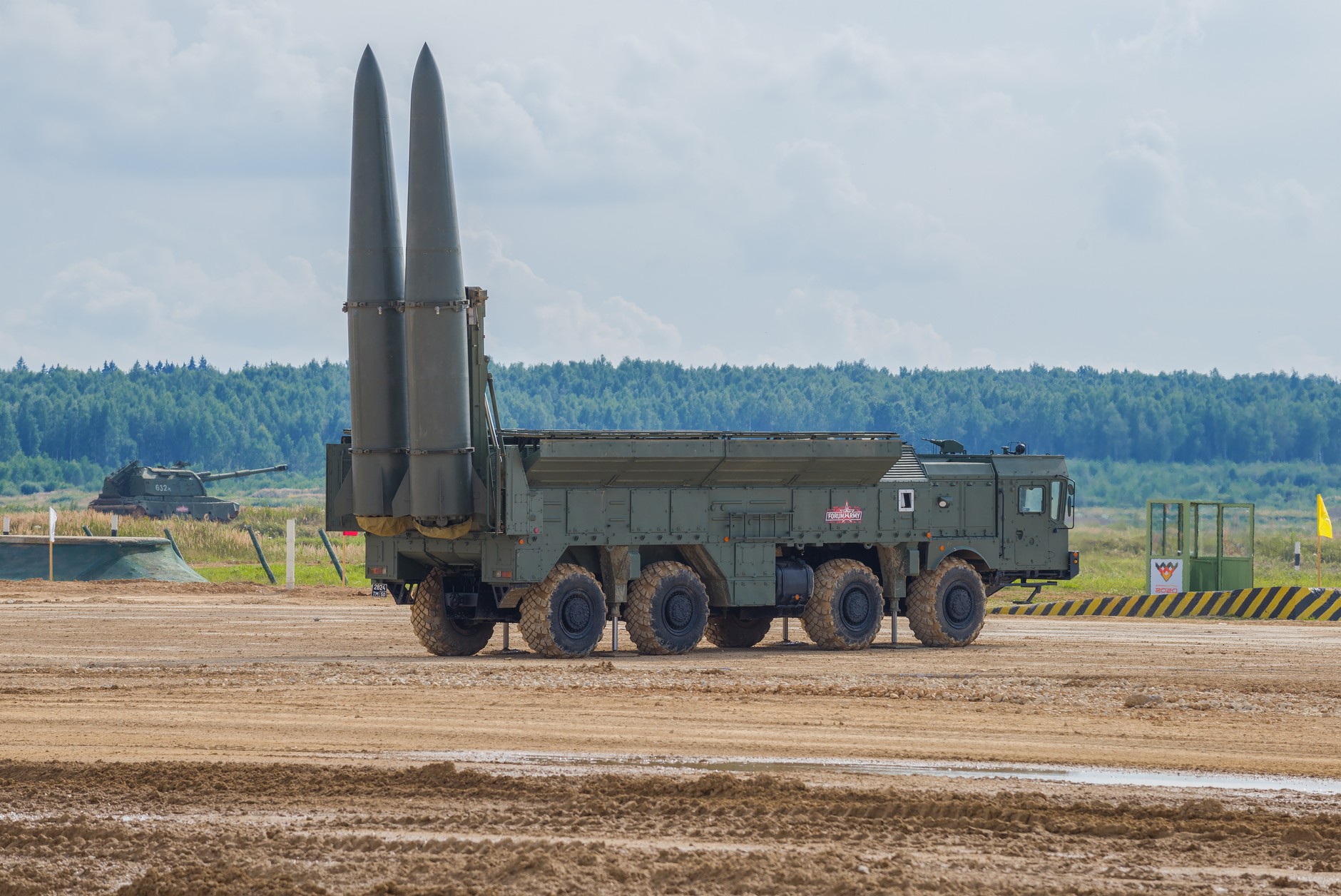
Ruspolimet purchased from Turkey a used numerically controlled vertical carousel lathe with two supports and a turret (model TITAN SC 43) manufactured by the Romanian Umaro factory. Ruspolimet is a regular supplier of titanium and steel rings for the plant in Votkinsk in the Urals, where, among others, Iskander missiles, which use metal elements produced by this company.
Iskander missile launcher (illustrative photo)Karasev Viktor / Shutterstock
As you can see, Türkiye has consistently specialized in re-exporting high-end Western technology to Russia. Chinese deliveries are rather larger in volume, but the quality of products imported from there is also gradually increasing.
Only massive sanctions can be effective
Including individual intermediary companies on sanctions lists does not bring much effect, but only… causes exports to be transferred from one entity to another. Many of them are established as bush companies specifically for trade with Russia, so closing them is not a serious problem.
However, if the authorities of Western countries decide to impose sanctions simultaneously on several thousand suppliers of the Russian arms industry, it may actually seriously harm war production for several reasons.
Firstly, such wide-ranging sanctions will affect not only bush companies, but also… also in companies with real interests in the USA and Europe.
Secondly, such major restrictions may put pressure on the only players on the market who are able, and often willing (if they consider it profitable), to block transactions between Russia and its suppliers – i.e. Chinese and Turkish banks. Considering the risks, banks may come to the conclusion that serving suspicious customers trading with Russia is not worth the possibility of being put on the sanctions list.
Third, even if most sellers are small intermediaries, massive sanctions will seriously hamper imports, if new sanctions lists are published faster than supply chains can be changed. Even when using shell companies, redirecting supplies to new legal entities takes time – the company must be registered, a bank account opened, contracts concluded, customs cleared, etc.
Not in all cases, suppliers of the Russian arms industry are willing to change intermediaries every few months. This means that the sanctioning authorities of Western countries have a chance to overtake them and “strangle” illegal imports.
I’m Ashley Davis as an editor, I’m committed to upholding the highest standards of integrity and accuracy in every piece we publish. My work is driven by curiosity, a passion for truth, and a belief that journalism plays a crucial role in shaping public discourse. I strive to tell stories that not only inform but also inspire action and conversation.