If, by an unfortunate whim of fate, Balzac's work were to disappear, humanity would be left with the creation of Honoré Daumier (1808 – 1879) as an irresistible bibliography. This renowned painter, caricaturist, lithographer and sculptor whose evolution overlapped, for about two decades, with that of Balzac, went through a century marked, in his native France, by major political and social events, including five changes of regime. He has given posterity a chronicle irrigated by the sad and at the same time spectacular humor of the tireless observer who submits to the knife of satire the infinite morphology of human material.
Starting from 1830, he collaborated, for 5 years, with the satirical journal At Caricatureand between 1832 and 1870, with the magazine Le Charivari. The long marriage with Le Charivarias well as numerous independent works produced an elaborate analysis of French society, also rendering its physiognomy sometimes endearing, often repugnant.
Until May 25, his admirers, as well as those seduced by the delights of the art he ennobled by vocation, have the rare opportunity to see more than 200 of the creations he signed, brought together in the largest Daumier exhibition of the last 90 years, hosted by the Museum Albertina from Vienna. Most of them come from the Museum Städel (Frankfurt). In the few rooms in which, now and then, uncontrollable giggles are heard, the human spectacle unfolds, from the imaginary backstage penetrating the ghost of a half-sardonic, half-compassionate smile. In drawing and painting, Daumier's attention and affection were mainly directed towards the world of circus performers, fair fighters and workers (he himself being married to a seamstress). One of the exhibition rooms brings together several such illustrations. But his remarkable talent, as well as courage and irreverent spirit, accompanied by an entomologist's precision, were fully expressed in the thousands of lithographs that relentlessly expose the vices of society, in general, and the strengths of politics, in particular.
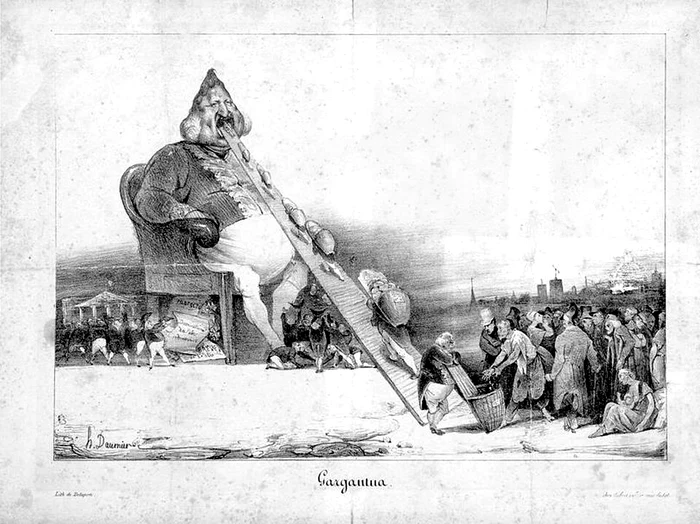
In 1831, he published his most famous caricature, Gargantuana gesture that drew the anger of King Louis-Philippe, whom he had parodied, and earned him a sentence of 6 months in prison. In fact, some of the exhibited works evoke the world of magistrates. Part of the series Les gens de justice
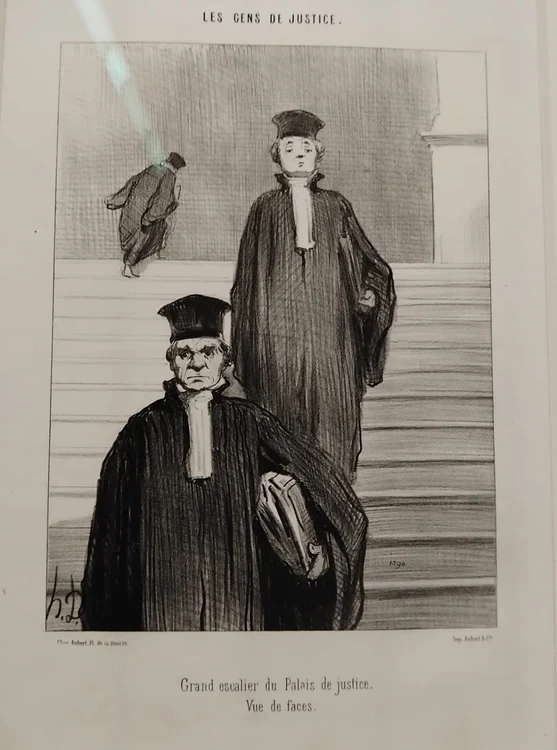
(“People from justice”), published in they Charivaribetween 1845 and 1848, they bring before the viewer the recognizable morgue of the protagonists. The gulf between their world and the uncertain realm of the defendants is reflected in several courtroom scenes. In the midst of the colossal success recorded by the juries, attracting, on a daily basis, a larger audience than the one gathered at the theater, the legal chronicle proposed by the French journals finds a picturesque correspondent in the artist's creation. A lithograph depicting two prosecutors frozen in crushing splendor, descending the steps of the Palace of Justice, greets the visitor in the first room of the exhibition – the appearance itself seems to represent a sentence. The title of the illustration, made in 1848, speculates a pun based on homophony. “The main staircase of the Palace of Justice – front view” (in the original vue de faces) contains a phrase that produces a malicious ambiguity between the singular front – as a reference to the facade of the building – and the plural FACEdesignating the faces of the two magistrates. Another lithograph has in the foreground an accused with the air of a victim, who dares to express an at least unusual suggestion. Leaning toward the lawyer who is staring at him impassive, he whispers, “I have a feeling the president is getting bored with all this. You should tell him to let me go about my business.”
Inhabited by an existential void, deeply alienated and hostile by nature, the magistrates portrayed make up a collective persona beyond the telluric. Their rebarbative features and Olympic air populate the creations signed by the man who had the opportunity to know the penitentiary universe from the inside.
According to the presentation proposed by the exhibition, one of the favorite subjects of the lithographs is the monarchy, towards which Honoré Daumier showed obvious disdain and animosity. A fierce Republican, he attacked it mercilessly throughout his career, sometimes managing to evade censorship. It should be emphasized, in this context, that the laws of September 1835, adopted after the assassination attempt on King Louis-Philippe, forbade the representation of him and the royal family and stipulated that a copy of each caricature be handed over to the state censorship authority. Using a red pencil, the authority targeted the materials (writing
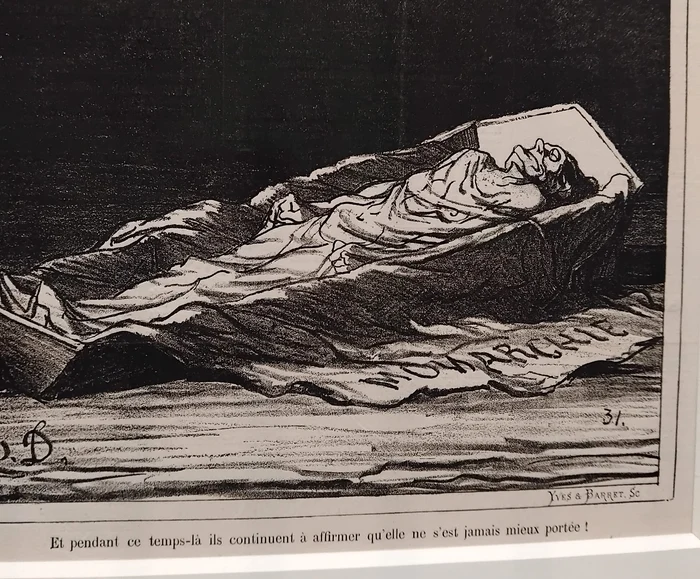
ow or authorized), or rejected them (writing non or refused). One of the exhibited lithographs still preserves, perfectly legible, a ow red in the left corner of the board. As the explanatory texts mention, this form of direct censorship was temporarily abolished after the Revolution of 1848. To the visitor familiar with French history, the analysis of the creations reveals some of the stages that fundamentally determined its course in the 19th century, including the tumultuous avatars of the monarchy. The ravages of the Franco-Prussian War are suggested by a rough and all the more meaningful lithograph: a cannon in the foreground aims at a deserted land on which the tragic silhouettes of some ruins can be seen. The title of the work: “A landscape in 1870”. Constantly scourged, the monarchy knows embodiments of extreme naturalism. In a caricature published in 1872, she appears as a frightening old bride who tries to seduce Jacques Bonhomme (the common name given to the simple peasant or commoner). Deeply reluctant and visibly frightened, he retorts, “Thanks, old man, but you're too decrepit!” In another cartoon published the same year, the monarchy is personified as a decaying corpse lying in a coffin. Accompanying text: “And all the while they say in unison that he feels better than ever!”
Predictably, the work Gargantuanalready mentioned, is accompanied by various explanatory texts with information regarding both its origin and the scandal caused at the time. It is mentioned that it was not Daumier who first imagined and drew, in caricature form, the famous pyriform physiognomy of King Louis-Philippe, but Charles Philipon (1800 – 1862), journalist, lithographer and caricaturist. Moreover, Philipon proposed a series of sketches (also exhibited) rendering the metamorphosis of the king's face, from a vague but real resemblance to a pear to the shape of the fruit itself. The image of Louis-Philippe, depicted as a giant personage, seated on a throne, fed by servants with bags of money collected from subjects and excreting decrees and other official documents, is an anthology. Brutal naturalism and transparent morality compose a portrait worthy of the pages of a universal handbook of corruption.
An unconquered spirit of contestation led Honoré Daumier to attack another canon. The exhibition hosted by the Viennese museum also chose to present some lithographs parodying mythological characters such as Pygmalion, Andromache and Penelope. Imagined as an emaciated being crushed by the death of hope, the latter appears slumped in a chair in front of the loom. On the wall is a caricature sketch of Odysseus, his helmet standing out in contrast to his hawkish face. This profane, inevitably playful approach is also manifested in other mythological scenes whose substance the artist exiles to the periphery of aesthetics.
In other rooms, attention is drawn to works that ridicule the snobbery and tyranny of models, as a phenomenon stimulated by industrial and transport development, as well as by the evolution of the press. The impact of the urban transformations made by Baron Haussmann also becomes the subject of analysis in a satirical key. A caricature with disturbing humor is worth mentioning. In the midst of the modernization of Paris, an anonymous man is brutally awakened from his sleep by a man who summons him, with a fateful air: “Come on, citizen, get up quickly! It's your turn. I have to demolish you!” In the background, a worker can be seen with a pickaxe, climbing a pile of rubble. Dismayed and governed by fear, the protagonist, this French Leonid Cone, whose cap seems to come to life in the middle of the tense scene, is silenced.
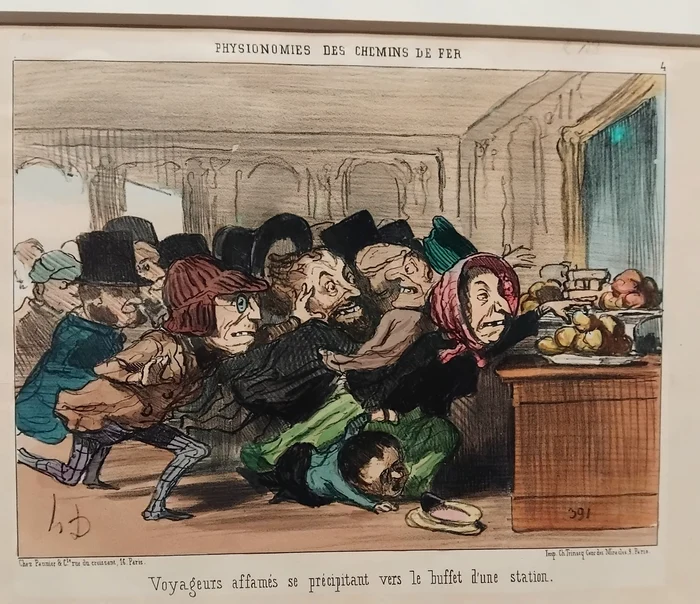
In the same register, several lithographs illustrating the railway reality are entered. Taken from the cycle Physionomies des chemins de fer (“Physiognomies of railways”), published in 1852, respectively from the series Les trains de plaisir (“Holiday Trains”), from the same year, they capture the chaos, the unleashing of instinct and the dissolution of all social restraint in the passion for travel in the vehicle which, at the time these cartoons were published, had been in use in France for some two decades. The image of a suffocated compartment of sleeping passengers, exhausted and huddled together, is remarkable, with the commentary dryly stating: “A holiday train. Two o'clock in the morning.” Another caricature reveals the dehumanization that primal selfishness combined with an intense gregarious spirit causes: a group of disfigured people stomping their feet for food (“Peaceful travelers pouncing on a station buffet”). Daumier does not omit any of the coordinates of the railway experience. Thus, a lithograph (on loan from the Metropolitan Museum of Art in New York) exhibits the observation of Mr. Prud'homme, a character who embodies the typical French bourgeois of the 19th century, regarding the archipline carriages of the underprivileged: “Long live the carriages of the third class! You can die asphyxiated, but never assassinated.”
Two portraits of Honoré Daumier, located in the last room of the exhibition at Albertinareproduce the face of this artist from whose vision a perfect mold of the human being was born. Next to them is exhibited a series of small busts made by him between 1832 and 1835, representing the most famous political supporters of Ludovic-Filip. Lombrosi's physiognomies, some having the features of alcoholics or the air of satyrs, cover the whole gamut of the grotesque. Arrogance, hypocrisy, greed, the venom of authority, captured in thousands of lithographs and sketches, find their ultimate expression here, this character study taking the form of a conclusion to the reflections that the exhibition provokes. An etymological breeze would perhaps give the viewer a sense of deep understanding of the sublime art of caricature – the term comes from
_______________________________
Bibliographic notes:
https://www.albertina.at/en/exhibitions/honore-daumier/
https://www.etymonline.com/search?q=caricature