Washington and Tel Aviv have been trying to get the Kurds to revolt against Tehran for months. Although on Sunday, March 8, Donald Trump announced that he had ruled out their participation in the offensive against Iran, this does not necessarily mean that the matter is closed.
For about a year, Israel has been maintaining contacts with Iranian Kurdish organizations in an attempt to persuade them to take up arms against the Islamic Republic of Iran. This information was provided to Reuters by two interlocutors from Kurdistan and one source in Israel.
The goal is not to overthrow the authorities in Tehran, but to weaken their control over the western part of the country. The Kurds would take over several border towns and force the Iranian authorities to transfer some of their forces there. And this would mean a serious problem for Tehran.
These are paramilitary groups of Iranian Kurds that have their bases outside Iran, primarily in the territory of autonomous Kurdistan in Iraq. These include:
Party of Free Life of Kurdistan (PJAK),
Democratic Party of Iranian Kurdistan
and the Kurdistan Freedom Party.
In February, just before the US-Israeli attack on Iran, they announced the creation of a joint alliance. It is estimated that in total they can field from about five to eight thousand fighters.
It is assumed that the aim of a possible uprising would be to take over several border cities in Iran inhabited mainly by Kurds, such as Piranshahr or Oshneviye in the West Azerbaijan province.
Israeli and American aircraft are bombing positions of the Iranian army and the Islamic Revolutionary Guard Corps in the region, thus preparing ground for a potential offensive by Kurdish troops. Local Kurds also provide the US and Israel with intelligence on targets for airstrikes in border areas.
This is not about the overthrow of the Islamic Republic by Kurdish forces. Rather, the goal is to weaken Tehran's control over the country's peripheral regions and to divert some of the forces of the Islamic Revolutionary Guard Corps to other directions. The United States and Israel are to promise the Kurds air support, while the Kurds are demanding supplies of small arms, drones and air defense systems.
Before withdrawing his idea, US President Donald Trump publicly called on Iranian Kurds to rise up. He also reportedly had telephone conversations with several Kurdish leaders — not only from Iran but also from Iraq. However, the authorities of Iraqi Kurdistan declare that they do not intend to get involved in the war between the US, Israel and Iran. At the same time, Iran is carrying out strikes on the territory of Iraqi Kurdistan, where an American military base is located.
The Kurds: a history of unfulfilled promises
Kurdistan – the area where the Kurds live – covers mainly mountainous areas divided between Turkey, Syria, Iraq and Iran. In each of these countries, Kurdish separatism is one of the most important political challenges. The only officially recognized Kurdish autonomy is that in Iraq.
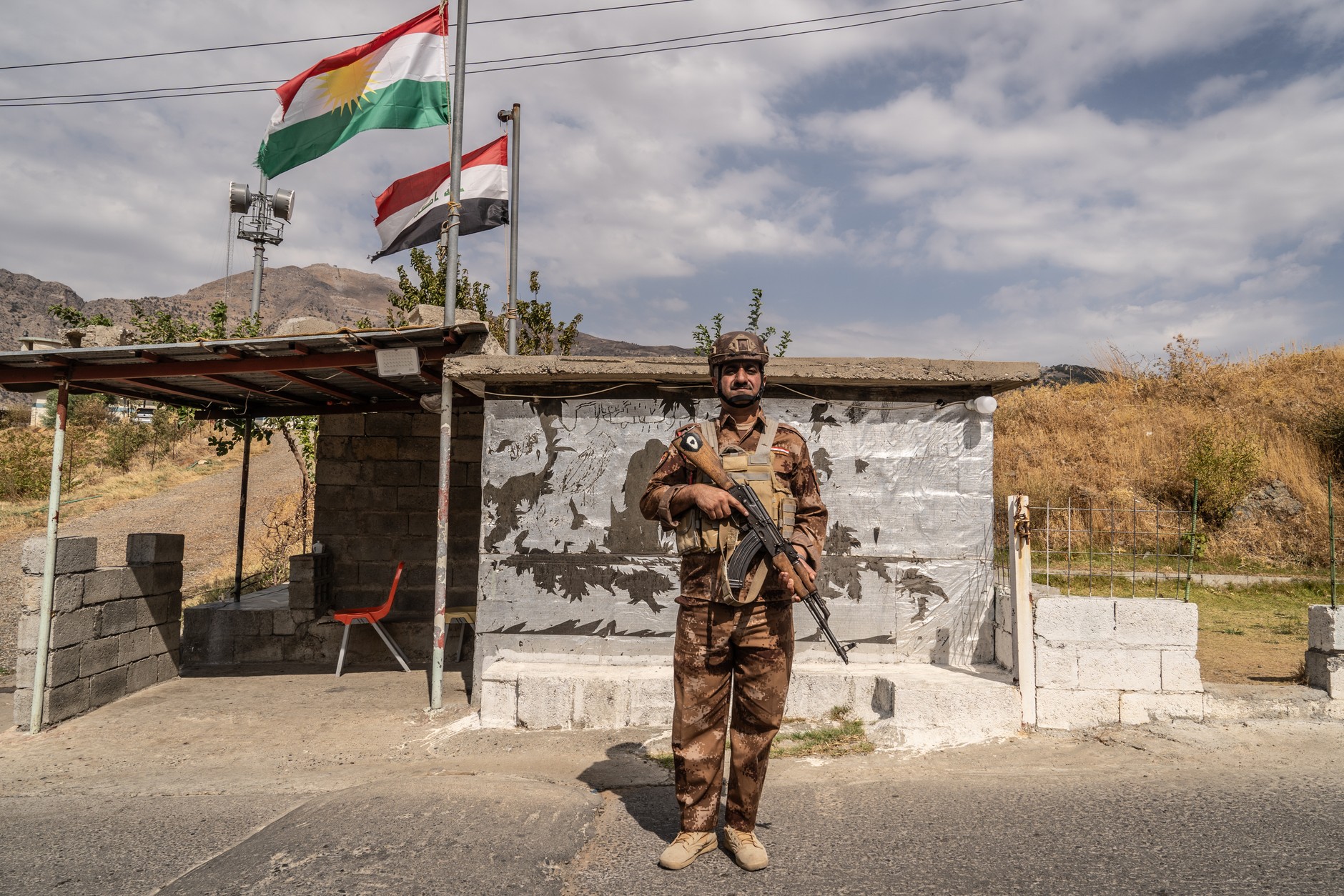
A Kurdish fighter guards a checkpoint on the border with Iran in the mountainous northern Kurdistan region, September 30, 2024.Giles Clarke / Contributor / Getty Images
In practice, it operates largely independently of the central authorities in Baghdad and maintains complex relations with them – partly partnership, partly conflict.
Until recently, de facto Kurdish autonomy, known as Rojava, also existed in Syria. The regime of Ahmad al-Sharaa forcibly liquidated it in January, having previously obtained a “green light” for it from the administration of Donald Trump.
In the light of the fate of Rojava Many Iranian Kurds are very cautious about the declared help from the US and Israel. Syrian Kurds also received American support when they were needed as ground forces in the fight against the so-called Islamic State. However, when they were no longer necessary, Washington chose Sharaa – and Rojava was effectively left to its own devices.
Iran's weak points
Iranian Kurdistan — which includes all or part of the provinces of West Azerbaijan, Kurdistan, Kermanshah, Eelam, Lorestan and Hamadan — stretches along about half of Iran's western border. It is mostly a relatively poor region, where in recent years protests against the authorities of the Islamic Republic have broken out relatively easily, most often on economic grounds.
The article continues below the video
Apart from the Kurds, there are also other ethnic groups in Iran, among which there are separatist sentiments. An example is the Ahwazi – the main population of the southwestern province of Khuzestan, rich in oil deposits. They speak Arabic and practice Shiite Islam, like the inhabitants of neighboring southern Iraq. When Iraqi dictator Saddam Hussein attacked Iran in 1980, one of the official goals of the war was to annex Khuzestan to Iraq.
In the northwest of Iran, the majority of the population are Azerbaijanis – a Turkic people in linguistic terms and also Shiite in religious terms. In the 1980s, there was a strong movement demanding the creation of Azerbaijani autonomy within the Islamic Republic, but it was suppressed, and today Azerbaijanis are largely integrated into Iranian society. Moreover, the killed supreme leader of Iran, Ali Khamenei, had Azerbaijani origins on his father's side.
The Baloch people live in the southeast of the country – most of them Sunni, as is much of the population of neighboring Pakistan. Baloch separatists periodically carry out terrorist attacks in Iran – mainly explosions and attacks on police stations and bases of the Islamic Revolutionary Guard Corps.
In his speech after the start of the war with Iran, Israeli Prime Minister Benjamin Netanyahu did not appeal to the entire Iranian nation as one community to overthrow the ayatollah regime. Instead, he addressed his words separately to each ethnic group:
I’m Ashley Davis as an editor, I’m committed to upholding the highest standards of integrity and accuracy in every piece we publish. My work is driven by curiosity, a passion for truth, and a belief that journalism plays a crucial role in shaping public discourse. I strive to tell stories that not only inform but also inspire action and conversation.