Minister from Lithuania about the new bastion of Europe. Points to Poland


Władysław Kondratowicz: I understand that the Germans are analyzing the situation in Lithuania – according to plans, their brigade is to be stationed here, we are currently preparing for it. Developing forecasts is therefore natural – the military must be ready for various threats and scenarios, regardless of whether they are openly articulated or not. We have been saying for a long time that the threat from the East is real – just look at the Russian-Belarusian Zapad exercises, during which these countries practice operations against us.
However, we must keep our cool. Lithuania, like other Baltic countries and Poland, is determined not to allow aggression. We invest in security and modernize our armed forces to the highest possible level to remain a reliable partner within NATO. We must have our own capabilities and be ready to support other allies.
We have been experiencing various hybrid activities since 2021, when Belarus initiated the migration crisis. Minsk used migration as a tool and weapon to destabilize the situation and increase tension not only in our country, but also in the entire EU. Therefore, various acts of sabotage occur, such as arson of shopping centers – not only in Lithuania, but also in Poland. Close cooperation between the services: police, intelligence and other institutions, also at the international level, within the EU and NATO, is crucial. Thanks to this, many actions have already been thwarted. But we still remain vigilant.
Should balloons that regularly enter Lithuania from Belarus be treated as simple contraband or as something more?
This is an example of using criminal organizations – under the guise of cigarette smuggling – to exert pressure. This poses a threat to civil aviation – Vilnius airport is located only 30 km from the border with Belarus. We do not see the Belarusian services stopping people involved in this activity. This is convenient for Minsk – not only in economic terms, it also serves as a destabilization tool. We are intensively counteracting this and the situation is gradually improving. We detain people involved in smuggling to limit the possibilities of cooperation on the Belarusian side – regardless of whether we are dealing with hybrid pressure or ordinary crime.
Lithuania, a relatively small country, has accepted a significant number of migrants and refugees from Belarus and Ukraine. What percentage of Lithuanian society are refugees?
There are approximately 200,000 people in Lithuania. third-country nationals on various legal bases. Among them there are approximately 77 thousand. citizens of Ukraine, of which approximately 50 thousand they are war refugees, the others arrived earlier. They function under the same principles as in other EU countries – we have provided them with good conditions and, to a large extent, they integrate well with Lithuanians. A significant part of them are women and children, the youngest attend schools. Depending on where you live, education is available in various languages, including Polish – there are dozens of Polish schools in Lithuania.
Many Ukrainians work and learn Lithuanian, even though it belongs to a different language group. Some will probably stay, some will come back – it's an individual decision. There are also over 50 thousand Belarusians, most of them are employed and work. Many have family here and historical ties to Lithuania, especially in the border regions. More than 1,000 Belarusians are protected as political refugees.
In some Western countries, social tensions and anti-Ukrainian voices are emerging four years after the invasion began. Are similar tensions also visible in Lithuania?
What is Lithuania's integration policy towards foreigners?
Similar to the policy of other European countries. Differences – for example in free public transport – may occur at municipal level. Lithuania is a country of many nationalities. I am Polish myself, we have a well-developed education system in Polish and Russian. We create opportunities to learn in your native language.
How big is the Russian minority in Lithuania? Isn't it the same size as in Latvia or Estonia?
National minorities constitute about 15 percent. population of Lithuania – approximately 300 thousand people of different nationalities: Polish, Ukrainian, Belarusian or Russian. It depends on the region – for example, in the Vilnius region, people of Polish origin predominate. There are still some issues to be resolved, such as the spelling of names, but we are making progress on this topic. From January 1, 2026, driving tests can be taken in Polish, and from February – in Ukrainian. There is great interest. We are also considering the Belarusian language. We continue to work on the Act on National Minorities, but the changes must achieve broad social consensus.
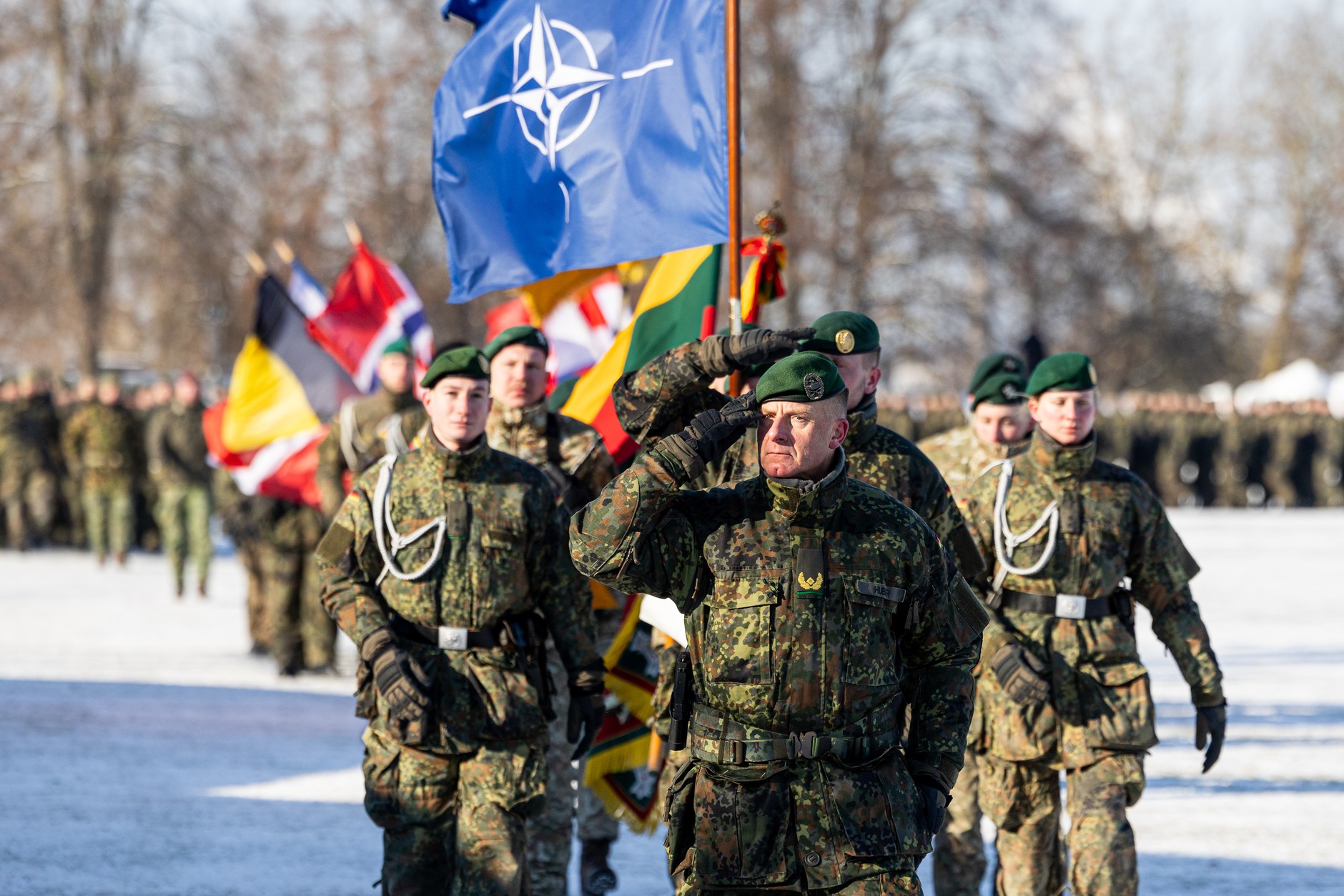
Brigadier General Christoph Huber participating in a ceremony marking the expansion of German military involvement in Lithuania, February 4, 2026.Paulius Peleckis / Stringer / Getty Images
Polish-Lithuanian relations – also in the historical context – are very good today, although historically this has not always been the case.
We cooperate closely with Poland – at the level of governments and presidents, as well as within international alliances. Problems, when they arise, are usually local, not central. An example is the reorganization of the school in Połuknie, which sparked opposition from the Polish community – it was a decision of the local authorities. We must act carefully because national diversity is Lithuania's strength.
Poland and Lithuania regularly refer to their common heritage – the Polish-Lithuanian Commonwealth, the Grand Duchy of Lithuania, the January Uprising. Recently, we witnessed joint celebrations in Vilnius, attended by the presidents of Poland and Ukraine.
We also celebrate November 11, Poland's Independence Day, especially in the Vilnius region. Only together can we face the threats from the East. In this context, contacts with minorities are also important.
However, in the 1990s there were some tensions – some Polish circles proposed autonomy for the Vilnius region.
Tensions can easily arise with just one irresponsible step. That's why we need to protect the relationships we have today.
Yes, although it should be remembered that he has just been released from prison after many years behind bars. In such situations, you should choose your words carefully – some reactions are difficult to stop later.
In many EU countries, pro-Russian forces or forces skeptical about further support for Ukraine are gaining importance. Some people talk about a crisis in transatlantic relations. How is Lithuania dealing with this situation?
We are a member of NATO, and strong transatlantic cooperation is the basis of our security. Joint defense is much more effective than acting alone. We are only as strong as NATO.
Do you feel any symptoms when you observe the increase in support for radical forces such as the German AfD? [Alternatywa dla Niemiec]?
Traditional parties must respond to this. They often defend values that extremist groups seek to undermine, which poses a threat to the stability of the EU. This does not only apply to Germany – there are countries in the East that dream of the success of radical parties. For now, mainstream parties are maintaining support and limiting the risk of their coming to power. Nevertheless, the threat to a system built over decades is worrying.
Without entering into the competences of the Ministry of Foreign Affairs, I can say that the Lithuanian state and government support Ukraine's European path. There is still a lot to do in this matter, but Ukraine has chosen the right direction. Most European countries are open to its EU membership. The last four years have shown that Ukraine is able to face an aggressor that is stronger militarily and economically. If he wants, he can do it.