In recent years, state-backed hackers — often linked to Russia — have increasingly targeted critical infrastructure. However, NATO allies still struggle to develop an effective response. As new public opinion surveys show, states' restrained response to hybrid attacks is in clear contradiction to public sentiment. In many countries of the alliance, a significant number of citizens believe that actions such as cyberattacks should be treated on an equal footing with an act of war.
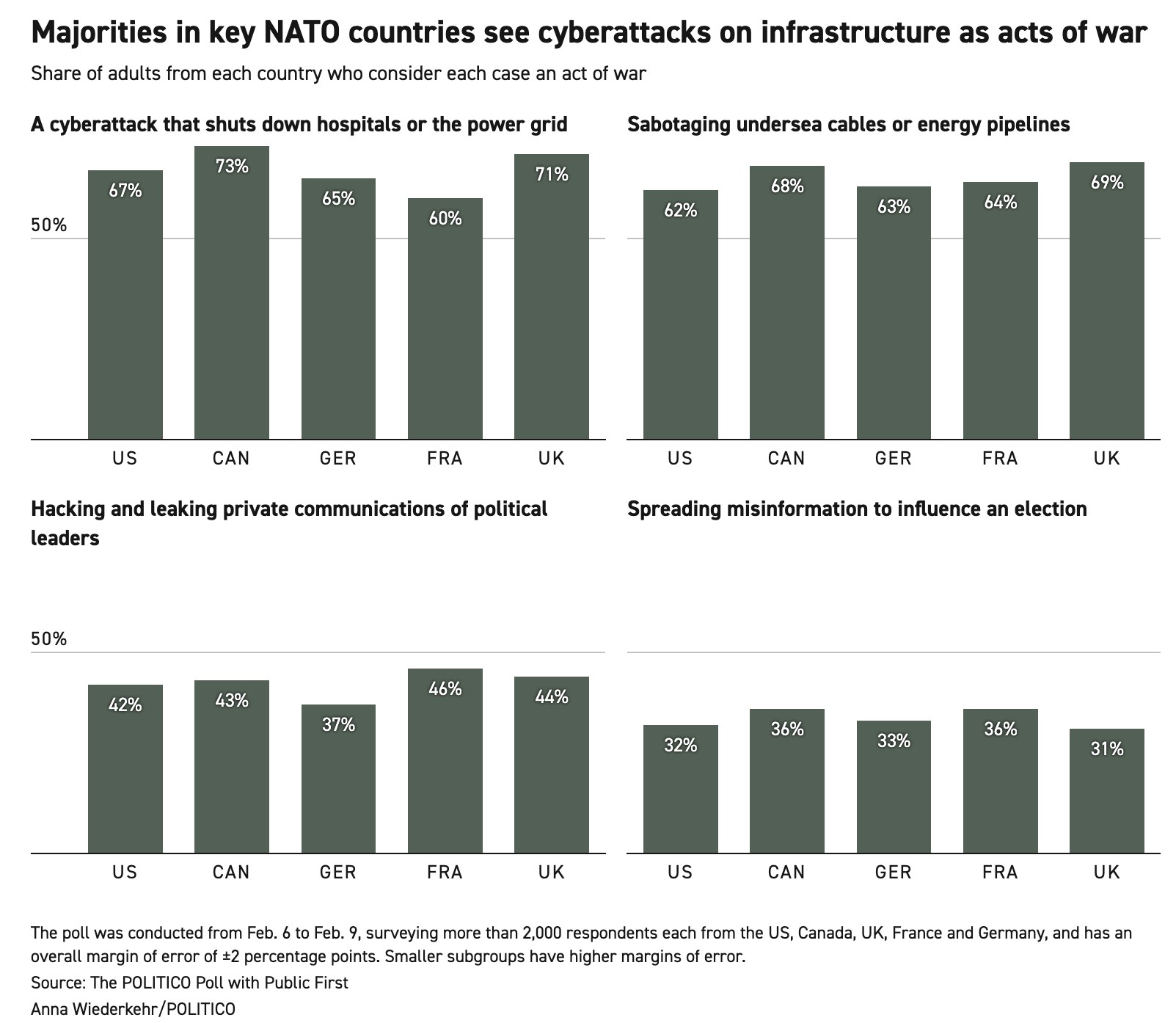
The POLITICO poll, conducted in the United States, Canada, France, Germany and the United Kingdom, found that most respondents consider a cyberattack that paralyzes hospitals or power grids as an act of war. Canadians were the most determined – as much as 73%. of them shared this opinion.
Respondents from all five countries also unanimously supported the view that sabotage of undersea communications cables or energy pipelines – which has occurred with increasing frequency in recent years – should also be considered an act of war.
In 2024, a Russian hacker group carried out a massive cyber attack on the American company Change Healthcare, which deals with billing medical services. As a result, sensitive data of over 190 million people was disclosed.
The British National Health Service (NHS) confirmed last year that a cyber attack on its systems – also attributed to Russian hackers – contributed to the death of one of the patients.
In turn, in 2022, the Federal Bureau of Investigation (FBI) accused hackers supported by the Iranian government of trying to break into the computer network of Boston Children's Hospital.
While these actions have not been officially recognized as acts of war, governments around the world are beginning to take attacks on key national systems more seriously. Already in 2014, NATO announced that a foreign cyber attack could trigger Article 5 of the North Atlantic Treaty — that is, the principle of collective defense, providing for a joint reaction of the alliance.
In 2022, however, one NATO official admitted that it was still unclear how severe a cyberattack would have to be to trigger such a response. It could include “diplomatic and economic sanctions, actions in cyberspace, and even the use of conventional armed forces – depending on the nature of the attack.”
“You have to actively defend yourself”
European security services increasingly often and more decisively accuse the Kremlin of organizing digital destabilization operations in the West. Recently, their target was, among others, the Polish energy infrastructure.
At the same time, the perception of Russia as a global threat differs markedly on both sides of the Atlantic. Most respondents in Germany, France and the UK rated Russia as greatest threat to world peacewhile in the United States 39 percent agreed. respondents, and in Canada – 29 percent.
While respondents in the five countries surveyed strongly viewed major cyberattacks on public infrastructure as acts of war, they were much more cautious about smaller forms of digital sabotage.
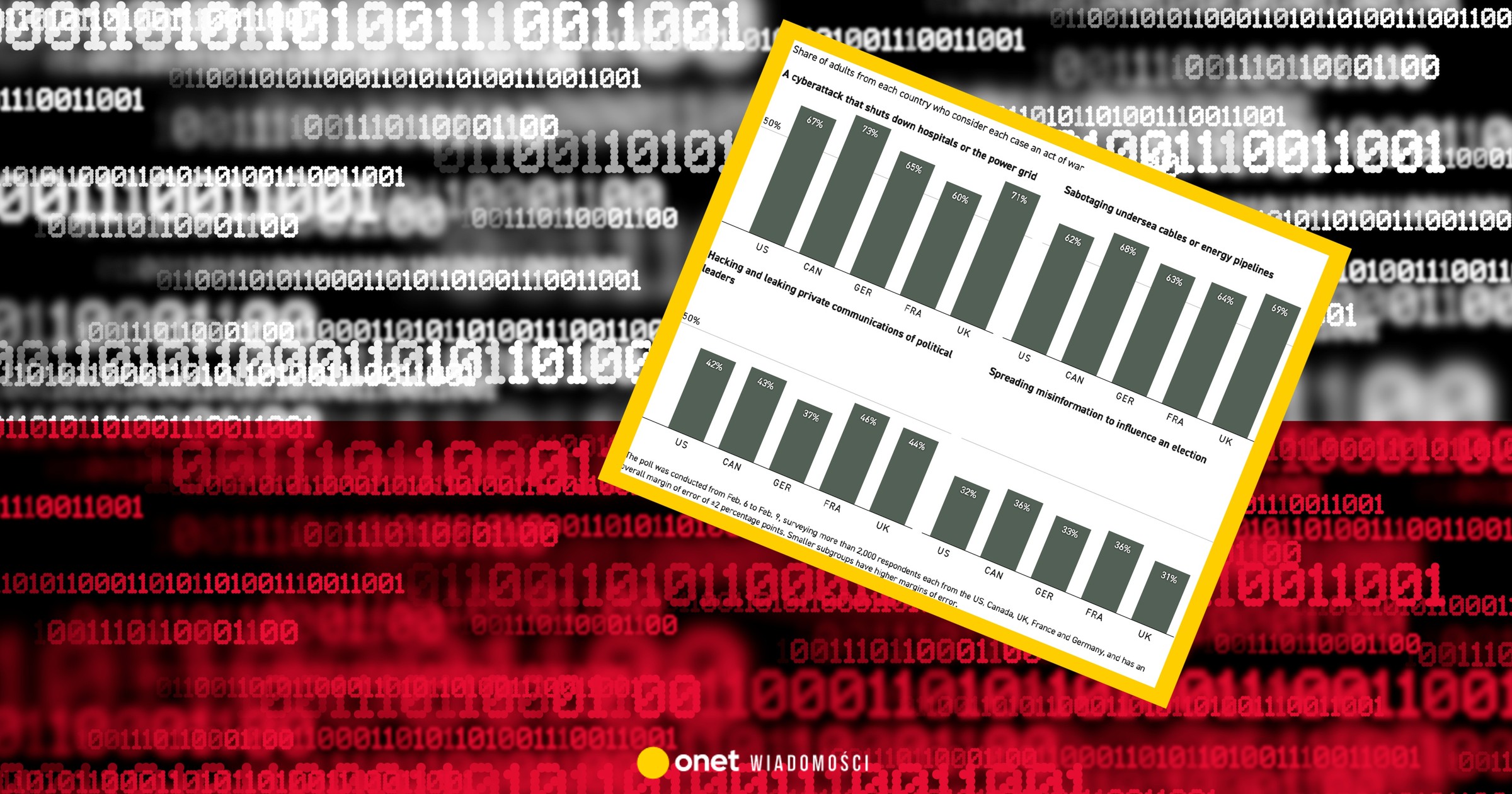
Results of a survey in NATO countries regarding which cyberattacks society considers acts of war. Most people consider a cyberattack that paralyzes hospitals or the energy network and sabotage of infrastructure (cables and pipelines) to be an act of war. Much fewer respondents treat leaking politicians' private conversations or spreading election disinformation as an act of war.POLITICO POOL / Politico
Less than half of the respondents believed that hacking into politicians' private correspondence and making it public should be treated as an act of war. Even fewer considered spreading disinformation to influence elections to be an act of war.
At the same time, there is clear agreement that governments must integrate cyber and artificial intelligence capabilities more into their defense strategies. Most respondents indicated that cybersecurity, AI and traditional military power are equally important today.
At least one-third of respondents in each country also said that cybersecurity and defense against cyberattacks should be among the highest priorities in national defense spending.
Resistance alone is not enough, because it is impossible to merely passively absorb all threats. You have to actively defend yourself
– said Dag Baehr, vice president of the German Federal Intelligence Service (BND), during last week's conference in Munich.
Is America preparing a digital counterattack?
U.S. officials are increasingly pushing for a more offensive military response to cyberattacks, especially after the massive 2024 hack of global telecommunications networks attributed to the China-linked group Salt Typhoon.
The article continues below the video
In the coming weeks, the White House is expected to announce a new national cybersecurity strategy that is intended to encourage the United States to be less “reactive” and more proactive in cyberspace.
National Cybersecurity Director Sean Cairncross told the Munich Security Conference that a “mindset shift” is needed to make it harder for attackers to succeed.
In recent months, Donald Trump's administration has been increasingly open about using its own cyber capabilities to conduct offensive activities.
It was revealed, among other things, that US cyber forces helped to shut down electricity in Caracas during January operations that ended with the capture of former Venezuelan President Nicolas Maduro. U.S. Cyber Command and the National Security Agency (NSA) also participated in last year's U.S. missile attacks on Iranian nuclear facilities, reportedly helping to disable Iranian air defense systems.
In Germany, the government is currently preparing a thorough reform of the powers of the intelligence services and the cybersecurity system, which is intended to enable more effective counterattacks against foreign hackers and spies.
**
The online survey was conducted between February 6 and 9 by independent London research firm Public First.
I’m Ashley Davis as an editor, I’m committed to upholding the highest standards of integrity and accuracy in every piece we publish. My work is driven by curiosity, a passion for truth, and a belief that journalism plays a crucial role in shaping public discourse. I strive to tell stories that not only inform but also inspire action and conversation.