

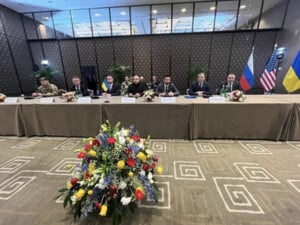
The military negotiations, which took place in Geneva over the past two days in parallel with the political ones, were led by US Army Secretary Daniel Driscoll and the commander of the US European Command, General Alexus Grinkevich.
The political negotiations were chaired by US President Donald Trump's special envoy Steve Witkoff and the White House head's son-in-law Jared Kushner.
According to CNN, one of the main tasks of the military negotiating team was to achieve agreement between both sides on key terms that will be used for political negotiations. As an example, the media cites the practical conditions of the ceasefire and what would be considered a violation of it.
Progress has been made in this direction, although political officials still need to give final approval, the source said. Officials expect another meeting to be scheduled soon, likely within weeks, the source said.
President of Ukraine Vladimir Zelensky, after the report of the negotiating group from Kyiv, also announced “progress in the military direction.” Negotiations on the territories and the Zaporozhye nuclear power plant, according to the president, were less productive.
In his evening video message, he added that he could not say that the result of the negotiations was “sufficient.” He also expressed hope for new meetings in February.
Context
On February 17, negotiations in Geneva focused on “practical issues and the mechanics of possible solutions,” reported Head of the Ukrainian delegation, Secretary of the National Security and Defense Council Rustem Died. Axios journalist Barak Ravid wrote that, according to his sources, the negotiations “stuck” because of the positions presented by the historian Vladimir Medinsky, who in Geneva headed the contact group from Moscow. However, President Trump's special envoy Steve Witkoff said there was “significant progress.” After trilateral negotiations, the Ukrainian group met separately with delegations from the United States, France, Great Britain, Germany, Italy and Switzerland.
Negotiations on February 18 lasted about two hours, reported Speaker Umerova Diana Davityan. Medinsky called the negotiations “difficult, but businesslike,” and announced the next meeting “in the near future.”


