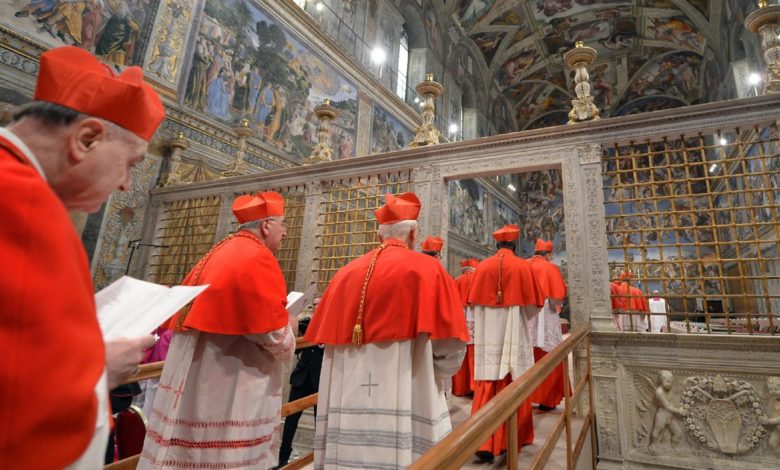
- The choice of the Pope is one of the most spectacular moments, primarily because of the scenery of the Sistine Chapel and the unchanging and mysterious ritual
- Each conclave lasts less than in Viterbo – it emphasizes ironically in the media. According to legend, the elections in the 13th century lasted over 1000 days. The town's authorities, to mobilize cardinals to make a decision, began to ration of water and food. The disassembly of the roof above the building, in which the choice was made
- The results of the conclave like to surprise. Bishops have already congratulated this cardinal once. In 2013, when Jorge Bergoglio became the pope, the Italian episcopate in the sent e-mail accepted “the news that the successor of St. Peter will be Card. Angelo Scola”
- More important information can be found on the Onet's main page
The choice of the Pope is one of the most spectacular events in the modern world, primarily because of the scenery of the Sistine Chapel and the unchanging and mysterious ritual recalling the centuries -old tradition. Voting for the conclave is a great unknown. Its result is often surprising, usually media speculation does not work, regarding the chances of so -called papabili, i.e. favorites.
These, before the closest “elections”, include Pietro Parolin, pizza pizzaballa, Luis Tagle, Peter Turkson, Fridolin Ambongo Besungu, Jaime Spengler, Raymond Burke and Peter Erdo. Among conservative Catholics, e.g. Cardinal Robert Sarah. You can read more about them here.
It is also unpredictable how long the conclave will last. Over the past 100 years, none of them lasted more than five days.
The longest conclave in history and a slip -up with congratulations
Each lasts less than in Viterbo – it is ironically emphasized in the Italian media, which evoke the elections of the Pope from the 13th century, which according to legend lasted over 1000 days. The irritated authorities of the sub -ness town in order to mobilize a group of about 20 cardinals to make decisions, began to ration of water and food. Apparently, the disassembly of the roof above the building, in which the choice was made.
The results of the conclave of 1978 turned out to be a complete surprise, when Cardinal Karol Wojtyła was elected, but also in 2013 with the choice of Cardinal Jorge Bergoglio. It was also a complete surprise; Also for the Italian Episcopal Conference, which in a sent e-mail managed to accept with joy “news that the successor of Saint Peter would be Cardinal Angelo Scola”, the then metropolitan of Milan.
Important aspect
The “spectacle” related to the conclave ends for the outside world when the door of the Sistine chapel closes (in Latin – Cum Clavis). This term is used since the end of the 13th century. It was then that Pope Grzegorz X decided that only cardinals have the right to choose the pope. According to current regulations, electors are only purplers who are under 80 years old. The conclave must begin between 15 and 20 days from the death of the Pope.
General congregations in the Vatican, started after the Pope's death, are called pre -concit, because the subject of these meetings are current challenges for the Church, his situation and problems whose solutions are expected from the new pope.
During the discussion, a kind of profile of the church head needed in the present time is slowly sorted among cardinals. Every day during the congregation, several dozen cardinals speak. The course of the meeting is not disclosed, but it is unofficially known that hierarchs present postulates, indicate priorities and ask questions. In the case of current congregations, purpants will meet because they come from the farthest corners of the world; including 70 countries.
The whole process of choosing the Pope is accompanied by a secret and an absolute commitment to silence.
At the time of starting activities related to the selection, all electors must live in the House of Saint Marta. It was in this building, renovated and turned into a convenient hotel at the behest of John Paul II for the needs of the conclave, that Francis lived for 12 years. For the first time in history, it will happen that the electors cardinals will live in the house where the Pope lived. This will be the third conclave, during which the cardinals will live in the House of Saint Marta, after choosing in 2005 and 2013.
Cardinals have numerous bans
Pursuant to the provisions of the Apostolic Constitution, “Universi Dominici Gregis” by John Paul II from the moment of starting all activities related to the election to his public announcement, the room of the House of Saint Marta, as well as in a special way a Sictory Chapel and the places taking place at that time liturgical celebrations, they must be inaccessible to unauthorized persons. What's more, the entire area of the Vatican state and the activities of all offices there are to be managed in such a way as to guarantee secrecy and free course of the conclave.
One of the requirements is to make sure that no one is approaching electors on the road between the House of Saint Marta and the Apostolic Palace, where the Sistine Chapel is located.
Cardinals are banned from conducting all correspondence and telephone contacts and other, i.e. internet with outsiders. The exception are random situations and an urgent necessity, which is recognized by the so -called particular congregation, i.e. a special group of cardinals, headed by the Church Managing during the Camerling vacancies.
Before the conclave, specially qualified technical staff carries out meticulous control in the Sistine chapel and the rooms adjacent to it to make sure that audiovisual or eavesdropping devices have not been hidden in it.
How the conclave goes
The first stage is the Mass in the Vatican – Pro Eligendo Papa, i.e. for the election of the Pope.
Then the electors go to the Sistine Chapel in a procession, which will be accompanied by the song Veni Creator, calling for the help of the Holy Spirit. After arriving at her in a solemn retinue, they take an oath, promising to keep the secret and meticulously follow all the provisions. It also includes the following words: “At the same time we promise, commit ourselves and swear that if any of us, from a divine decision, is elected Bishop of the Roman, will make efforts to faithfully fulfill the service of the shepherd of the universal church and not cease in the effort to ensure and defend the persistently of spiritual and temporal laws and the freedom of the Holy Capital.”
There is also an oath of a commitment to “not to give any support or favor any impact, opposition or any other form of interventions, through which the secular authorities of any order and degree or any group of people or units would like to interfere in the choice of the Roman bishop.”
Then each cardinal takes an oath, putting his hand on the Gospel.
When everyone does it, the papal master of liturgical ceremonies, which is currently the Archbishop of Diego Ravelli, will issue the “Extra Omnes” command, signaling that only electors remain in the Sistine Chapel, and other people must leave it. The place of election of the pope is then closed.
In the chapel there is still a master of the ceremony and a previously elected priest who will consider the task of waiting for electors and the need to act for the good of the universal Church. After delivering a speech, the priest will leave the chapel with the ceremony master. When most cardinals will assess that nothing prevents you from starting to start the choice of choice, it can start.
Cardinals remain closed until the pope's election; Of course, with breaks for meals and overnight at the House of Saint Marta.
During the conclave, electors cannot watch television, listen to the radio, read newspapers, use online media. They can move around the Vatican and walk on a specially secured part of the Vatican gardens, but they cannot communicate in any way with people not related to the selection of the pope.
Cardinal Camerling together with three cardinals watches all the time so that the secret to everything that takes place in the Sistine Chapel is not violated in any way.
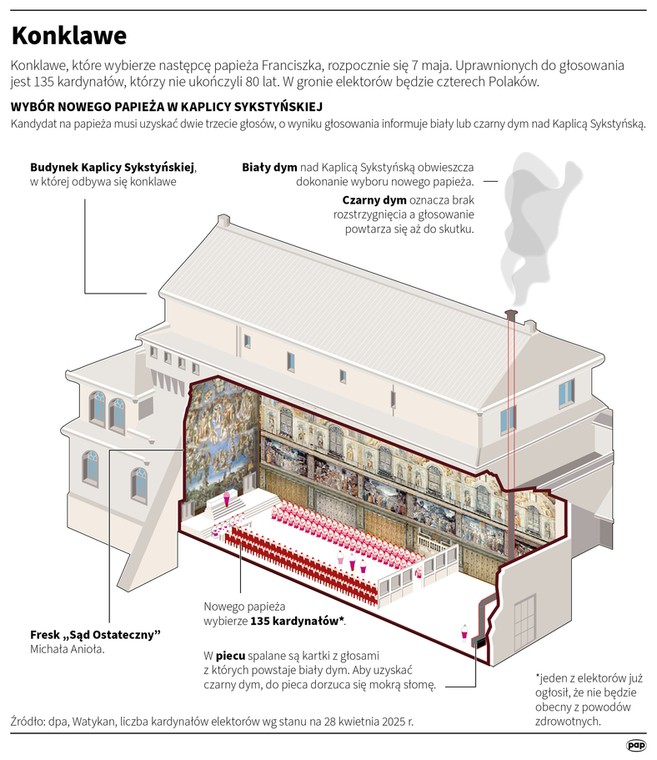
Two -thirds of votes are needed to choose from.
Voting cards are to be rectangular. At the top, the words: “eligo in summum pontific” (I choose as pope). In the lower half there will be a place to enter the name elect. The Apostolic Constitution recommends entering them with the nature of the letter as unrecognizable, and submit the card from being put in the urn.
After each vote, which does not bring the decision, the cards are burned, and chemicals are added to the stove, which will color black smoke rising a moment later over the Sistine chapel. It means no choice.
The bells will dispel doubts
When the choice is made, other chemicals added to the stove will color smoke white and in this way crowds collected in St. Peter's Square will learn that there is a new pope.
White smoke will be accompanied by bells. This will definitely dispel any doubts about the color of smoke and prevent misunderstandings if the color was unclear or badly visible, for example because of the weather.
Probably a few dozen minutes after the appearance of white smoke, Cardinal deacon will appear on the balcony of the Vatican Basilica and announce to the world “Habemus Papam” (“We have Pope”) and give the name of electa and the name of elect and the name he took as a pope. Then the new pope will show up on the balcony and greet the faithful for the first time.