Politicians are reluctant to admit the failures of projects that were the apple of their eye. It is therefore not surprising that on February 9, French President Emmanuel Macron he denied the reports that The European project to build a sixth-generation fighter was close to collapse. This is the Future Combat Air System (FCAS) program, which he initiated in 2017 together with the then German Chancellor Angela Merkel. According to assumptions, the cost of the project was to reach tens of billions of dollars.
In the face of the threat from Russia and fears of abandoning American support the implementation of the project became even more urgent. Growing European defense budgets should make it easier to implement such plans. However, for months FCAS has been referred to as a “walking dead”. Macron intends to talk to German Chancellor Friedrich Merz, hoping to revive the project.
The FCAS program was presented as an opportunity to strengthen European air forces after failing to compete with the American fifth-generation F-35. The project includes not only the fighter itself, which would replace the French Rafale and the Eurofighter Typhoon used in Germany and Spain (Spain joined the project in 2019). FCAS also assumes development of a swarm of autonomous drones supporting the fighter and a communication “combat cloud” connecting all system elements.
It was clear from the very beginning that cooperation between three large countries on such a complex system will be a challenge. Meanwhile, FCAS is plagued by ineffective cooperation between the companies involved, typical of many previous European defense projects.
The article continues below the video
Sebastian Laiseca Segura, former director of the FCAS program on behalf of Indra, the Spanish partner in the consortium, claims that the problems concern not only the fighter. Three other joint projects from the last five years, he says, can also be considered lost.
In October last year, France withdrew from the drone construction program worth EUR 7 billion (approx. PLN 30 billion), in which Airbus, Dassault and the Italian company Leonardo also participated. Franco-German disputes have delayed work on the new tank for years. Another project — France and Germany building a naval patrol plane — fell apart in 2021 when Germany chose an American design instead.
FCAS paralyzes, among others: disputes over the division of labor. According to the assumptions, Dassault, the creator of Rafale, was to lead the work on the fighter. Airbus (previously a partner in the Typhoon project) would be responsible for the combat cloud and its remote media. Indra would focus on the sensors. However, the French and Germans cannot agree on a model of cooperation.
– I will not agree to three people at one table deciding on all technical aspects – said Eric Trappier, head of Dassault, in September. The French believe that the project leaders should have the deciding vote, while the Germans want to use the project to develop their own competences. Dassault sees no need to transfer intellectual property to Airbus. Other large French companies involved in FCAS are behaving similarly, according to a person familiar with the project.
Germany is ready to withdraw from the project. There's only one thing keeping FCAS alive – Macron and Merz have no idea how to cancel the project without losing face. Despite Macron's assurances, Dassault will most likely go his own way. The only part that may survive will remain the “combat cloud” as a separate project.
“The merits of a national strategy may be considered.”
Given that Germany will almost double its defense spending over the next three years, Airbus may continue the work on its own, according to Ben Schreer of the International Institute for Strategic Studies think-tank. Germany wants a heavier fighter than the one designed by Dassaultwhich in turn focuses on a machine capable of operating from an aircraft carrier.
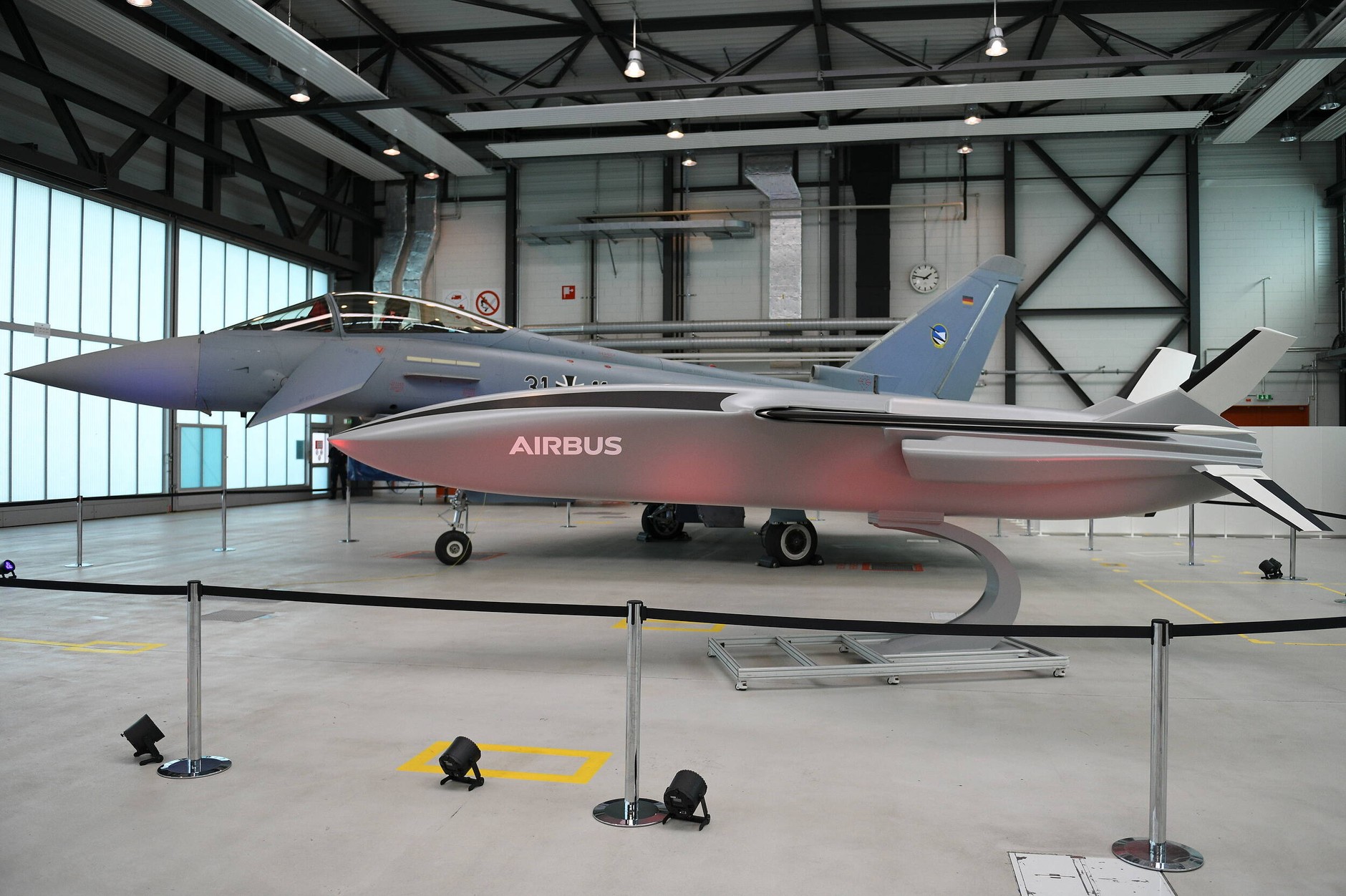
A model of a remotely controlled transport drone and Eurofighter aircraft displayed in the hangar during the visit of German and French representatives of the Ministry of Defense. Manching, September 17, 2020EPA/PHILIPP GUELLAND / PAP
Airbus may also establish cooperation with Swedish Saab, the manufacturer of the Gripen, whose interest in participating in the competitive British-Italian-Japanese project has waned. Despite declarations about limiting the fragmentation of the industry, Europe may end the race with four different sixth-generation fighters.
Two other key European joint projects are doing better. The 2024 European Long-Range Strike Approach (ELSA) initiative focuses on the development of ballistic and cruise missiles. It includes seven partners: France, Germany, Italy, the Netherlands, Poland, Sweden and Great Britain. The European Sky Shield Initiative (ESSI), launched in 2022, is a German procurement program for air defense systems, which has been joined by over 20 countries.
None of these projects is as ambitious as FCAS. ELSA is a loose coalition in which individual programs will be implemented by two or three partners at a time. For example, France, Italy and Great Britain are jointly developing a difficult-to-detect cruise missile, while Germany, in cooperation with Sweden, is developing a more powerful version of the Taurus missile.
ESSI has yet another specificity. It assumes the acquisition of ready-made systems for defined applications: European ones for short and medium-range defense; American Patriots and Israeli Arrows for long-range defense. France did not join the program, arguing that Europe should not rely on American solutionseven if it takes longer to develop your own. However, Ben Schreer believes that combining funds for the purchase of already available systems is more beneficial than complicated joint programs to build new solutions.
Camille Grand from ASD – a European organization associating the aerospace and defense industries – believes that, paradoxically, the rapid increase in defense budgets in some countries reduces the pressure and makes cooperation less likely than in times when there were fewer resources. – You can then consider the advantages of a national strategy against the complexity of cooperation – he notes.
For years, France has adopted the most national model of military procurement in Europe. Soon though Germany can spend twice as much on defense as the French. Germany's reluctance to be a junior partner in FCAS reflects this new financial power. “The question is,” Grand says, “how much cooperation is actually desirable and under what framework?”
I’m Ashley Davis as an editor, I’m committed to upholding the highest standards of integrity and accuracy in every piece we publish. My work is driven by curiosity, a passion for truth, and a belief that journalism plays a crucial role in shaping public discourse. I strive to tell stories that not only inform but also inspire action and conversation.