Canadians feel really betrayed. They say this in conversations: many people in Canada have relatives in the USA, lived in the United States and, if they could afford it, fled to the apartments in Florida or Arizona.
– We will always be neighbors and hopefully friendly, but special relations no longer exist. We have resources in the north that need to be defended against Russia, China, and now probably also against the Americans – says in an interview with Politico Tom Long, a long -term strategist of the Canadian Conservative Party, headed by Pierre Poilievre, one of the two main candidates in the election.
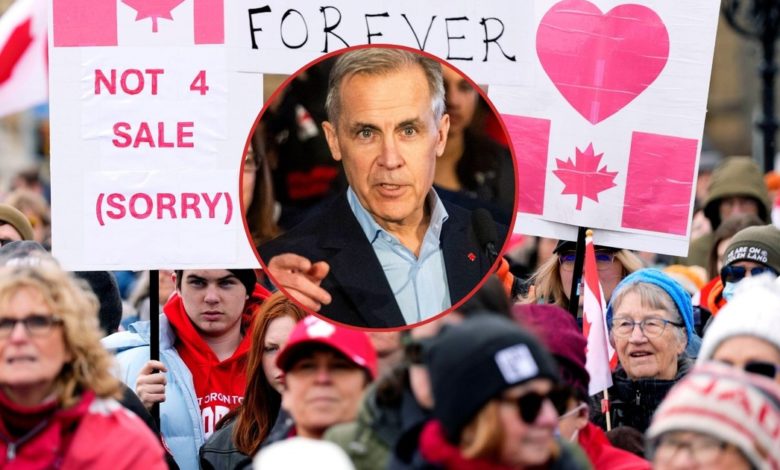
On the day of the election, ubiquitous flags with a maple leaf are waved on cars, trucks and shop windows, sometimes decorated with the inscriptions “Buy Locally” or “Proud Canadian company”. T -shirts with the inscriptions “Never 51” (“Never 51. USA”) and “Not for Sale” (“Not for sale”) also appeared. The current atmosphere has a gigantic impact on the elections.
Both leading candidates accepted slogans referring to Trump – “Canada First” (“Canada primarily”) in the case of Pierre Poilievre and “Canada Strong” (“Canada strong”) in the case of the current Prime Minister Marek Carney.
When Politico asked the prominent liberal member of the parliament if Canada would have to consider a new security agreement – perhaps the conclusion of an alliance with other countries of the Nations (the Commonwealth or Commonwealth of Nations) and the rest of NATO, apart from the United States – did not hesitate.
“One of the big challenges is to determine how global security will function, when the United States will not guarantee a free world,” said Christ Freeland, a former Canadian finance minister, whose resignation contributed to the political fall of former prime minister Justine Trudeau.
Referring to two nuclear powers, Freeland said that the new alliance “begins with France and Great Britain.”
For Canadians, the most painful that the new reality is not a temporary situation. There was a tectonic change.
Canada versus Trump. How Monday elections will go
The duties and insults of the President of the United States have changed alliances around the world, and their echo resounds from Quebec to Alberta and Washington.
In March, shortly after the firm victory of Prime Minister Ontario Douga Ford in the election, the leader of the Conservative Party of Canada Pierre Piilievre reluctantly called the leader of the most populated province of the country to ask for the advice of a conservative rival.
Continuation of the material under the video
– He asked: “What advice can I expect?” I replied that there is one thing that our polls show, namely the fact that we have just won: It's about duties. A few years ago [James] Carville [były strateg w kampanii Billa Clintona] He said, “It's an economy, foolish.” Well, now it's about duties, stupid. This is how it is – says Ford about the phone from Poilievre.
Why, then, did not change his message?
“I can't understand it,” Ford said, pleased that he can stick a pin to his rival a few days before the election to the new government.
Over the past months, it seemed that the dynamics of Monday's federal elections would be predictable. The vote was primarily about this who will handle Donald Trump, his duties arsenal and Canada's annex. But it's not that simple.
Liberals are close to maintaining power, and Prime Minister Mark Carney can even win most of 343 seats in the House of Commons. Poilievre did not adapt to the changed situation and alienated the key leaders and voters.
“Effect of the existential threat from Trump”
It is the last element that may be crucial – and can decide whether the liberals will create a majority or minority government.
Canada has long had strong minority parties that play a key role in both provincial and federal policy, in particular the left -wing new Democratic Party (NDP) and the Quebecki block, which is in favor of Quebec nationalism in the French -language province of Canada.
However, the effect of the existential threat from Trump is the marginalization of these parties. In the face of an unprecedented situation, Canadians unite around two main parties: center -right and centro -leaved. In these elections, it is on these groups that Canadians can allocate the highest percentage of votes than generations.
It is the peak of irony that Canada takes over the American style of policy to repel dangerous Americans. However, this is heard in the statements of people going to conservatives, especially to liberals: just like in the United States, Canadian voters are afraid of wasting their votes for parties that have no chance of winning.
– The reason for weakening the third and fourth party is that voters of these parties throw themselves at the liberals to stop Pierre [Poilievre] – said Dan Multon, a strategist of the Canadian Liberal Party.
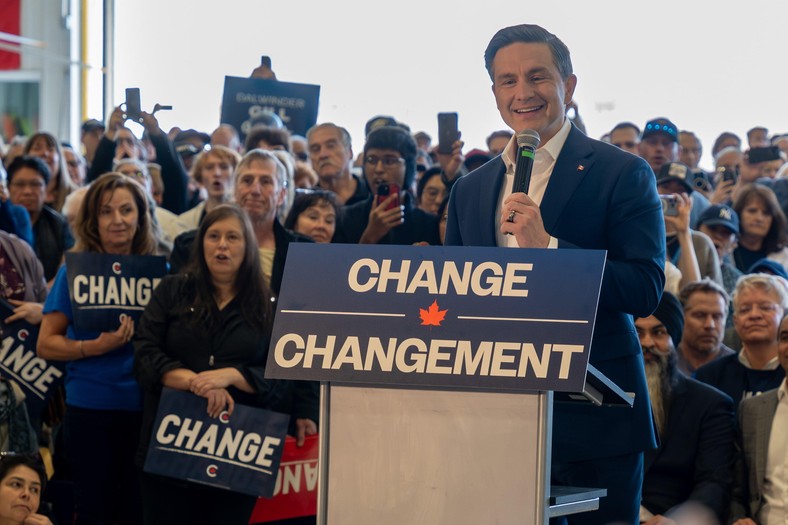
Leader of the Canadian Conservative Party Pierre Pailievre at a rally in Calgary, April 25, 2025.
A dangerous moment
In the last days of the election, the issue of restless, western and conservative provinces of Canada is also coming to the fore.
Few people from the main political current believe that Albert and Saskatchewan are seriously considering leaving the country, but in the east there is a fear of how conservatives will react who can be sentenced to the fourth term of liberals.
Freeland is afraid that Trump will tighten the tone and focus on annexation when he discovers that even a small part of Canada, which has so much energy and other raw materials, which the US president wants so much, has separatist tendencies.
Will it be a dangerous moment? Politico asked Ford about it.
– I think so. We are also a bit concerned here in Ontario, because We have more key minerals than any other region in the world. There is a lot of oil in Alberta. Why don't we use it and start working together? – answered the prime minister of the Canadian province.
Returning to the idea of ”Am-Can Fortress” [amerykańsko-kanadyjskiej]which he presented in Washington at the beginning of this year, Ford recalled the threat before which both countries have.
– China cut off the United States from key minerals, which [Amerykanie] They need for military and aviation production. Who has them? We have them here – he said.
“Double blow” for conservatives
Tom Long, a long -term strategist of the Canadian Conservative Party, said that the leader of the liberal party and the current Prime Minister Marc Carney in the face of the current internal situation must demonstrate as soon as possible to the pursuit of national unity.
Carney could do another gesture towards unity and calm down the Western provinces. His first and most significant gesture could be the abolition of oil and gas emissions limits, which aroused the anger of many Albert's inhabitants.
Carney may not be willing to go so far, but he has already distanced himself from the most polarizing Trudeau proposal, abolishing the tax on carbon dioxide emissions for consumers after taking office in March.
Economics, foolish
A survey conducted among Canadian voters by Politico/Focaldata clearly shows what is most important to them: 60 percent. respondents said that the most burning issue for them are the cost of living.
The challenge for conservatives is that the second most commonly mentioned issue by voters was Trump, and three -quarters of the respondents said that he did not like the American president.
The difficulty for Poilievre is that he stands in the face of a gap between his election base, which does not treat Trump priority, and a wider electorate that boycotts American goods and travels to the United States and almost tattooed maple leaves on the shoulders.
In his speech, the conservative leader barely mentioned Trump, focusing almost exclusively on internal matters.
The only eating allusion he directed at the president was aimed at hitting his liberal rival: “Trump, and Carney with higher taxes,” said the conservative – both of them “want to tax Canadian industry.”
Because some conservatives admire Trump or at least share his contempt for the left, Poilievre has limited possibilities, and it is antagonism around Trump that you can now gain many votes in Canada.
As Evan Solomon, the presenter of the Canadian CBC television, who became the candidate of the Liberal Party in Toronto: “Canada is the first referendum in Trump in democratic countries.”
I’m Ashley Davis as an editor, I’m committed to upholding the highest standards of integrity and accuracy in every piece we publish. My work is driven by curiosity, a passion for truth, and a belief that journalism plays a crucial role in shaping public discourse. I strive to tell stories that not only inform but also inspire action and conversation.