The East Shield is growing before your eyes. This year, as many as 200 km will be added, and allies will join the action

2026-01-26 14:57
publication
2026-01-26 14:57
Last year, as part of the Shield East project, 60 km of the Polish border was secured, of which 10 km were linear fortifications and 50 km – resources prepared for use during the crisis – said the General Staff of the Polish Army. It is planned to secure 200 km of the border by 2026, including 20 km of fortifications.
Shield East is a project implemented by the Ministry of National Defense and the Army to secure the border with Russia and Belarus in order to make the actions of possible attackers as difficult as possible and at the same time provide the best possible operating conditions for defenders.
On the one hand, it concerns the construction of classic fortifications – such as anti-tank barriers – and the construction of warehouses of materials needed to build dams or block roads, on the other hand, it concerns other systems intended to support the region's defense – including reconnaissance and anti-drone systems, stockpiles for the army and investments in the maintenance of various types of natural dams, such as wetlands or dense forests.
60 kilometers are ready. More are already under construction
In a statement provided to PAP, the General Staff of the Polish Army summarized what was achieved under the project in 2025 and what the plans are for this year. As reported, in 2025, “engineering protection of a total of 60 km of the border” was carried out. On the one hand, it involves the construction of linear fortifications on a section of approximately 10 km, and on the other – the preparation of materials collected in 13 warehouses, ready to quickly secure another 50 km of the border in the event of a crisis.
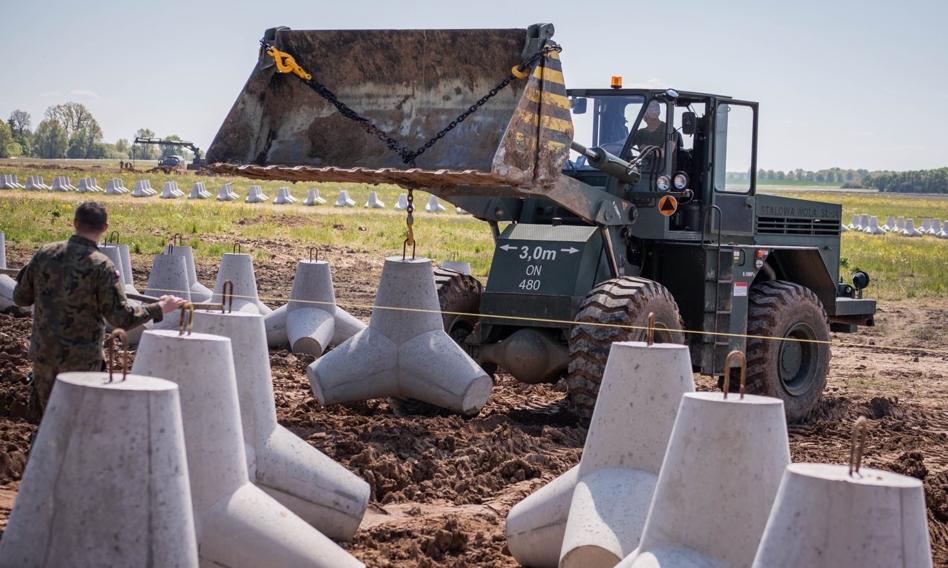
In 2026, the army plans to secure 200 km of the border, including the construction of 20 km of linear fortifications and the preparation of materials in warehouses – including the so-called concrete ones. hedgehogs or barbed wire – to quickly block the next 180 km of the border.
Moreover, as indicated, in 2025, 5 border crossings – road and rail – with Russia and Belarus were blocked, and materials were prepared for the quick blocking of another 12.
The General Staff emphasized that, taking into account what was done last year and what was planned for this year, nearly 260 km of the border is to be secured by engineering by the end of 2026.
This security will cover “almost 30 km of linear development and approximately 230 km secured using engineering assortment collected in 37 material depots” – and this will constitute over 38 percent. length of the border as part of the implementation of the East Shield program.
For the purposes of building fortifications and material depots, the army has so far acquired 38 properties on key sections of the border. “This year, these plans are more than three times larger – it is planned to acquire 150 properties in 52 locations. In 2026, it is also planned to acquire 45 plots from KOWR resources for the expansion of 19 storage sites,” announces the Staff. Some of the material warehouses are also to be created in the area of military units located near the border.
Specialized heavy equipment on the construction site
In the construction of various installations related to the East Shield, the army began using two UBM (Ultimate Building Machine) machines purchased in the USA; As noted in the SGWP announcement, the army asked the Ministry of National Defense for further expansion of engineering units using this technology and the purchase of two more UBMs. Moreover, during the work of the Military University of Technology, a solution was found that allows the construction of layered structures resistant to attacks by smaller drones and mortar shells, the Staff reported.
The construction of the East Shield is also associated with, among others, with the expansion of telecommunications infrastructure, including the construction of seven new base stations (BTS), as well as the purchase of equipment for the army – these are the purchases of San anti-drone systems, as well as Baobab mining vehicles and reconnaissance and attack drones planned for the near future
Costs? Nearly one billion zlotys in 2025
SGWP announced that in 2025, PLN 870 million from the Ministry of National Defense budget was allocated for investments related to the Eastern Shield; in addition, there are EU funds; in the next stages of the project, it is also planned to use – for part of the investment – funds allocated for civil defense and population protection.
The army is also cooperating with, among others, the construction of the East Shield. with the Ministry of Climate and Environment, including to recreate peat bogs, swamps and wetlands – natural dams – in places of key importance for defense. “These activities combine defense and environmental goals, strengthening the state's resilience while respecting nature. Approximately PLN 120 million is planned to be allocated for the implementation of these projects in the coming years,” informs the Staff.
As recalled, the Eastern Shield is an international project – a similar program called the Baltic Defense Line is being implemented jointly by Lithuania, Latvia and Estonia along their borders with Russia and Belarus; projects are also supported, among others: through Finland, Great Britain, Germany and the USA. “From mid-2026, it is planned to involve allied troops in the expansion of engineering infrastructure on Poland's eastern border,” announces SGWP.
Poland's land border with Russia (Königsberg Oblast) and Belarus is 628 kilometers long, and there is also a 22 km long sea border with Russia in the Vistula Spit region. (PAP)
mml/mok/