When will Romania and Bulgaria be united with a highway to Greece. In Ruse, Bulgarians want to take to the streets to protest / How the plans for a quick connection between the two countries look today


Romania is already connected by highway with Hungary, and now it is launching the project to build the “Moldovei” Highway to beyond Siret, in Ukraine. However, there is less talk of a high-speed road connection with Bulgaria, the neighboring state south of the Danube. Sofia authorities plan to bring the highway to Ruse before Romania is ready with comparable infrastructure on its side.
- Article made within the European project PULSE by Victor Cozmei (HotNews.ro), with the contribution of Lilly Granitska (Mediapool.bg – Bulgaria).
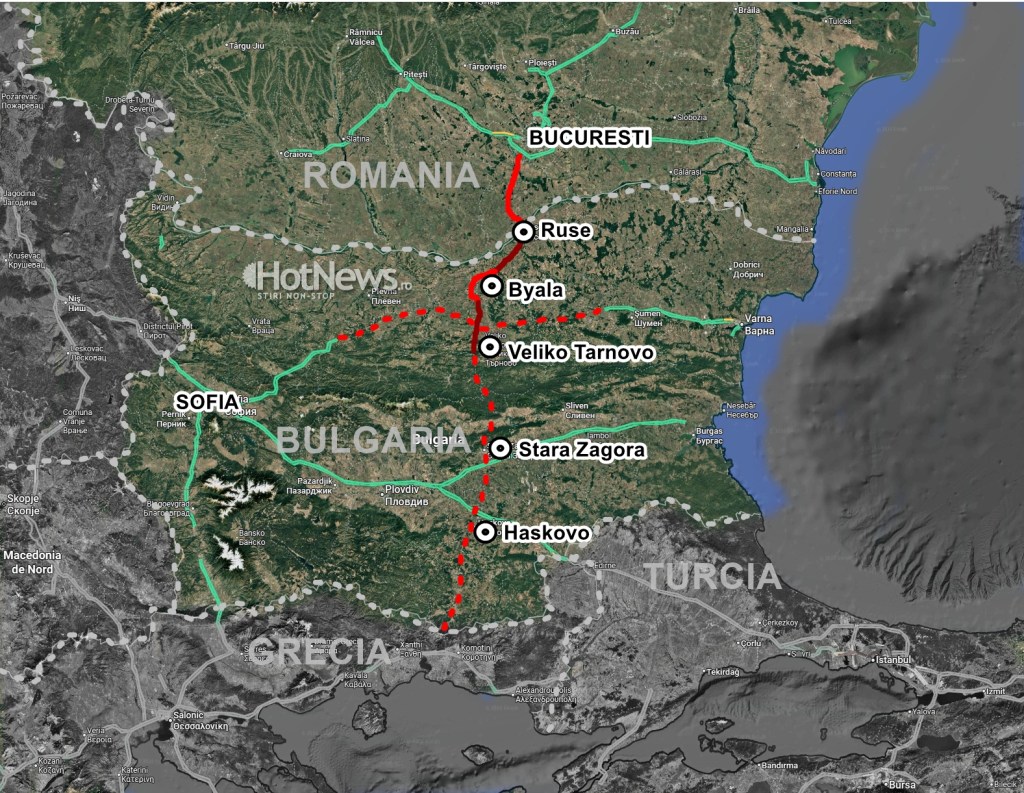
Bulgaria plans to link Ruse to the capital Sofia by highway, but also to extend the current expressway network with a link to the south, starting in Veliko Tarnovo and passing through Stara Zagora, to the border with Greece.
Both routes are important for Romania. Once it would represent a fast connection between the capitals of the two countries, while a highway on the North-South axis in Bulgaria would help not only freight traffic, but also the seasonal traffic of tens of thousands of Romanians who go on vacation in Greece.
For now, Bulgaria's concrete plan provides for a highway from Ruse to Veliko Târnovo over a distance of 133 km, part of the Pan-European Corridor 9.
The first sections, from Ruse to Byala, are contracted, but the works have not yet started. The horizon for the completion of the highway that starts from the border with Romania is 2030, before our country succeeds in bringing a high-speed road to Giurgiu and building a new Bridge over the Danube.
Romania is only now studying a high-speed road connection between Bucharest and Giurgiu
Although Bulgaria has already contracted the first sections of the highway from Ruse, even if the works are delayed to start, Romania has only now begun to study the option of building a new high-speed road connection between Bucharest and Giurgiu, which will connect with the future bridge over the Danube to be built in the Giurgiu-Ruse area.
At the moment, a contract is underway for the elaboration of the Feasibility Study (SF), which will analyze the type of road (highway or expressway), the final route and the technical solutions for execution.
The contract, worth 6.6 million euros, was signed in December 2025 by CNIR (National Road Investment Company) with the consortium formed by Activ Proiectare Infrastructură SRL (leader) and Emay Uluslararasi Muhendislik ve Muşavirlik Anonim Şirketi, and on January 19, the contractor received the order to start the works, with a deadline of 16 months.
Thus, if all goes according to plan, by the summer of 2027 the study could be completed, allowing the tender for design and execution to be launched. Construction is expected to take approximately 24 months, while the design phase could take between 8 and 12 months.
Only in a very optimistic scenario a fast connection between Bucharest and Giurgiu could be inaugurated in 2030. In a more realistic scenario, the opening could take place between 2033 and 2035.
However, the calendar could be accelerated depending on the evolution of the project of the new bridge over the Danube and the speed with which Bulgaria will reach the border with its highway.
Bucharest – Giurgiu highway: where will it pass?
Currently, the estimated length of the project is approximately 85 km, but the designer is tasked with testing various route options to connect to Bucharest and the A0 ring highway.
A variant that will be tested provides for the road to bypass Bucharest entirely through the southwest, making the junction with the future A6 highway towards Alexandria and further with the A1, depending on the preferred transport flows. The Director of CNIR, Gabriel Budescu, argued for HotNews that such a route variant could turn part of the Bucharest-Giurgiu Highway into a real second ring sector of the Capital's ring highway for the southwest area.
The study will calculate design and execution costs based on the preferred route and final length.
An interesting element of the study will focus on construction materials, analyzing whether the use of road concrete, instead of asphalt, would be more economical for Romania (a country that produces concrete but imports bitumen for asphalt).
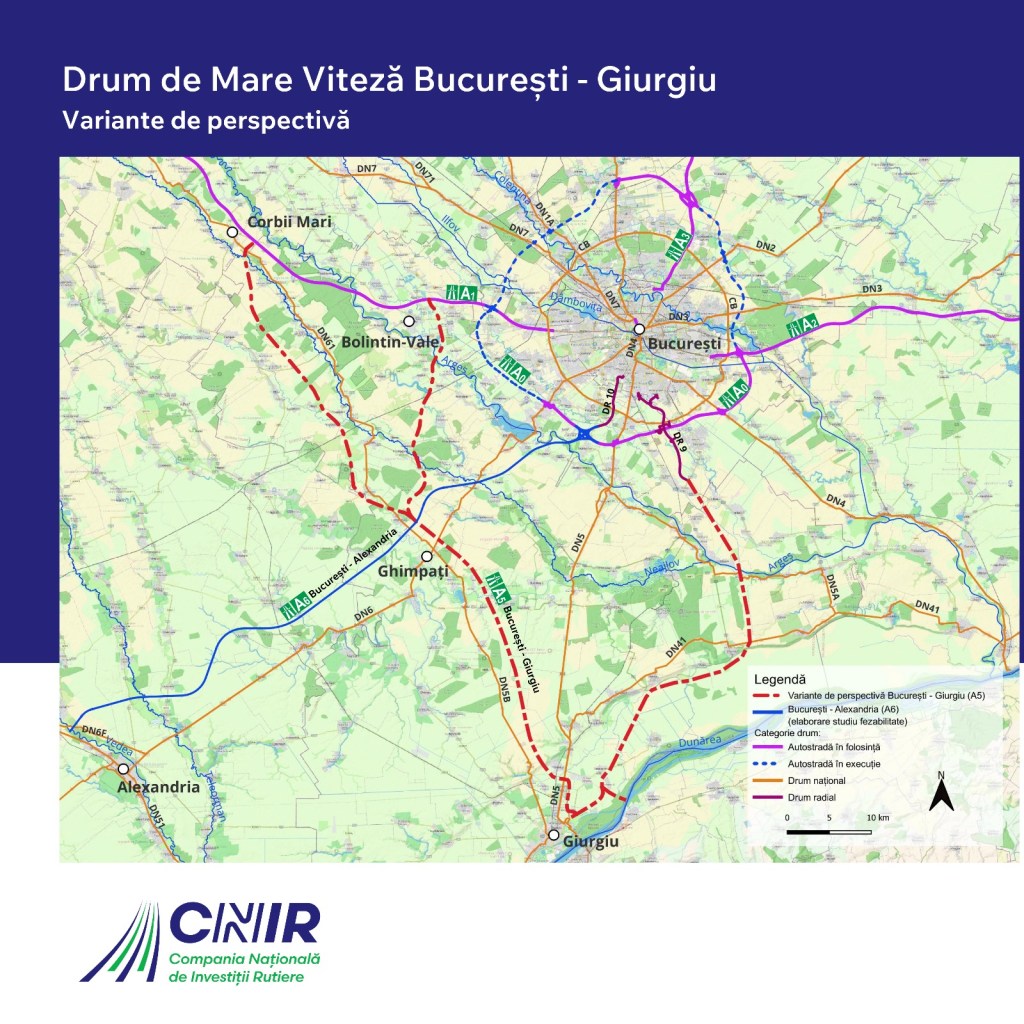
Current situation: The Bucharest – Giurgiu road is modernized, but it passes through all the localities
Currently, the traffic between Bucharest and Giurgiu (from one belt to another) is carried out mainly on DN5. The road is approximately 50 km long, and its journey takes, on average, between 45 minutes and an hour.
Although it is a modernized one and has two lanes in each direction, long separated by parapets, DN5 is hampered by the fact that it crosses many localities. Outside towns, the speed limit is 100 km/h, but in villages it drops to 60-50 km/h or even 30 km/h at certain critical points.
A notable exception is the eastern bypass of Giurgiu (“friendship road”), about 5 km long, opened five years ago to express road standard and built of concrete.
The future bridge over the Danube from Giurgiu is making progress
The Feasibility Study for the second bridge over the Danube in the Giurgiu area is managed by CNAIR (National Road Infrastructure Administration Company) and, although it has been put out to tender since autumn 2024, it has not yet been awarded.
In July last year, 11 offers were submitted, but even today the CNAIR commission has not yet announced a winner. The next deadline is January 30, but this too can be postponed again.
The estimated value of the study is 14.4 million euros, half of which comes from European funds.
Once the contract is signed, the deadline for completing the study is 23 months. Subsequently, a separate tender will be launched for design and construction, which is expected to take between 36 and 48 months.
In an optimistic scenario, the inauguration could take place in 2032-2033. Realistically, without sustained political momentum or adequate funding sources, it is quite possible that the new bridge will not be ready before the end of the next decade.
The highway from Ruse to Veliko Târnovo
Bulgaria has already started building a highway to connect two of the most important cities in the north of the country. The highway from Ruse to Veliko Târnovo will be 133 km long and has been divided into three sections:
- Lot 1: Ruse – Byala – 40.6 km
- Lot 2: Byala Belt – 35.4 km
- Lot 3: Byala – Veliko Târnovo – 57 km
The first two lots have a cumulative cost of around 1 billion euros for the around 76 kilometers, and the money is partially secured from European funds from the 2021-2027 financial cycle.
The first two lots are scheduled to be open to traffic by the end of 2030, the builders have already been selected, but the works are behind schedule, reports Bulgarian journalists from Mediapool.bg, a publication that, together with HotNews, is part of the European Pulse project
The first works started as early as 2030 on Lot 2, which practically represents the bypass for the city of Byala, but the discovery of unstable soils along the route forced the builder to design new technical solutions.
Bulgarians want to protest in Ruse for the highway
The construction of the other section, the 40.6 km from Ruse to Byala, has not yet started, although the authorities have awarded the contract to a builder, but, without giving an explanation, have not yet given the order to start work.
The delay caused the residents of Ruse to form a civic initiative demanding the acceleration of the highway project. Civic initiative threatens to take to the streets and block traffic on the Ruse-Giurgiu bridge. Residents are unhappy with the delays and demand clear government involvement to speed up the project, Mediapool journalists report.
The last section of almost 60 km to Veliko Târnovo has not yet been contracted. The highway project was put out to tender in May 2025, but so far only the technical bids submitted by the builder have been opened, not the financial bids.
Lot 3 is very expensive. The Bulgarians point to Romania
The cost of Lot 3 is quite high and has sparked controversy in Bulgaria. For the approximately 57.2 km of the project, the Sofia authorities estimate a cost of 1.82 billion euros, that is, a cost of almost 32 million euros per kilometer.
This led to opposition politicians accusing the government that a “corruption premium” was included in the price.
The government justified the record price by inflation and the very difficult terrain, full of hills and valleys, Mediapool journalists claim.
In this sense, the Bulgarian authorities often point the finger at Romania as having the most expensive highways in the Balkans.
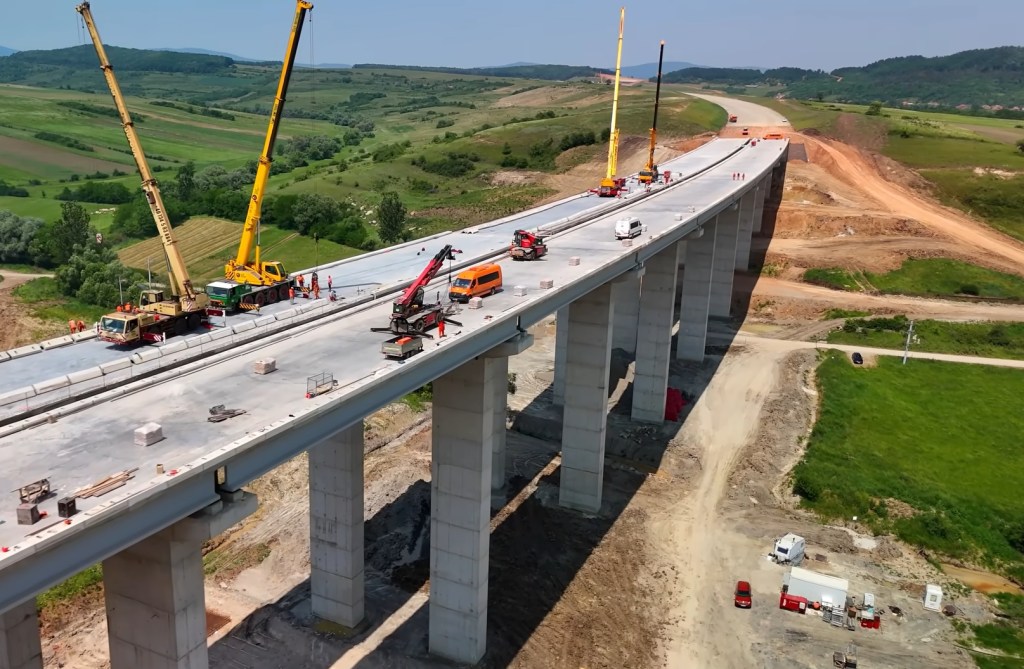 Why did highways end up costing so much? Explanations for very large contracts / Bulgaria points the finger at Romania when it also makes new expensive tenders
Further on the highway from Veliko Tarnovo: In which direction?
From Veliko Târnovo, the highway would connect to the Hemus highway (A2) under construction, which will connect Sofia with Varna.
Construction of the A2 Hemus highway began 52 years ago, in October 1973, under the leadership of communist leader Todor Zhivkov. With an estimated length of about 420 kilometers from east to west, about 200 km of it are still to be completed.
In 2025, a 15 km section of the Hemus highway was opened after seven years of construction (started in 2019), but the rest is in question, including the connection to Veliko Târnovo.
The problem arises on the financing side: the Hemus Highway is financed entirely from the state budget, and the construction is carried out by the so-called “internal” method, whereby the state assigns the construction work to the state company Avtomagistrali, which then subcontracts the work through contracts for the supply of equipment and materials to private companies. This approach bypasses standard public procurement procedures, the Bulgarian journalists write.
The method was introduced by Boyko Borissov's third government with the aim of speeding up construction, with the promise that the highway would be completed by 2024. In practice, it proved ineffective, and corruption investigations were launched following changes of government, and today no political representative in Bulgaria is prepared to provide a timetable for the completion of the remaining 200 km.
As for the North-South connection passing through Veliko Tarnovo, it is part of the main European TEN-T Core road network and part of the pan-European Corridor 9.
If the Ruse–Veliko Tarnovo highway is a firm project and is already taking shape, the continuation to the south remains at plan level for now.
South of Veliko Tarnovo, Bulgaria's plans call for a highway to pass through Stara Zagora and connect, near Haskovo, with the Maritsa highway, which links to Turkey.
Then, further on, an alternative high-speed route through Kardzhali would provide the connection to Greece and the Aegean Sea.

The PULSE project is a European initiative to promote cross-border journalistic partnerships, co-financed by the European Commission (DG CONNECT) within the Multimedia Actions through grant agreement LC-02772862. HotNews.ro collaborates within the project with other prestigious publications from Europe: Delfi (Lithuania), Deník Referendum (Czech Republic), the largest Austrian newspaper Der Standard (Austria), some of the largest publications in Greece – EFSYN, El Confidencial – Spain, the largest Polish newspaper Gazeta Wyborcza, the oldest Bulgarian analytical and information site Mediapool, one of the largest independent Hungarian publications HVG and Italian economic profile newspaper Il Sole 24 Ore, one of the oldest and most powerful publications in the Peninsula.
Three renowned transnational media organizations – OBCT (Italy), N-ost (Germany) and Voxeurop (France) will coordinate the project activities.