What is actually hidden behind Ukraine's new citizenship law. Expert: “Romania has done a lot, but in a way that is not very vocal”

The entry into force, on January 16, of the Law on Multiple Citizenship in Ukraine generated a wave of indignation, given that Romania is not among the five states included in the list approved by the Government in Kiev. According to the Ministry of Foreign Affairs, the law does not target the Romanian community in Ukraine, being especially designed for Ukrainian communities abroad. At the same time, it concerns the foreign military involved in the war on the side of Ukraine. Security expert Marius Ghincea, from ETH Zurich University, and Sergiu Mișcoiu, professor at Babeș-Bolyai University in Cluj and Paris-Est Créteil University, analyze the new law. Meanwhile, the Romanian-language press in Ukraine covered the subject extensively.
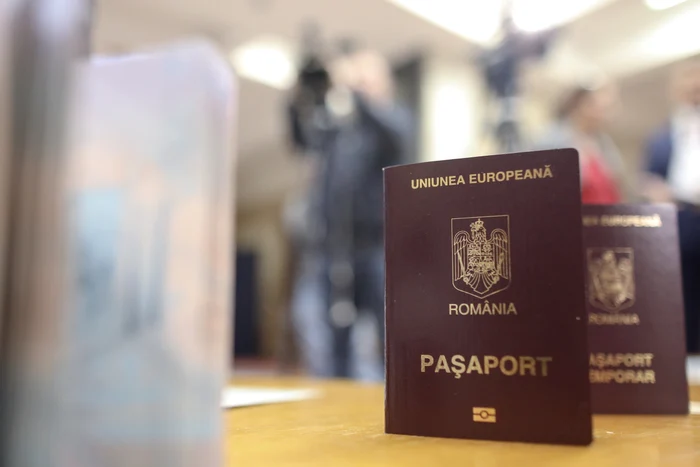
Romanian passport. PHOTO: Inquam Photos / Alexandru Buscă
The new normative act updates the rules regarding the acquisition and loss of Ukrainian citizenship, with the main purpose of simplifying the procedures for certain categories of foreigners. The direct beneficiaries are foreign servicemen fighting for Ukraine and their family members. They can submit a declaration of renunciation of the previous citizenship and recognition as a citizen of Ukraine, without having to wait for the effective termination of foreign citizenship, a process that was previously bureaucratic and time-consuming.
Why are ethnic Romanians not affected?
The confusion that appeared in the public space seems to start from an erroneous interpretation of the law. The new legislation would target third-country nationals who want to become Ukrainians, not Ukrainian citizens by birth who want to obtain another citizenship. Ethnic Romanians in Ukraine are already Ukrainian citizens, and the provisions of the new law have no impact on their legal status.
Currently, like Spain, Ukraine does not recognize multiple citizenship, but this is valid for all states of the world, not only for Romania. According to our information, discussions about the right of the Romanian minority to hold multiple citizenships are the subject of separate negotiations between Romania and Ukraine.
The myth of Romania's discrimination
Thus, the inclusion on that list would have assumed that the Romanian state has the interest that its own citizens become Ukrainian citizens. According to “Adevarul” information, Romania did not request this from the Kiev authorities, unlike other states that have a large number of volunteers at the front or different strategic interests.
Security expert Marius Ghincea is a researcher at ETH University Zurich, Switzerland, and at the European University Institute, Florence. In his opinion, the decision that causes waves in Romania comes to show certain priorities in foreign policy and shows, without any doubt, that in Kiev we are not perceived as one of the important allies.
What the experts say
“Ukraine's decision to allow dual citizenship only for certain allied and EU states signals our priorities in Ukrainian foreign policy. First of all, the decision of the Ukrainians shows us that we are not considered in the group of the most important partners who have helped Ukraine, which is not a surprise, considering Romania's discreet and very restrained position compared to the Czech Republic, for example, which launched, among other things, the initiative regarding the supply of war munitions for Ukraine”says Ghincea.
Even if today Babic's Czech Republic is a Eurosceptic state and refuses to get involved in supporting Ukraine, Kiev has shown itself more benevolent towards Prague than towards Bucharest for the way in which the Czechs have been involved so far.
“The Czechs have provided much more significant military and political support than us, so they benefit from this help and the assumed pro-Ukrainian position. We decided to be more discreet and more restrained, so we do not benefit from the same treatment. It rather depends on the fact that we did not want to get too involved, we did not put anything on the table, so we cannot expect to be offered a status similar to that offered to the Czech Republic or Poland.”points out Ghincea.
What Ukrainians are after
But there is another reason, and it has to do with reminiscences of the old policy promoted by Kiev regarding numerous minorities. And the Romanians, who are the second largest minority in Ukraine, do not always benefit from the best treatment.
“At the same time, Romania has the second largest ethno-linguistic community in Ukraine, and here it is possible that Ukrainians avoided opening the way for such a significant ethno-linguistic group to obtain or recognize the citizenship of a foreign state.” considers Marius Ghincea. Romania must learn this lesson and act accordingly. Consequently, says Marius Ghincea, Romania should continue to support Ukraine and increase the support given to this country, but know how to claim better conditions for the Romanians in this country.
Where is Romania wrong?
“What Romania should do is increase support for the defense struggle of Ukraine and demand in return the continued respect for the cultural and political rights of the Romanian-speaking communities. Including our inclusion in this list of countries with which dual citizenship is allowed”concludes Ghincea.
Decorated by the French state with the medal of Officer of Academic Laures for his academic activity, Sergiu Mișcoiu is a professor at Babeș-Bolyai University in Cluj and at Paris-Est Créteil University. Summarizing, he sees two possible important explanations for the gesture made by Ucaina.
“The explanations are numerous, but I think we can go along two lines. The first line is that, as regards the states with which Ukraine has a direct, neighboring border, the traditional policy is a more prudent one, because the dual citizenship in these states is likely to make pressure from neighboring states influence electoral behavior, petno-territorial claims and so on. So this as a general policy. And only the villages that have made historical compromises, France, Germany, Romania, Hungary, followed this acceptance”, says Miscoiu.
On the other hand, he believes, Kiev's gesture says a lot about the way Romania is perceived. Romanian diplomacy does not have the best image at the international level, and Romanian officials do not know how to impose themselves, nor are they able to follow the country's interests, as diplomats from other countries do.
“On the other hand, Romania again, I think is paying for its position of diplomacy and a position that is not very assertive at the international level”, points Miscoiu.
Regarding the support given by Romania to Ukraine, Professor Mișcoiu sees things a little differently. In his opinion, Romania helped Ukraine enough, but did not know how to ask for anything in return, as other countries did. Last but not least, the lack of transparency and communication of Romanian officials turned against the country. Thus, although Romania was among the states that helped Ukraine a lot, Bucharest adopted the position of the ostrich and refused, unlike other countries, to make public the information about this aid and make it known to the whole world.
We suffer from communication and transparency
“Regarding aid to Ukraine, Romania did many things, but it did them in a way that was too little obvious, too little vocal, that is, we didn't show anything of what we did. We were very shy and timid precisely because we didn't want to stand out and raise the anger of the Russian Federation, we didn't want to assert ourselves in the front line. And this was interpreted as an act of concession to any kind of position that would come from the Ukrainian side. Basically, Ukraine, like any other state, is eager to defend its own interests, and when it comes to states with which it is in a relationship and with which it allows itself to impose itself in a certain form, it does so. We are still the victims of our own timidity, which is now also reflected in the positions we adopt in relation to the Greenland issue, with the option for the Peace Council, with other such international files.”
emphasizes the expert.
What should Romania do? Sergiu Mișcoiu is of the opinion that a different, firmer attitude is needed, including towards allies like Ukraine, but in no case a change in foreign policy.
“We are talking about this shyness that has somehow become a classic of Romania in asserting a position and, in the end, including the help that Romania gives to Ukraine. If Romania considers that it is in its interest that dual citizenship be applied in the case of Ukraine and Romania, then we should be much more assertive and seek to defend our arguments in a much better strategic way”. is the opinion of Sergiu Mișcoiu.
What the Romanian-language press in Ukraine says
The topic was widely covered by the Romanian-language press in Ukraine, which in turn interpreted the new law as an act of discrimination against ethnic Romanians.
“A slap to ROMANIA instead of “THANK YOU!!” – Ukraine does not recognize Romanian citizenship after the entry into force of the law on dual citizenship, even despite the fact that Romania is one of its biggest friends and supporters!! Ukrainians will be able to obtain citizenship of the states whose list is established by the Cabinet of Ministers – the USA, Canada, Germany, Poland and the Czech Republic. Incidentally, the list does not include the following countries: Romania, Hungary, Israel”headlined “Zorile Bucovinei”, a Romanian-language newspaper from Cernauti, about the controversial law.
The article also states that Romania “spends millions of euros to help its neighboring country in the war with the Russian aggressor, shelters Ukrainian refugees, provides both humanitarian aid – products, medicine, equipment, etc., as well as logistics.”
Finally, the journalist sounds the alarm: “If at the state level there is such a “benevolent” attitude towards Romania… what can we, native Romanians, expect – that our constitutional rights to education in the mother tongue be respected, that exceptions be made for ethnic Romanians to be able to keep their HIGH SCHOOLS with the Romanian language of instruction even after 2027?”
“Romania is not included in this list for now”
Libertatea cuvântului, a Romanian-language newspaper from Chernivtsi, published a neutral news item stressing that the situation is temporary:
“Romania is not included in this list for now. Citizens of these countries will be able to obtain the passport of Ukraine through a simplified procedure, and Ukrainians will be able to obtain the passports of these states without losing theirs. The Cabinet of Ministers will be able to modify the list of countries at any time, at its discretion.”
The law establishes that, when forming this list, the Cabinet of Ministers must take into account the fact that these countries are members of the EU, as well as pay attention to whether the respective states supported the sanctions imposed against the Russian Federation. The government is to determine, through a separate provision, which authority will be responsible for the formation of this list, the newspaper also states.
The news agency from Chernivtsi – Bucpress – kept the neutral tone of the news regarding the fact that Romania is not among the top five countries whose citizens will benefit from the new legislation. The news also shows that “Until the outbreak of the war in 2022, Ukrainian citizens of the Chernivtsi region who also held Romanian citizenship were perceived as a threat to the territorial integrity of Ukraine. The subject was frequently addressed by the local nationalist press in Chernivtsi, dual citizenship being presented as a risk factor for national security.”
Prior to this legislative reform, Ukraine applied one of the most restrictive citizenship policies in Europe, prohibiting dual citizenship, the news agency also points out.
The other Romanian-language publications in Ukraine published the news in a neutral tone.