
They want to create a copper giant. The number one mining company in the world may be created


This time it may be possible to create the largest copper producer in the world, and at the same time the most expensive mining company in the world. Rio Tinto, valued at over USD 130 billion, and Glencore, worth over USD 70 billion, returned to merger talks. Their merger is more possible than ever, fueled by the bullish copper market, but the current industry leader, valued at over $160 billion BHP, could be involved.
The copper boom will continue
Rio Tinto is looking to increase its exposure to copper amid favorable market forecasts. Glencore has large copper mines in its assets, including: in Chile and Peru. According to the International Energy Agency (IEA), global demand for copper in 2030 will be over 31 million tonnes, growing by a quarter over a decadein the announced greenhouse gas commitments (APS) scenario. The forecasted growth rate of demand for raw materials is even greater in the net zero emissions (NZE) scenario for 2050.
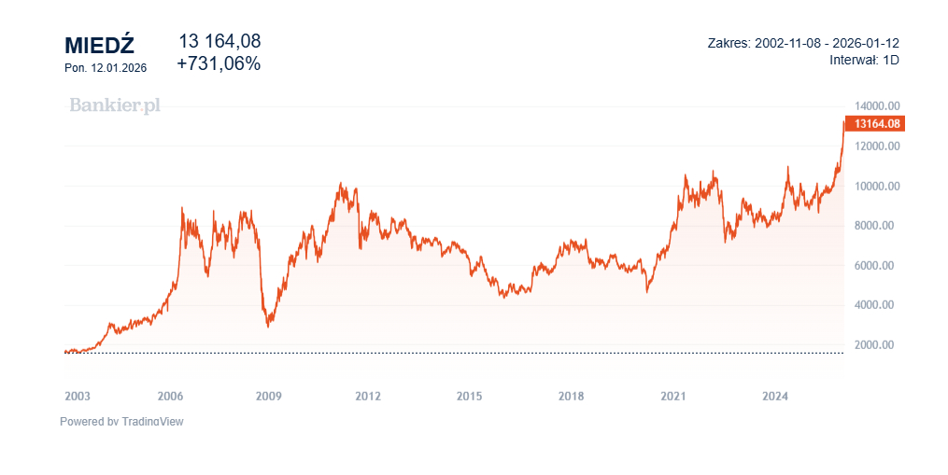
Although a ton of copper now costs a record over $13,000, demand driven by the global energy transformation, the development of electromobility and the demand for data centersshould support the continuation of the upward trend, especially with simultaneous deficits on the supply side. Copper is therefore the main catalyst resumed talks between Rio Tino and Glencore.
Return to Rio's talks with Glencore in new circumstances
Let us recall that a year ago both companies were exploring the possibility of a merger. According to observers the failure of the previous round of negotiations was due to Rio Tinto's reluctance to pay a high premium for the acquisition of Glencore. In addition, Glencore pressed for its CEO, Garry Nagle, to lead the merged company, which was agreed to by the larger Rio Tinto and its then-boss, Jakob Stausholm.
But Rio Tinto changed its CEO in the summer of 2025 mainly due to growing strategic tensions between the supervisory board and Jakob Stausholm, regarding, among others, approach to costs and large acquisitions. The council was more open to large acquisition transactions. Stausholm preferred a more cautious approach. On August 25, 2025, Simon Trott took over as CEOpreviously head of Rio Tinto's key iron ore segment.
Moreover, analysts pointed out the following obstacles to bringing the earlier talks to a conclusion: Glencore's large involvement in thermal coalwhich Rio Tinto has withdrawn from in recent years. However, this also changed when Donald Trump said a resounding “NO” to subordinating the economy to climate requirements when he took office as US president for the second time.
Investors quickly sensed where the wind was blowing now.
BlackRock, the world's largest asset management company, has decided to withdraw from the Net-Zero Asset Managers initiative – an organization of investment companies that have committed to allocating funds in line with climate goals. Large American banks also withdrew from the initiativeincluding Bank of America, Morgan Stanley, Citigroup, JP Morgan and Goldman Sachs. Others went even further, such as Wells Fargo completely abandoning its goal of achieving net zero emissions in all portfolios it finances by 2050.
Changing investor attitudes towards coal mining means that Rio Tinto could buy Glencore in its entirety without the need for a complicated separation of the coal segment for fear of market reaction. Bloomberg even reported that Rio Tinto is open to retaining Glencore's coal inventory.
Rio Tinto's deal with Glencore is closer than ever
According to people familiar with the matter, cited by industry mining.com, the return to talks about the merger of Rio Tinto with Glencore makes the deal closer than ever. “The current round of talks about creating the world's largest mining company is the most serious in history, although it is still at an early stage,” we read on the mininig website. com
|
The largest listed mining companies in terms of market capitalization (in USD billion) |
|||
|---|---|---|---|
| Ranking | Name | Capitalization | Country |
| 1 | BHP Group | $162,005 | Australia |
| 2 | Southern Copper | $143,764 | United States |
| 3 | Zijin Mining | $142,092 | China |
| 4 | RioTinto | $134,560 | United Kingdom |
| 5 | Newmont | $123,696 | United States |
| 6 | China Shenhua Energy | $119,282 | China |
| 7 | Agnico Eagle Mines | $98,451 | Canada |
| 8 | Barrick Gold | $84,534 | Canada |
| 9 | Freeport-McMoRan | $83,657 | United States |
| 10 | Grupo Mexico | $81,898 | Mexico |
| 11 | Glencore | $73,862 | Switzerland |
| 12 | Ma'aden | $69,856 | Saudi Arabia |
| 13 | CMOC | $69,720 | China |
| 14 | Vale | $59,899 | Brazil |
| 15 | Wheaton Precious Metals | $58,764 | Canada |
| Data: companiesmarketcap.com | |||
The interested parties themselves confirmed that talks for this purpose are being held last Thursday, January 8. The two mining giants informed investors that they are in preliminary talks on “a possible merger of some or all of its businesses, which could include a stock merger between Rio Tinto and Glencore.”
The transaction may therefore involve the combination of “part or all” of the assets of both groups, including a full share-for-share merger. It was also emphasized that there is no certainty whether the offer will be submitted or under what conditions, if it is submitted. Under British takeover rules, Rio Tinto has until February 5 to make a formal offer takeover of Glencore or withdraw from the talks.
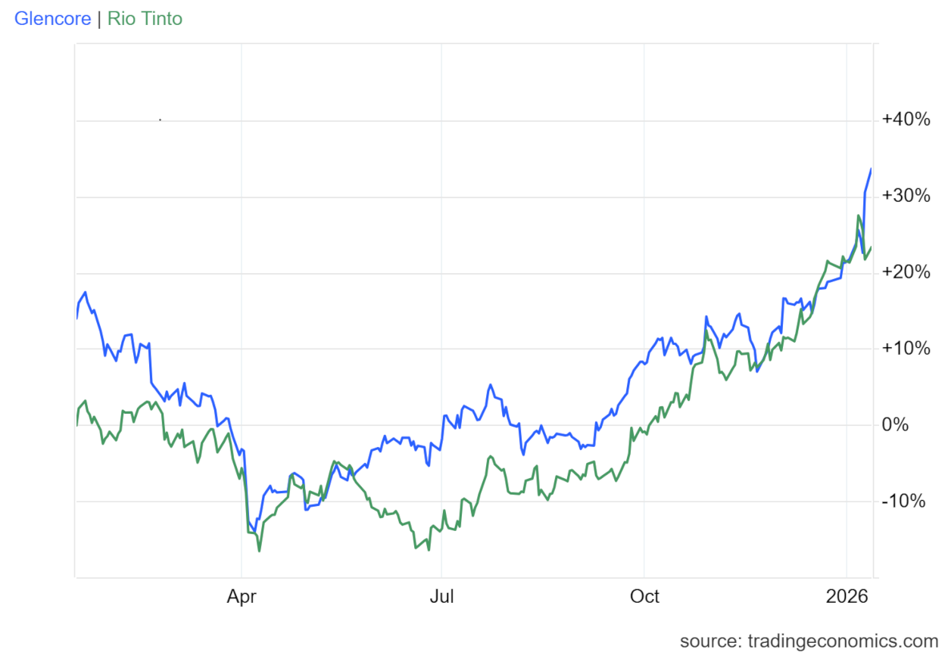
After this announcement, the share price of Glencore gained 9.6% on the London Stock Exchange. In turn, Rio Tinto shares fell by 3%. Over the last year, investors have increased the prices of both companies almost to the same extent. Glencore has increased in price by 29 percent, while Rio Tinto is worth 26 percent more. However, this is a general trend visible in the mining industry recently.
New wave and mining clean-up
Analysts note a growing wave of consolidation in the mining industry. In September last year, Anglo American announced the acquisition of Teck Resources from Canada, valued at USD 53 billion. The merger will create the fifth largest copper producer in the world. In 2023, the same Teck Resources was targeted by Glencore in a proposed transaction worth USD 23 billion, but the transaction did not take place. In turn, the ultimately rejected offer to take over Anglo American in 2024 was submitted by the world's largest mining company, BHP. However, in 2024, Rio Tinto was successfully acquired for USD 7 billion. Arcadium Lithium.
Interestingly, Rio Tinto's merger with Glencore has not only been the topic of the last two years. The idea first appeared before the global financial crisis in 2008. It then returned in 2014 when Rio Tinto rejected Glencore's proposal. He returned again in late 2024.
Both companies are diversified mining conglomerates, engaged in mining on various scales, including: ores, iron or copper, but also coal, gold, diamonds and oil. As mentioned, the particular area of interest on which the talks are held is the copper market. Potential
The merger of Rio Tinto with Glencore would create the world's softest mining company with a value exceeding USD 200 billion and the largest copper producer in the world.
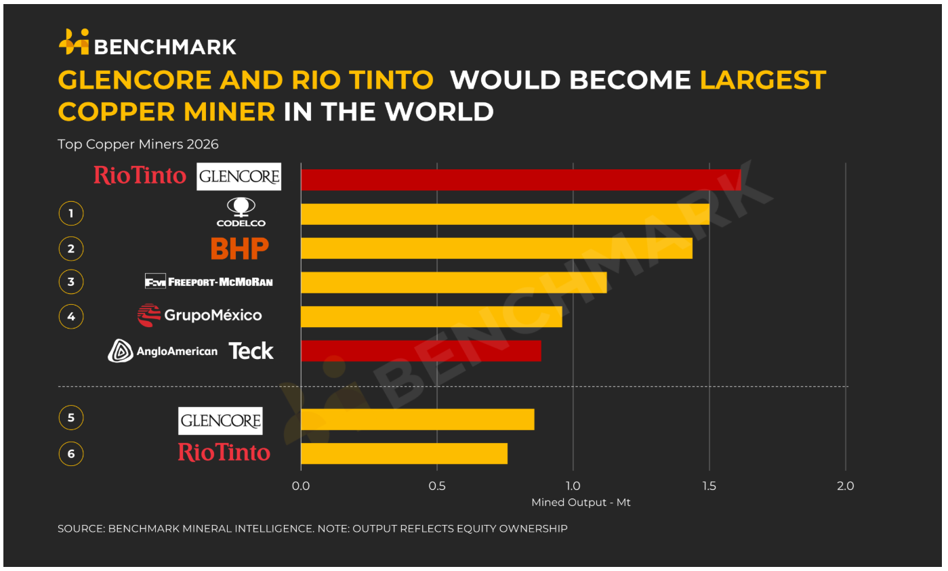
Rio Tinto needs more exposure to copper. Although the company is a significant player in commodity markets, iron ore still accounted for more than half of its profits at the last report, and investors believe iron faces long-term price pressure. Purchasing copper assets would be better than waiting years for the construction of new mines.
Interestingly, however, ithe merger initiative was to come from Glencore. Its president, Gary Nagle, has been proclaiming that for a long time the mining sector needs consolidationand he was to name the merger with Rio Tinto “the most obvious transaction in the mining industry”. Moreover, Bloomberg reported last September that Glencore was continuing to work behind the scenes with its bankers on the outline of a potential deal.
So, taking into account the expectations of both parties and the fact that Rio Tinto and Glencore have signaled that they are more willing to compromise than a year ago, the huge transaction actually has a good chance of success. “Both sides seem to want an agreement.” said George Cheveley, portfolio manager at Ninety One, which holds Glencore shares. On the other hand, BMO analysts say the companies have little in commonapart from the appetite for growth in the copper market, and there is little synergy beyond marketing and corporate functions.
Analysts are drawing up various scenarios
However the world's number one mining company will be involved in everything, i.e. the BHP concern valued at approximately USD 160 billion, according to the opinions of analysts and experts obtained by Reuters. “Fundamentally, given that the deal is copper-driven, we think BHP could consider acquiring Glencore in a competitive bid, keep the copper and possibly get rid of the rest,” said Richard Hatch, an analyst at Berenberg, quoted by the agency.
Other analysts say that Occupational Health and Safety may decide it is better to do nothing. “BHP has a clearer growth profile in the copper segment than the combined Rio/Glencore company, so I don't think they need to do anything,” commented Kaan Peker, an analyst at RBC. Reuters reports that if BHP does not submit a counteroffer, it may consider another transaction to maintain its leadership position. “This is the most likely result of BHP's approach to Glencore's diversified assets,” the agency cites its source.
If Rio Tinto and Glencore attempt a merger, both companies will also have to take into account the control of regulators, and in many jurisdictions. Rio Tinto is a British-Australian concern, while Glencore is a Swiss-British concern. Given the global importance of their business, any deal is likely to be reviewed by competition authorities in Australia, the UK, the European Union and other key markets. Let us add that in 2008, BHP itself attempted to take over Rio Tinto, but the collapse in the raw material markets and the attitude of regulators ended the matter.


