The EU states approved the trade agreement with the Mercosur bloc on Friday, despite intense opposition / What the Romanian Minister of Agriculture said before the vote


The decision, which gives the green light to the signing of the largest free trade agreement ever concluded by the EU, needed the approval of 15 countries representing 65% of the bloc's total population. The EU capitals are now expected to give written confirmation later on Friday or Monday, Reuters and AFP write.
The ambassadors of the EU states took the preliminary decision on Friday to approve a free trade agreement with the South American bloc Mercosur, according to three diplomats quoted by Reuters.
European Union capitals have until 17:00 Brussels time to confirm their votes in writing, diplomats said.
It is the largest free trade deal ever concluded by the EU bloc, more than 25 years after negotiations began and after months of wrangling to win the support of key member states.
The European Commission, which ended the negotiations a year ago, and countries such as Germany and Spain say it is a vital element of the EU's efforts to open new markets to offset trade losses caused by US tariffs and reduce dependence on China by securing access to essential minerals.
But opponents, led by France, the European Union's biggest agricultural producer, said the deal would increase imports of cheap food products including beef, poultry and sugar, undermining domestic agricultural producers.
The Romanian Minister of Agriculture also expressed a reluctant position on several occasions, saying, even on Friday, that he asked Brussels for additional guarantees for Romanian farmers.
What's next
The decision needed the approval of 15 countries representing 65% of the bloc's total population. EU capitals are now expected to give written confirmation later on Friday or Monday.
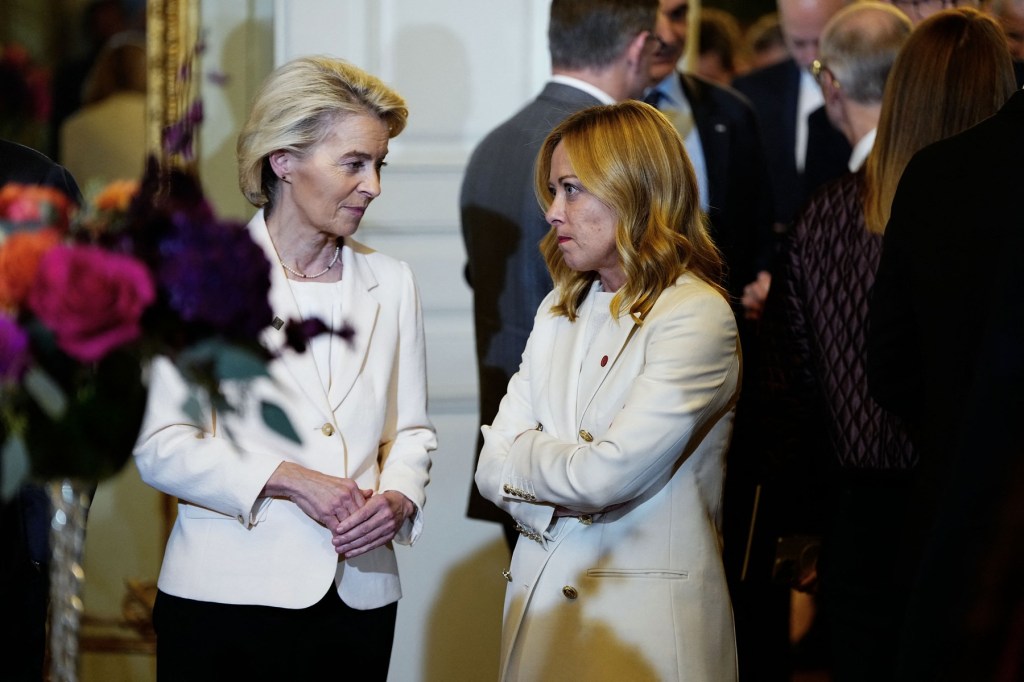 A carefully staged political scene and a bet of 45 billion euros, for the crucial vote. But it is not yet known whether the plane to the Mercosur countries will take off
This will pave the way for Commission President Ursula von der Leyen to sign the deal with Mercosur partners – Argentina, Brazil, Paraguay and Uruguay.
The European Parliament will also need to approve the deal before it can come into force.
Intense negotiations
The free trade deal would be the European Union's most significant tariff reduction deal, eliminating 4 billion euros worth of taxes on its exports.
Mercosur countries have high taxes – 35% for car parts, 28% for dairy products and 27% for wines, for example.
The EU and Mercosur hope to expand trade in goods equally to 111 billion euros in 2024.
EU exports are dominated by machinery, chemicals and transport equipment, while those of Mercosur focus on agricultural products, minerals, pulp and paper.
To convince skeptics, the European Commission has put in place safeguards that can suspend imports of sensitive agricultural products.
The Commission has also strengthened import controls, particularly on pesticide residues, set up a crisis fund, stepped up support for farmers and pledged to reduce import duties on fertilisers.
The concessions weren't enough to win over Poland or France, but Italy appears to have gone from a “no” in December to a “yes” on Friday.
The French Minister of Agriculture, Annie Genevard, said on Thursday that the fight is not over and pledged to fight for the rejection of the agreement.
Farmers launched protests across the EU, blocking French roads on Thursday. The government in Paris also faces two no-confidence motions from opposition parties.
What the Romanian Minister of Agriculture says
The Minister of Agriculture and Rural Development, Florin-Ionuț Barbu, announced on Friday that he requested, in Brussels, additional guarantees for Romanian farmers and the maintenance of a fair common agricultural policy.
He said that he did not sign the Memorandum submitted by the Ministry of Economy regarding the EU-Mercosur Agreement.
“We asked Brussels for additional guarantees for our farmers and the maintenance of a fair common agricultural policy, which would offer real support to Romanian farms and villages! I am with the Romanian farmers and I did not sign the Memorandum submitted by the Ministry of Economy regarding the EU-Mercosur Agreement,” wrote Barbu.
The Minister of Agriculture participated on Wednesday and Thursday at the Meeting of Ministers of Agriculture in the European Union, a meeting dedicated to political discussions regarding the future of the Common Agricultural Policy and the EU-Mercosur Agreement.
According to a statement from MADR, the discussions were attended by Christophe Hansen, the European Commissioner for Agriculture and Food, Maros Sefcovic, the European Commissioner for Trade and Economic Security, and Oliver Varhelyi, the European Commissioner for Health and Animal Welfare.
“We have also conveyed to the European commissioners that it is mandatory for this Agreement to guarantee that imports from third countries comply with standards equivalent to those applicable to farmers in the EU, including in the field of food safety, environmental protection, pesticide use or animal welfare. It is our duty to ensure that the products entering the European market comply with phytosanitary and sanitary-veterinary standards, by testing them in the laboratories of each member state”, the minister also wrote on Facebook.
Also, the Romanian official also requested that the EU-Mercosur Agreement provide for the possibility of being suspended in the situation in which the volume of imports under preferential conditions is found to be 5% higher than the average of the last three years or in the situation where there is an increase in prices by more than 5% compared to the average of the last three years. In this sense, each member state must have the possibility to license economic operators that carry out import-export operations of agri-food products.