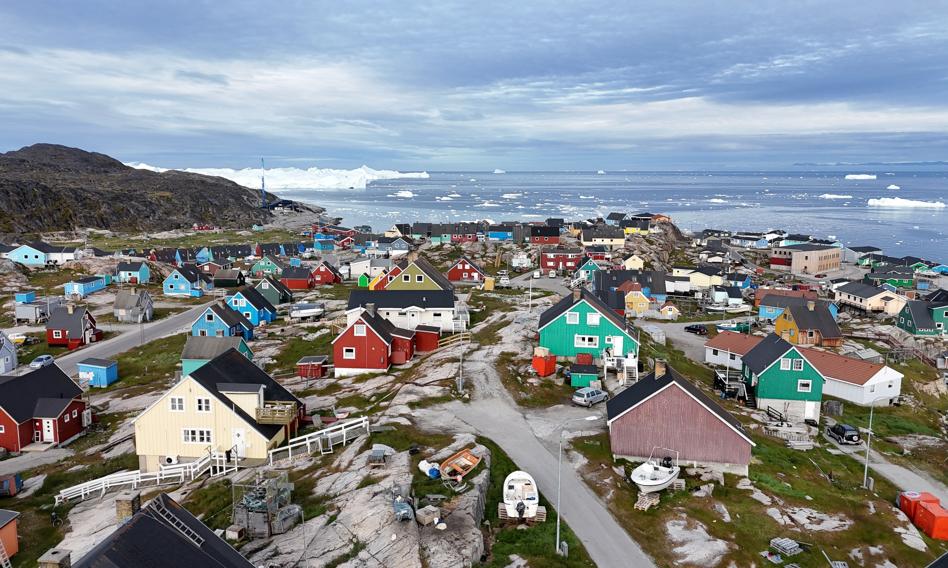
It should be seriously taken into account that Donald Trump intends to take control of Greenland. The administration is exploring ways to deepen the rift between Denmark and its autonomous territory or to conclude a direct agreement with the island, says the Economist.
“As usual, in the case of Trump, it is difficult to assess how serious his intentions are (…) but his interest (in Greenland) should be treated seriously,” emphasizes the British weekly, although it emphasizes that “open annexation” of the island is unlikely.
However, the Trump administration is considering two options for taking control of Greenland: the first would be to strengthen the independence movement on the island and stoke resentment towards Denmark; the second – by offering the Greenlandic authorities an agreement while completely bypassing the Danish government.
The Economist reminds that attempts to deepen the rift between Denmark and the island were repeated throughout last year, and US Vice President JD Vance announced during his March visit to Greenland that the Danish authorities had failed the Greenlanders and that America would now engage in “talks with the people of Greenland.”
In December, Trump appointed Republican Louisiana Gov. Jeff Landry, a completely uninformed foreign policy figure, as the White House's special envoy for Greenland, which was seen to some extent as a signal that the U.S. intended to treat the island as an entirely separate entity from Denmark.
CIA and NSA were to intensify intelligence operations against Greenland
The CIA and the National Security Agency (NSA) were to step up intelligence operations regarding the Greenlandic independence movement and were tasked with identifying islanders “sympathetic to America.” The Danish government has summoned American diplomats three times to provide explanations regarding reports of US espionage activities on the island and “secret influence operations,” the weekly reports.
At the same time, there are increasing reports of plans to propose to Greenland the COFA (Compact of Free Association) agreement, usually signed by the US with small countries in the Pacific. According to the Economist, representatives of the Trump administration have tried to establish direct contact with the island's authorities on this matter, but so far their efforts have been rejected.
Either way – the weekly assesses – Trump's repeated declarations regarding Greenland are further proof of his “heartfelt hatred towards Europe”, which is a derivative of the “surreal aspects” of the US-European dispute, such as the opinion expressed by the head of German diplomacy, Johann Wadephul, that the annexation of Greenland would mean the activation of Article 5 of the North Atlantic Treaty, this time as part of the defense of a European dependent territory against the US.
In early April, the Washington Post reported that the White House was estimating the costs the United States would incur in managing Greenland if it came under American control.
Reuters wrote in May that the White House was exploring the possibility of drawing Greenland into Washington's sphere of influence by offering it a Free Association Agreement with America (COFA), which connects the US with the Marshall Islands, Micronesia and Palau.
Generally, under such an agreement, America guarantees its partner a certain set of benefits – from postal management, through guarantees of assistance in emergency situations, to military protection. In return, the US has full freedom of action in the partner country, and mutual trade is duty-free.
When asked about this many times, Trump did not rule out the possibility of taking over Greenland by force. The president claims that the United States needs control of the island for international security reasons; is also interested in the rich deposits of valuable raw materials, including rare earth metals, located on the island.
Former Swedish Prime Minister: The US will probably use “raw force” against Denmark
The US will probably use “raw force” against Denmark in the next six months, former Swedish Prime Minister and foreign minister Carl Bildt said on Tuesday in a post on the X platform.
Bildt commented in this way on the questioning of Denmark's sovereignty over Greenland by US Presidential Advisor Stephen Miller in an interview for CNN. When asked whether the United States ruled out taking control of the island by force, Miller replied: “We live in (…) a real world ruled by force.”
The former Swedish prime minister, in his analysis for the European Council on Foreign Relations (ECFR) think tank, also published on Tuesday, noted that Europe must be prepared and “load its guns” for a confrontation with the US over Greenland.
Bildt believes that American President Donald Trump is obsessed with the Western Hemisphere and is “in war mode after his initial success in Venezuela.” “Trump seems to believe that Russian and Chinese ships are surrounding Greenland, in fact nothing like this is happening. (…) There is no doubt that Greenland is geographically in the Western Hemisphere: but it is also clear that it is part of Denmark and has been so for longer than California has been in the United States,” wrote the former Swedish politician. He added that the people of Greenland are EU citizens.
According to Bildt, although Venezuelan President Maduro had no democratic legitimacy and could probably be considered a bandit, none of these statements mean that Venezuela is not a sovereign state. “The claim that the United States was the object of aggression by Venezuelan criminals and acted in accordance with the right to self-defense is simply incorrect,” he said.
Bildt is critical of the US use of violence to solve international affairs. “Kinetic (forceful) actions are now becoming almost as popular a tool for Trump as his beloved tariffs. There will probably be more of them,” he concluded.
Experts: The US takeover of Greenland threatens a NATO crisis
The head of the Norwegian Atlantic Committee, Kate Hansen Bundt, stated that the possible takeover of Greenland by the US would change the role of the Americans in the Alliance and undermine the faith of the remaining members of the pact in its defensive nature. Europe would have to prepare for a new type of defense against Russia, she emphasized.
– It could be a developed formula of a “coalition of the willing”, i.e. countries that unanimously recognize the Kremlin as the main threat – said Bundt in an interview with PAP.
Researcher Marianne Riddervold from the Norwegian Institute of International Relations NUPI pointed out that the mere threat of using force or limiting American security guarantees could be enough to paralyze the European response.
– If the US were stubborn about taking over Greenland and were ready to use further military pressure, Europe has no real means to oppose it – Riddervold noted in a comment for PAP.
The expert emphasized that US actions against Greenland would not have to be a classic invasion. The White House can use political pressure, influence campaigns and influence on public sentiment and electoral processes on the island itself, gradually increasing civilian control over the territory where it already has its military bases.
Mujtaba Rahman from the Eurasia Group think tank, quoted in Tuesday's edition of the “Aftenposten” daily, stated that Donald Trump's implementation of his announcement of taking over the Danish island may dramatically divide both NATO and the European Union.
– It would be a much greater threat to European security than a Russian invasion of Ukraine – he said in an interview with a Norwegian newspaper.
On Monday evening, Norwegian Foreign Minister Espen Barth Eide, referring to Trump's announcement to take over Greenland, warned that this would mean breaking the very idea of NATO and it would be difficult to imagine the continued functioning of the Alliance. In this way, he supported Danish Prime Minister Mette Frederiksen, who assessed that an attack by one NATO country against another would stop the security system built in Europe since the end of World War II.
Daniel Zyśk from Stockholm, Mieszko Czarnecki from Oslo (PAP)
cmm/ adj/ żys/ sp/ fit/