“We are fascists to the core.” The memoirs of the Russian activist Maria Aliohina, member of Pussy Riot, an x-ray of contemporary Russia


In December 2013, after serving time for “hooliganism motivated by religious hatred,” Russian political activist Maria Aliohina noted that she and her fellow punk band Pussy Riot “ended up in another country.” Externally, Russia wanted to project the image of a serious global power, from the Winter Olympics in Sochi to the Kremlin's public appearances. The reality, however, was quite different: just a few months later, Russia was starting war against Ukraine, annexing the Crimean Peninsula and unleashing bloody fighting in Donetsk and Luhansk.
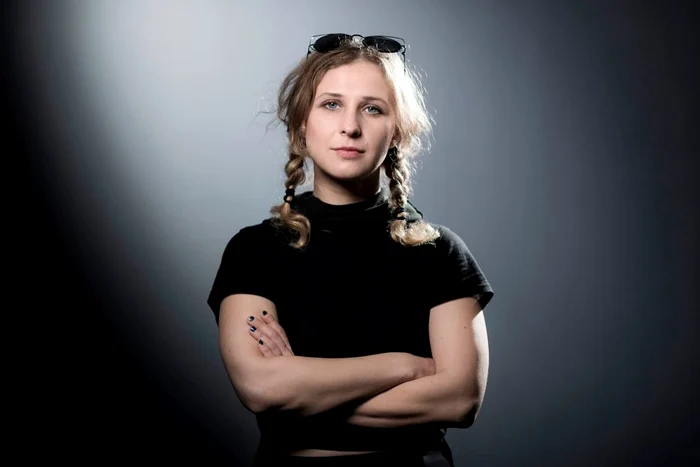
Russian political activist Maria Aliohina/PHOTO:X
As Russian soldiers committed violence abroad, Russian society plunged deeper and deeper into internal darkness: “The authorities are giving the green light for creating violence in their own country. The number of neo-Nazi groups is increasing. Gopniks with St. George ribbons, self-proclaimed patriots, attack and beat anyone who does not fit into the new patriotism,” Aliohina notes.
Her book, Political Girl: Life and Fate in Russia, covers the period from her release from prison to her escape from Russia in the spring of 2022, overlapping some of the darkest moments in the country's recent history: the assassination of opposition leader Boris Nemtsov, the downing of Malaysia Airlines Flight 17 over eastern Ukraine and the poisoning of Aleksey Navalny. These episodes are not dramatic climaxes, but recurring markers of a society sliding into repression.
The book avoids artificial dramatic effects. Read in sequence, the accumulation of events reveals not only the political violence in contemporary Russia, but also how the exceptional becomes the everyday—and the catastrophe, repeated enough times, loses its ability to shock.
Russian society remains complicit in the horrors that followed
Unlike many works of Russian exiles, often polemical or fragmented, Aliohina impresses with the clarity of judgment. It does not avoid the issue of the collective guilt of Russian society for the war. He insists on two uncomfortable truths: he did everything he could to change the country, despite the personal cost, and that Russian society remains complicit in the horrors that followed. The book's moral force lies precisely in its refusal to turn individual resistance into collective exoneration.
“I'm afraid to say out loud the most important thing — a verdict,” Aliohina writes about the Bucea massacre. “It's a verdict on everyone. I'm not sure Russia has a right to exist after that.”
The horror of Russian war crimes in Ukraine is accentuated by the rapid acceptance of the conflict by a section of Russian society, with many justifying Vladimir Putin's actions. War is not only a weapon of external aggression, but also an internal tool for strengthening loyalty and suppressing dissent. Alyokhina bluntly denounces: “Numbing. We are fascists to the core.”
A significant part of the book is dedicated to documenting Russia's crimes in Ukraine, but also other injustices, such as the persecution of the Crimean Tatars or the repression supported by the Kremlin in Belarus. Alyokhina describes in detail the actions of Pussy Riot, both in Russia and abroad, for the release of political prisoners, among them the Ukrainian director Oleh Sentsov.
A central message of the book is: criticism of one's own state can be the deepest form of love for it. While Russophile authorities label dissidents as “traitors,” Maria Aliohina's actions show that the hope of a more just society depends on confronting authoritarian structures that block reforms.
“Nothing changed. I was behind bars, I got out and nothing changed”
The book also captures the moral cost of dissent, especially in a context of full-scale war, when expressing a critical opinion becomes dangerous at an unprecedented level. Under such conditions, imprisonment appears as “the only honest thing” to do. The sacrifices, however, often don't change much: “Nothing changed. I stayed behind bars, I got out, and nothing changed.”
Repeated meetings with Center E, the government's counter-extremism agency, reveal the workings of an authoritarian machine in Russia. “Extremism” actually means freedom of speech, assembly and independent thought.
The attempts to cross the border in the spring of 2022, after house arrest, are Kafkaesque: the tension rises with each attempt, and the reader is left in suspense, uncertain whether Alyohina will manage to escape the Russian prison system.
Political Girl is not just a memoir. It is a scathing condemnation of the moral and political corruption that permeates contemporary Russia, showing both the guilt of those in power and those who choose to turn a blind eye. Alyokhina clearly shows how deeply entrenched authoritarianism is and what a huge cost resistance entails. The book remains, at the same time, the testimony of personal courage and collective failure, a call to awareness of the reality that many choose to ignore.