How to help your child not become the perfect victim for bullying at school. “It's the shock effect. It's not expected”


Bullying is a reality that schools no longer try to hide, but look for solutions to reduce the phenomenon. A school counselor has warned parents that their desire to protect their children can make them perfect targets. He also had advice for teachers.
What do you do when you find out that your son or daughter is the target of bullying? It is the question that several parents were challenged to answer, during a meeting on bullying and addictions in teenagers.
School counselor Aurora Szocs put parents in front of the scenario that happens in schools today much more often than the system was, until recently, prepared to recognize.
Aggressive behavior, manifested intentionally and repeatedly, constitutes bullying, random incidents do not fall into this category. Bullying can be of many kinds, from verbal bullying – when the aggressors address insults or nickname their victims and physical bullying – the victim is pushed or even hit, and up to relational bullying – the victim is excluded from the group or rumors are spread about him and, more and more common, cyberbullying – online harassment.
Psychologist Aurora Szocs, school counselor at the “Radu Greceanu” National College in Slatina, drew the attention of parents that care to protect their children must first of all be manifested by raising and educating them so that they do not become vulnerable. Because bullying is actually a power game between the bully and the victim, and children who feel powerless become the perfect victims.
“The child comes home and tells us – mom, for some time there are some of my colleagues who make fun of me every day. What are we doing?”asked the psychologist. The game continued.
“First and foremost, is it our problem as parents, or is it his problem?”Aurora Szocs wanted to know the parents' opinion. And the answers were diverse. Some parents were of the opinion that it becomes their problem, because they are responsible for the child.
“It's his problem. Why? Because we can't be with him all the time. If we could close him in a glass globe it would be ideal, to be with him all the time and as he is with the phone in his hand all the time so we are with him. It would be ideal, but this cannot be done. That means it's his problem. It becomes our problem the moment he is affected. And as parents, what do we tend to do the first time he comes home and says something like that?“, continued the dialogue with the parents.
“Let's look for culprits” – was one of the answers.
“We start and make phone calls, look for culprits, call their parents, that's what we do. Does it help him? Or we tell him – Leave it, I'll move you to another school! – and after two weeks the same thing happens, he starts over, only changes the group”, explained the psychologist.
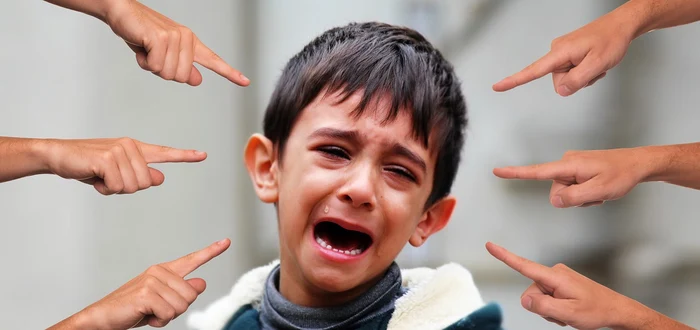
Parents could help their children by training them for bullying situations PHOTO: Pixabay/Geralt
What we should do is, in fact, prepare him for such situations, and the preparation must fit well in advance.
“The preparation is done slowly, it is done over time”, Szocs noted, explaining why we need to do this and that there is a victim pattern.
“They are the same children, the helpless children. The parents have always done things for them. And the moment we take the problem, , his feeling is that
“It's a power struggle. I'm teaching them to stand up straight”
An aggressor feeds on the victim's fear, on the humiliation he causes, Aurora Szocs described the nature of bullying, so she advised parents to encourage their children to resist such episodes, and this will be possible with training.
The response that the provoked must give must not be a violent one, instead he must demonstrate to the aggressor that he is not intimidated.
“I teach them like this – he may be twice your age, but that doesn't mean you have to let him dominate you; don't respond to violence with violence, learn to master it mentally -. I teach them that the moment someone comes to him and curses him, to stand up straight, to stand dignified in front of him, to look, let's say so, the opponent in the eyes, to smile and say to him: have you calmed down?”the solution also came.
Some of the parents indicated that such an attitude might not work in all cases. “And take it!”the parents went with the script further. “They take it anyway. They would have taken it anyway. We have to teach them this thing, to be dignified. Because if they are firm, there might be two or three people next to them who defend them. I can see them. But the moment they sit with their head down, they want to make themselves small, they want to disappear at that moment, the aggressors feed on this state, that's what they want, to make them feel humble. They are very rarely children who come to do harm. In general, they are children who cannot express themselves at home. Either they are traumatized, or they have taken it seriously.” the psychologist also explained.
“Preparation is actually putting them in that kind of situation”
Children raised by parents with excessive care will not know how to react appropriately in challenging situations for the simple reason that they have never faced such a thing.
“Our children do not know how to react. Especially if they are raised in a very safe environment, the moment someone attacks them or the moment someone says something bad about them they get stuck. It's the shock effect, they don't expect it, they don't know what it means and they don't know how to react. Preparedness is effectively putting them in that kind of situation, but in a controlled environment. You tell him: “You are ugly!”. And you explain to him how to react, what to do. You explain to him that at that moment you look fixedly at the person in question, you don't lower your head, you don't let him dominate you physically, you lower your voice a little, you smile and thus modulate the reaction of the person attacking you a little, so that he no longer has reasons to be so aggressive with you, to de-tension the atmosphere. This is what preparation is all about, that is, not letting the other person cause you suffering. Actually why is he attacking you? To trigger something in you. Like the moment he feels he's triggered something in you, he feels strong. It's a war of power, after all,” explained Aurora Szocs, for “The Truth”. The child will know that it is a training and will look for solutions for that situation that he can really face in his everyday life, for example at school.
Family “training” should start when children are young. That's why we will encourage them to do the things that are for their strengths, because each success will give them confidence.
What we instead see around us every day, or maybe even do, is to “help” them by doing things that should fall to them. We walk them to the school gate, carry their schoolbags, help them get dressed and at the age they can and should do it themselves, tie their shoelaces, etc.
A support for sensitive children, and not only for them, is also practicing a contact sport. “You don't necessarily know how to hit, first of all you have to know how to defend yourself. It just helps to know that you have your weapons with you, you feel strong. It's also about a lot of discipline behind it, it's about mentors there, it's about the team. Any sport in general shapes you differently, you don't get the discipline in sports from somewhere else”, the psychologist also showed.
“As a teacher it is very important to feel connected with them”
Teachers can, in turn, contribute to building harmonious relationships between students and to reducing the phenomenon of bullying, the psychologist showed. Aurora Szocs.
“As a teacher it's very important to feel connected with them, but for them to feel connected with them too. During class I can't really, they have something else to do, during the 10 minute break it's not enough and then I see them really connected in the moments when they are in activities. Go with them on weekends, go on trips, camps, or do all kinds of projects! Please have the courage to get to know your students and involve them in as much as possible activities! Because you have no way of knowing them from class.” the counselor said to the teachers present.
Episodes of physical violence in schools are now much easier to manage, since clear procedures have been established that guide school staff to act according to the severity of the incident, Aurora Szocs, on the other hand, appreciated.
An opportunity that schools also have is the program “Impreună prindem curaj”, financially supported by the Ministry of Education, through the county centers for assistance and educational resources (CJRAR). “The sums are not fabulous, but for two years, twice a year, there are projects that the schools do, and the teachers bought surveillance cameras for the school, they organized all kinds of workshops in which the children feel very connected, they made relaxation corners, every school needed what it needed. But such projects, very targeted, I think should be continued and would be the only chance to get rid of this phenomenon”. psychologist Aurora Szocs also said.