The new generations of traffic lights and road safety. What is “break on red” and how are drivers charged for exceeding the legal speed limit

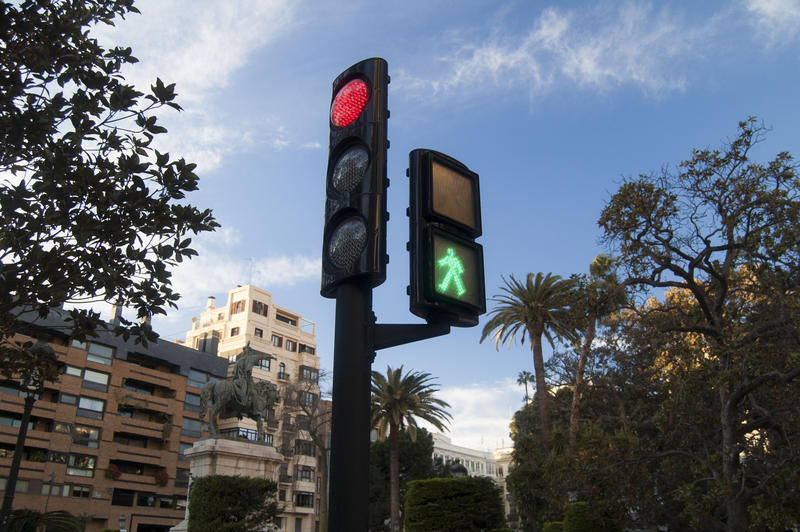
Video cameras or so-called road “humps” have long been considered effective methods of disciplining drivers in traffic, but the solution could also come from traffic lights that already have a century of existence, provided they are brought to a much more technological level, writes Bloomberg.
If until now the concern has been that traffic lights facilitate the movement of as many cars as possible in the shortest possible time, a growing number of cities are using them to change driving behavior at a negligible cost to the taxpayer.
Jadish Patel, CEO of Flow Labs, a traffic data and software company, says that previously the goal was to get as many cars as possible through a traffic light-regulated corridor, but now the focus is on safety.
 Romania in traffic: how much the lack of an integrated infrastructure costs us and how digitization can help us
Traffic lights, more and more sophisticated
The first traffic light was installed in Cleveland in 1914 and had only two colors, red and green. The yellow color was introduced after six years. More recently, using mathematical models, traffic engineers have adjusted traffic lights to optimize the flow of cars, sometimes with the help of computers, sensors and video cameras to record traffic levels in real time.
However, efforts to avoid traffic jams have had poor results. According to the Texas A&M Transportation Institute, in 2024, an average American commuter spent 63 hours stuck in traffic. Meanwhile, traffic optimization is no longer a dominant priority in urban areas where there are a large number of fatal accidents involving pedestrians or cyclists. Fortunately, traffic lights can reduce traffic, but also contribute to a higher level of safety.
“Green waves” or green lanes are a series of traffic lights adjusted in such a way that drivers can pass through several intersections without having to hit the brakes, so-called “smart traffic lights”.
But they also have a downside, even if drivers enjoy them. In general, drivers who take the same route every day learn them and tend to speed up to make sure they catch the “green corridor” for the entire length, which means a higher risk of road accidents, especially at night.
As a result, some cities have begun implementing the “break on red,” a road safety tactic that is resorted to after dark. At intersections, all traffic lights are red, which makes drivers pay more attention to what's around them. After a sensor registers their presence, the traffic light turns green.
In a more sophisticated version of the system, the sensors are placed further ahead of the intersection, and when they detect a car traveling at a speed within the legal limits, the traffic light turns red. In the case of speeders, it will stay red for a longer time. This makes drivers avoid excessive acceleration knowing that this is how they will avoid red lights.
A low-cost technology
The “break on red” is already implemented in cities like Portland or San Jose. “We did it during the pandemic because we had big problems with speed after regular work hours,” says Ramses Madou, who handles transportation planning and sustainability in San Jose.
Another solution is to extend the duration of the green color for pedestrians by a few extra seconds so that they have time to get out of the blind spot where drivers turning right or left at an intersection do not see them. New York's measure is credited with reducing pedestrian injuries by 33%.
Eric Raamot, former head of department at Econolite, a traffic light software company, also recommends special traffic light signaling for left turns, “the most dangerous movement on the road.”
“As a driver, you sit and think 'ok, I've got a flashing yellow and then it's going to be solid yellow and then red, and behind me, people are getting impatient.' With an increasing level of stress, the driver would be tempted to force the yellow, risking a collision with another car or a pedestrian,” says Raamot.
He believes that yellow should also be introduced as an intermediate period from red to green. “If I know that at the end of the flashing yellow I will have a green arrow, making the turn no longer becomes an emergency,” explained Raamot.
These measures are not very expensive, around $10,000 for a “red break” intersection, far below the costs of a “green corridor” with interconnected traffic lights. However, the spread of these traffic lights remains at about 5% of American cities. That's because traffic operators are under pressure to get traffic as fast as possible. “Citizen complaints usually focus on time spent at intersections,” says Flow Labs' Patel.
However, some cities have begun to quietly introduce traffic lights designed to increase the level of traffic safety, without drivers even noticing and starting to protest, as is often the case with bike lanes or those reserved for public transport.
“They really don't notice. All the drivers think they're experts at handling traffic because they deal with traffic every day, but I'd say 99 percent don't even know the basics,” says Jeffrey Tumlin, former director of the San Francisco Department of Transportation.