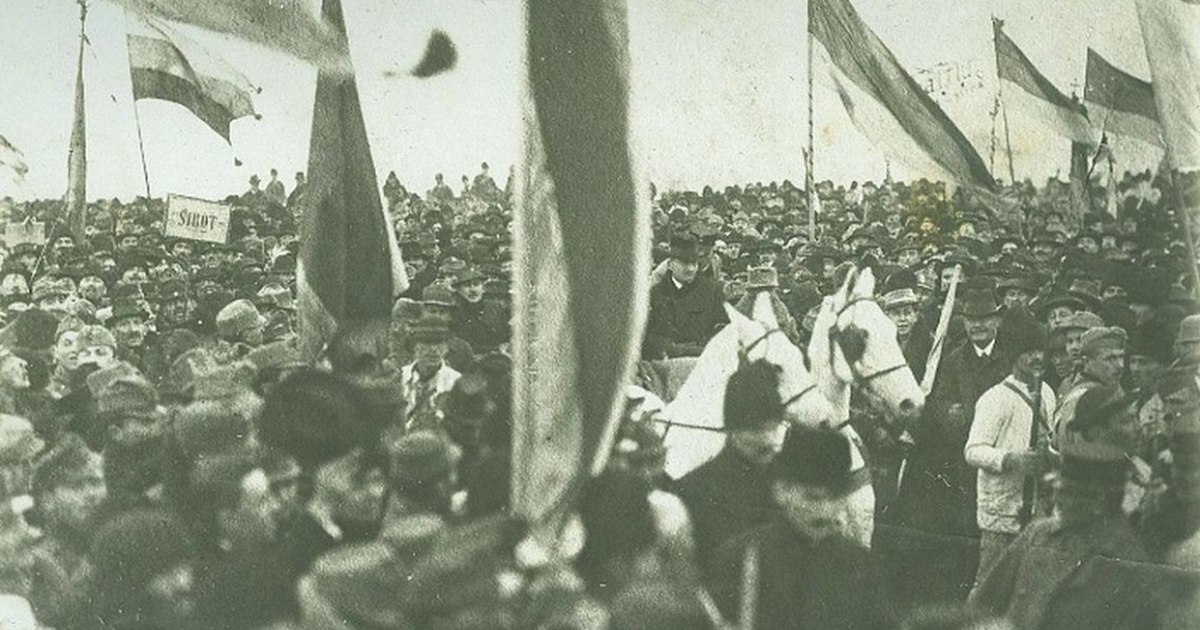
Romanians celebrate National Day on December 1. In our history, December 1 has a special meaning. Although it did not mark the political establishment of Greater Romania, as many believe, it still reflected the deep desire of Romanians to unite – the essential foundation of the Great Union.
The assembly in Alba Iulia on December 1, 1918 PHOTO Samoilă Mârza
On December 1, Romanians celebrate the National Day – a date with a strong symbolic charge for the Romanian people and state. It marks the historical events of Alba Iulia, from 1918, when Romanians from Transylvania gathered to demand union with Romania. Although Greater Romania would actually be established in 1920, when it was recognized internationally, by the Treaty of Paris, the day of December 1, 1918 is particularly important for the symbolic, social and political message transmitted by Transylvanian people to the great powers and to all European nations. It is the moment when Romanians united “in thought and feeling”, in order to later win the diplomatic battle for the recognition of this reality.
What happened on December 1, 1918
At the beginning of the 20th century, the majority population of Transylvania, then part of the Austro-Hungarian Empire, was represented by Romanians. That is about 65% of the population, followed by Hungarians, Szeklers and Saxons. This reality is also recorded in previous centuries. For example, in the 18th century, the scholar Andreas Teusch, a Transylvanian of Saxon origin, wrote in “Historia Regni sive Principatus Transylvaniae” that the Romanians form the largest ethnic group and that all Transylvanian writers consider them descendants of the Roman colonists from Dacia.
That is precisely why with the “century of nations” (19th century), but also with the independence of the Kingdom of Romania, more and more Transylvanian Romanians campaigned for union with the motherland. An important moment was Romania's entry into the First World War. The national importance of Transylvania for Romanians in the Kingdom was reflected in the military interest given to Transylvania. Practically, the first military actions of Romania in the First World War were the disenslavement and then the annexation of Transylvania. For their part, Transylvanian Romanians enthusiastically welcomed Romania's entry into the war against Austria-Hungary, as well as the entry of Romanian troops into Transylvania.
Many Transylvanians risked their lives and freedom to volunteer in the Romanian army. Many were arrested and imprisoned in camps. “Romania's entry into the war and the enthusiastic reception given by Transylvanian Romanians to the liberating troops led to repressive measures by the Hungarian authorities: the arrest and internment in camps of a large number of Romanians, especially intellectuals, the suspension of Romanian publications, the Hungarianization of Romanian confessional schools in the border area; were taken into account and saw the beginning of the application of Hungarian colonization plans in Romanian areas”states the historian Florin Constantiniu in “A sincere history of the Romanian people”.
Transylvanian Romanians experienced a real drama, many being recruited and forced to fight in the Austro-Hungarian army against their compatriots.
Transylvanians, Banatians and Bucovinians imprisoned in the camp at Darnița, in Bucovina, requested union since 1917, through a manifesto. “We demand with unwavering will our incorporation into free Romania”, they wrote. The best opportunity arose after the defeat of the Central Powers and the collapse of the Austro-Hungarian Empire, on November 3, 1918. Romania had reached the camp of the victors and the former nations of the former empire had the right to self-determination as stipulated by American President Woodrow Wilson.
Hungary proclaimed its independence on November 16, 1918. However, the Hungarians dreamed of restoring Greater Hungary, which included Transylvania. But Transylvanian Romanians, through the Romanian National Party – which included great personalities such as Iuliu Maniu, Alexandru Vaida Voievod, Ștefan Cicio Pop or Vasile Goldiș -, announced in the Budapest Parliament that “the Romanian nation is waiting and demanding, after many centuries of suffering, the affirmation and valorization of its inalienable, inalienable rights to full national lifeNeither the pressures, nor the violence, nor even the sending of the Minister of Nationalities, Oszkar Jazsi, to Arad, to negotiate with the leaders of the Romanian National Council, made the Romanians relent. “Complete Separation” was the verdict of Iuliu Maniu. Basically, the first stage was the proclamation of Transylvania's freedom and independence from the Hungarians. In just 10 days, a true organizational record for those times, a Great National Assembly was organized, planned for December 1, 1918. The place was not chosen by chance, having symbolic value: the fortress that Mihai the Brave entered in 1600 after the conquest of Transylvania. At the Great National Assembly in Alba Iulia on December 1, despite pressure and threats of violence from Hungarian groups, 1228 official delegates of the Romanian nation were present.
The assembly chaired by Gheorghe Pop de Băsești took place in a sea of enthusiasm, being marked by fiery speeches, but especially by the most important moment, the decision to unite with Romania, received with cheers by the more than 100,000 Romanians who came from all corners of Transylvania, some from considerable distances. “The national assembly of all Romanians from Transylvania, Banat and Hungary, gathered through their authorized representatives in Alba Iulia on December 1, 1918, decrees the union of those Romanians and all the territories inhabited by them with Romania. The assembly especially proclaims the inalienable right of the Romanian nation to the entire Banat, between Mures, Tisa and Danube”it was stated in the resolution read by the politician, publicist and pedagogue Vasile Goldiş.
In practice, the desire of Transylvanian Romanians to unite with the country was expressed, ending a whole cycle of similar resolutions given in Bessarabia and Northern Bucovina in March and November 1918 respectively.
The day of December 1, 1918 is important because the Romanians from all the territories separated from the decaying empires of Europe officially expressed their desire for union. It was the most important step on the basis of which the subsequent diplomatic struggles for the recognition of this reality could be waged. At the same time, as historians show, the Great Assembly from Alba Iulia in 1918 ended the process of establishing the modern Romanian national state. “The Great National Assembly from Alba Iulia concluded in 1918 the process, started in 1859, of the creation of the Romanian national state”the historian Florin Constantiniu specified in the same work.
National Day since 1990
Initially, the day of December 1, 1918 was celebrated especially by Transylvanians, during the interwar period, as a symbolic date of obtaining independence from Hungary but also of unification with Romania. However, it was not Romania's national day. Until 1948, Romania's national day was celebrated on May 10. This date commemorated the enthronement of Charles I as ruler of the United Principalities on 10 May 1866 and the establishment of the Hohenzollerns as the ruling dynasty. Later May 10 was loaded with other meanings. On May 10, 1877, the Romanian Senate voted for the proclamation of independence from the Ottoman Empire. From that moment, the national day of the United Romanian Principalities signified the achievement of independence. Also on May 10, but this time in 1881, Parliament voted to transform the country from the United Romanian Principalities into the Kingdom of Romania, and Carol I became its first king.
From that moment on, May 10 was also the day of the monarchy. The national day was celebrated with great pomp, but also popular celebrations, including the famous flower fight on the road.
But from 1948, with the forced abdication of King Mihai I and the transformation of Romania into a communist state, the national day was celebrated on August 23. This date commemorated the coup d'état of August 23, 1944, when Romania turned its weapons against Nazi Germany and got rid of the Antonescu regime. For communists, August 23 marks “the day of the liberation of Romania by the glorious Soviet army and the overthrow of the fascist Antonesian dictatorship by the patriotic forces led by the Communist Party”. Later, with the distancing of Ceausist Romania from Soviet Russia, the day of August 23 acquired other meanings, being a true ode dedicated to the communist party, the working people, but especially to the leaders of communist Romania.
After the revolution of 1989, in Romania, together with the regime, the date of the national day changed again. The parliament dominated by the FSN and with the approval of Ion Iliescu, the first post-December president of Romania, decided that the new national day should be celebrated on December 1. The decision was enshrined by Law no. 10 of July 31, 1990. By choosing this date, Iliescu and the FSN wanted to combat both monarchist sympathies (which demanded the return to May 10 as a national day), but also the anti-communist opposition which demanded as a national day the dates of December 16 or 22, the days of the revolution in Timișoara and Bucharest. In addition, it referred to the Great Union and the final moment of the unification of Transylvania with Romania. And so, December 1 remained Romania's National Day.
The tradition of the December 1 military parade
The first national day of December 1 was celebrated in 1990 in Alba Iulia and was marked by political disputes between the FSN-ists and the representatives of the opposition. One of the traditions of December 1 as a national holiday is the military parade. In every city in the country, the soldiers of the local garrisons, as well as the structures of the Ministry of Interior, participate in a parade where most of the city's people gather.
The most spectacular is the military parade organized in Bucharest and attended by the President of Romania, the Prime Minister, heads of the Army, and other officials. The military parade is basically a continuation of the tradition from the time of royalty. During the communist regime, large demonstrations were organized on the national day in which many Romanians participated, both students and workers, soldiers, but also other employees from various state institutions. They were parades inspired by the grandiosity of Asian communist regimes.