If the American administration were to stop arms deliveries, the war would become much more difficult for Ukraine — but it would not stop, writes politico.eu.
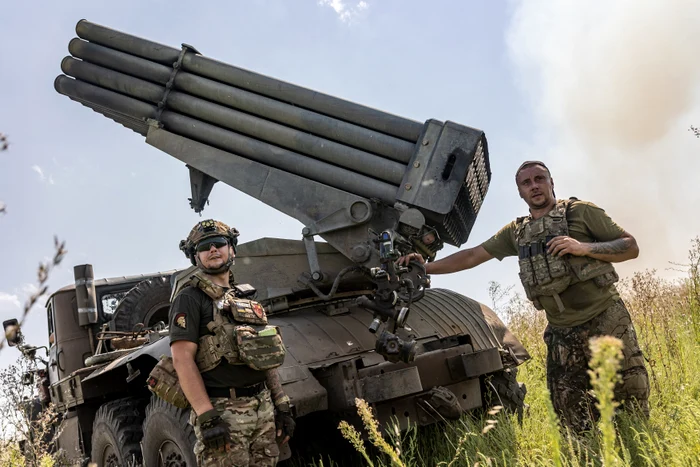
The Urainians will not give up the fight/PHOTO: Archive
Last week, US President Donald Trump surprised European capitals with an unprecedented ultimatum: Kiev should accept Washington's surprise project to end the war or risk losing US military support and intelligence.
Since then, the plan has been modified following discussions with Ukraine and European states, to remove elements clearly favorable to Russia. However, the pressure on Kiev remains.
This raises two questions: Can Europe smoothly and completely replace the role of the United States? And can Ukraine continue the fight without American weapons? The short answers: no and yes.
Below, an analysis of five key issues that Trump's ultimatum brings to the fore, made by politico.eu.
1. Can Europe simply replace the United States?
Not in the near future and not at the level Ukraine needs.
Christian Mölling, senior adviser at the European Policy Centre, says Europe can support Ukraine without the US, but “with much greater risks”. Without the American contribution, the losses would have to be compensated by adapting the way of fighting, and reaching the current level of support is “almost impossible”.
Europe supplies ammunition, tanks, fighter jets and other equipment. But American weaponry remains essential — especially in the area of air defense.
Ukraine relies decisively on Patriot systems and PAC-3 missiles, produced exclusively in the United States.
“I wish I could say we can do without the US, but only for a limited time”says Mikola Bielieskov, an expert at the National Institute for Strategic Studies of Ukraine. “Only the Americans can produce the PAC-3 MSE interceptors.”
Although Europe ships the SAMP/T system (and will receive an upgraded model next year), the intensity of Russian bombing means that Ukraine needs every system available.
2. How important is information sharing?
Ukraine detects missile attacks early thanks to America's dense network of satellites and sensors — a capability Europe cannot replicate.
According to Mölling, European assets can cover certain “gaps” but cannot match the American system.
Trump temporarily suspended this information exchange in March in an earlier attempt to pressure Ukraine to negotiate.
Kiev has access to commercial satellites, such as those of the Finnish company ICEYE, and European states have their own intelligence capabilities. But without the US, detecting attacks and preparing retaliatory strikes — such as those on Russian air defense batteries or refineries — would become significantly more difficult.
“Without American help, our ability to conduct long-range strikes on Russian territory will be severely impaired,” said a Ukrainian serviceman from the country's Unmanned Systems Forces, identified only by his callsign, Linch.
Maksim Skripchenko, president of the Transatlantic Dialogue Center, says the lack of information would “lead to more civilian casualties.”
Europe could, over time, expand its fleet of satellites and surveillance aircraft. But this process would take years.
3. Isn't Europe already spending more than the US on Ukraine?
Yes, but that doesn't give him control.
Data from the Kiel Institute shows that in 2022–2024, Europe and the US provided comparable levels of monthly military aid. After the installation of the Trump administration, the picture changed drastically: American support dropped to almost zero, while European states increased contributions to almost 4 billion euros per month in the first half of the year.
Instead of giving away free weaponry, the US sells it — and European allies pay US industry directly through the Prioritized Ukraine Requirements List (PURL), the NATO-agreed list of weaponry that Ukraine cannot get elsewhere.
It's a way to keep the flow of American equipment flowing, and at the same time a political tool to dissuade Trump from abandoning support altogether.
“Americans sell things to Ukraine that cannot be replaced”says Skripcenko, emphasizing that the American industry needs the European market.
But that does not give Europe the leverage to decide. Mölling says that Washington is no longer treating defense partnerships as stable agreements, but as flexible arrangements dependent on the domestic political context — a major risk for the Europeans.
4. Would the US really stop arms sales to Ukraine?
Skripcenko argues that economic logic opposes such a scenario: PURL includes commitments of $3.5 billion, a sum hard to ignore.
However, Mölling warns that political decisions can override commercial logic.
“The US government can stop exports with a single decision”he says — already demonstrated by the times the Trump administration has temporarily cut off supplies or information flows. Washington can also block re-exports or delay shipments to pressure Kiev or its European allies.
White House press secretary Karoline Leavitt said Monday:
“President Trump has stopped funding this war, but the US continues to sell or ship large quantities of weapons to NATO. We cannot do this indefinitely.”
5. Could Ukraine continue the fight without the United States?
Yes — but the conflict would immediately become more vulnerable and unpredictable.
Russia is losing thousands in the slow offensive, and Ukraine is managing to inflict significant casualties thanks to drones and increased domestic ammunition production.
Today, Ukraine has one of the largest defense industries in Europe, producing drones, medium- and long-range missiles, artillery systems and ammunition. President Volodymyr Zelenskiy said last month that the country was now producing about 60 percent of its battlefield needs.
“In three years, we have transformed a small sector into a dynamic industry, the foundation of our defense capability,” Deputy Defense Minister Hanna Hvozdiar said on Monday.
However, the missing 40 percent remains essential. Ukraine has no domestic capability to intercept ballistic missiles and depends on foreign funding to maintain its production pace.
Mölling warns that the loss of American support would force Ukraine to improvise, leading to additional risks and more casualties.
Even so, Ukraine's resilience is not in doubt. Skripchenko recalls that the country held out despite shortages of interceptors, ammunition, weapons and despite constant bombing.
“Ukraine did not capitulate and did not collapse”he says — a clear indication that the Ukrainian military would continue to fight even if Washington were to withdraw.