The Chinese have simulated full-scale electronic warfare to jam Elon Musk's Starlink system over Taiwan, and they think they've found a solution

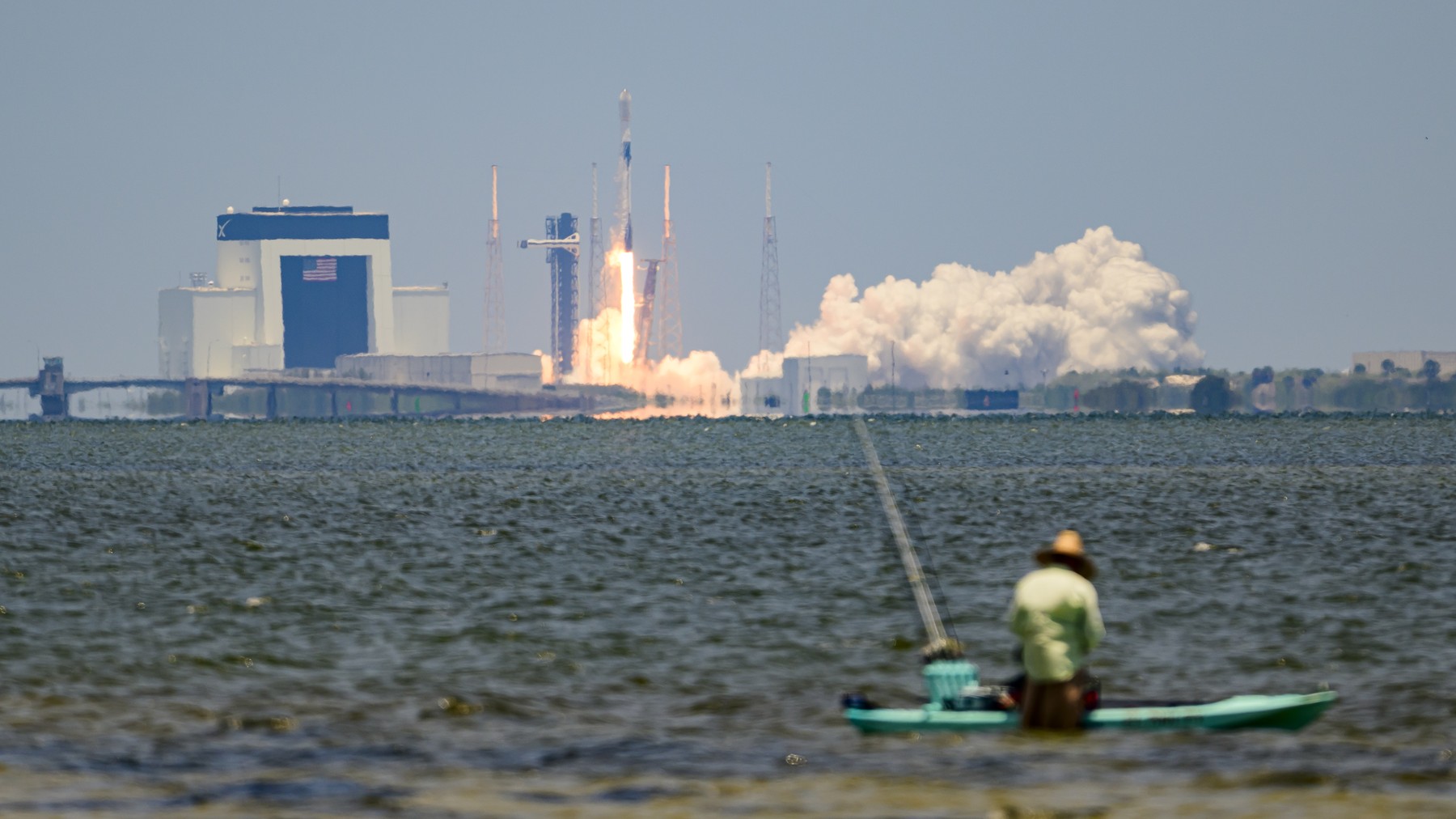
The Florida launch of a batch of 23 Starlink satellites aboard a SpaceX Falcon 9 rocket, photographed from a distance on May 24, 2025, PHOTO: Jennifer Briggs / Zuma Press / Profimedia Images
A group of researchers in China may have found the first way to disrupt the communications of the Starlink satellite internet network by creating a giant air barrier to jam signals transmitted from one satellite to another, Gizmodo reports.
The new study published in Systems Engineering and Electronicsa Chinese scientific journal that publishes papers after they have passed peer review, simulates a detailed attempt to jam a constellation of 10,000 satellites over an area the size of Taiwan, according to the South China Morning Post.
SpaceX's Starlink satellites are difficult to jam, and attempts to jam their signals from the ground would be futile. Instead, the researchers suggest deploying nearly 1,000 airborne jamming systems using drones, balloons or aircraft. A team of researchers from Zhejiang University and the Beijing Institute of Technology developed this new strategy.
SpaceX activated Starlink service to Ukraine immediately after the full-scale Russian invasion began in February 2022 to help maintain connectivity in areas where communications infrastructure had been damaged by heavy bombing. The Ukrainian military has used the Starlink connection for frontline communications as well as to connect drones to control centers, with SpaceX's satellite internet system becoming a vital component for Kiev's armed forces.
Unlike traditional satellite constellations, which are located above the Equator, the orbital planes of Starlink satellites are not fixed. The satellites, placed in low Earth orbit, are in constant motion, entering and leaving the field of view, and a user terminal switches between several satellites instead of connecting to a single one. This means that even if the Chinese military managed to override the signal from the ground, the connection would switch to another satellite within seconds.
China believes it would need nearly 1,000 jammers to jam Starlink over Taiwan
To successfully monitor or jam the Starlink signal, the new study suggests deploying a swarm of airborne jammers to create a massive barrier using drones. The researchers simulated jamming attempts, testing whether a Starlink satellite could still maintain a usable signal despite disruptive noise.
In the simulations, the jammer was launched at an altitude of 20 kilometers and spaced about 5 to 9 kilometers apart, emitting noise at various power levels. The researchers also tested two types of antennas: one with a wide beam, which covered a larger area, and another with a narrow, stronger beam, which required extra precision.
The study proposes an ideal way to jam Starlink signals, using a narrow beam antenna with a jamming power of 26 Decibel Watts and jammers placed 7 kilometers apart. To cover the entire area of Taiwan, which spans 36,000 square kilometers, China would need to deploy at least 935 jammers, each covering about 38.5 square kilometers.
The researchers also noted in their study that it would be necessary to obtain actual measurements of the radiation pattern data emitted by the Starlink terminals for more accurate results.