The secret of Dacian survival in the Carpathians, in winter. The great wealth they desperately fought for


The mountains were the most important “ally” of the Dacians in the wars with the Romans, even if living in the Dacian fortresses was extremely difficult during the winter. The great wealth of Dacia, for which the ancients were willing to sacrifice themselves. but it was not the fortresses of the Carpathians, nor their gold and temples.
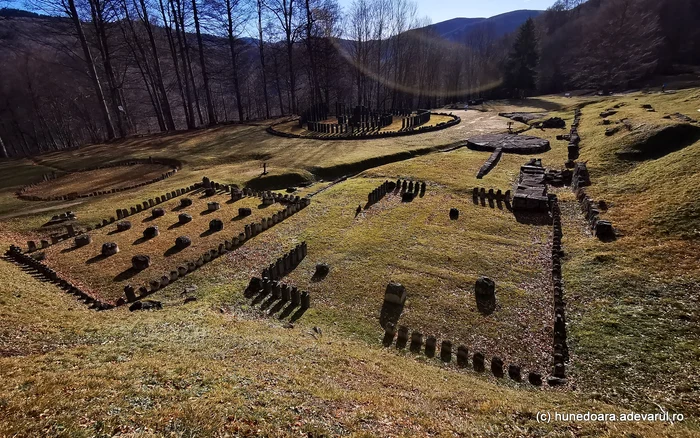
Sarmizegetusa Regia. Photo: Daniel Guță THE TRUTH
Sarmizegetusa Regia, the most flourishing Dacian settlement on the territory of Romania, was established in a hard-to-reach area of the Carpathian Mountains, at an altitude of over 1,000 meters.
The road to the former Dacian capital was modernized a decade ago, but in winter, with the first snowfalls, it becomes difficult to travel the last few kilometers.
Refuge in the heart of the mountains
The number of tourists decreases with the cooling of the weather, and the silence encompasses the ruins surrounded by the vast forests of the Orăștiei Mountains. Sarmizegetusa Regia was, according to historians, a power center and a religious center of pre-Roman Dacia, and the land around it was heavily populated before the Daco-Roman wars, a fact supported by numerous archaeological discoveries.
Seen today as a lonely place in the middle of the wilderness, the capital of the Dacians, along with the other mountain fortresses built by the ancients, offers travelers important clues about how the ancient inhabitants lived.
The ruins of its temples “speak” about the religiosity of the ancients, the sites of former workshops reveal their skill, the remains of ancient pipes show that the Dacians valued cleanliness and had a technically developed society, the many treasures discovered here testify to their wealth, and the surrounding fortifications and the way the terraces were built show the ingenuity with which they built and defended their place of life and refuge.
The highlands around Sarmizegetusa Regia are sparsely populated, and the few villages and mountain hamlets remain almost deserted in winter due to the harsh climate, impractical soil for agriculture, and isolation. With the cooling of the weather, the locals bring their cattle and sheep down from the hilltops to the villages in the valleys, where they care for them over the winter.
The forest was the refuge of the Dacians
Two millennia ago, the climate of this land was even more unfavorable, but the Dacians were used to surviving long winters. The forests, which occupied more than two-thirds of the current territory of Romania, offered them shelter and food, while also being their ally against the invaders. During the winter, the secular woods were an inexhaustible source of firewood and building materials.
“The land of Dacia, harmoniously composed and blessed with mountains, hills, high plain, low plain, surrounded by great “rivers”: Danube, Dniester, Tisza had, paleo-climatically, 4-5 months of winter (if not more, in colder years). Dacia was an agro-pastoral “complex” with its values and limits. It was not an agricultural country, i.e. producing wheat. It was above all a country covered with forests, dark woods, summer (alpine) pastures, then meant for raising cattle (herd)”informs the archaeologist Sever Dumitrașcu (1937 – 2022), in the work “Iernaticele”.
In the mountains, the Dacians built houses of logs, some with several rooms and even floors, designed to withstand the cold of winter and provide them with shelter. Ovens, used for heating, baking bread and preparing food, were almost indispensable in their homes.
Their inhabitants wore coats made of sheepskins, hoods and trousers (crows or itaris) made of thick wool. They covered their heads with hats and protected their feet by wearing felt or leather boots. The women also covered their bodies with long shirts, in the winter with thick cloth or wool covers, and they protected their heads with kerchiefs.
For Roman armies, accustomed to the milder climate of the Mediterranean, the Dacian mountains were extremely difficult to conquer in winter. On the threshold of the year 101, during the first war with the Dacians, the emperor Trajan gave up advancing towards Sarmizegetusa Regia, putting his troops under cover, his armies being less prepared to face the harsh winters of the Dacian mountains than the locals, who found refuge here.
“Instead of sandals and petticoats, the soldiers of the Roman army felt the cold of the temperate climate, which was getting colder, the 5-6 months of cold, they felt the need for trousers (moletteries, nadragis, ciocreci, îtari) and winter shoes, even with high boots (Germanic tureatca cism). Cold and hunger are fundamental geostrategic elements that the Roman officers had to face, on next to the internal (inhabitants of the provinces) and external (Germans, Dacians, Persians) threats”wrote archaeologist Sever Dumitrașcu.
Herds, the great wealth of Dacia
According to the historian, the land of Dacia had another important characteristic. The Tisa and Danube regions were then marshy stretches with numerous lakes, from the Iron Gates to the Black Sea. The lakes in the Danube plain were filled with Danube water twice a year: in the spring, when the mud from the Northern Carpathians melted, and in June, when the snow from the Alps melted. In winter, the swampy expanses became ideal places for bringing herds in transhumance.
“There were ponds with fish, but especially with hydrophilic flora, which constituted the winter pasture for the herds of Dacia. Crito, the Greek physician of Trajan, remembers not only the gold and silver from Dacia, but the herds of Dacia, taken by the Romans. The herds were of immense wealth, and not only sheep, but also herds of oxen. The herds, the herds, in free stables, at that time, in In Europe, they could only graze in the marshes on the left bank of the Tisza, as far as the Dniester. The only possibility to save the herds of oxen was in the marshes, in the summer pastures, and the Romans would have perished with them they realized this reality and turned Dacia into the land of pastures”, the archaeologist pointed out.
While gold and silver belonged to the sacred, the Dacians ensured their survival through animal husbandry. During the summer, the Carpathian pastures were favorable for animal husbandry. The land of the Dacian fortresses is, moreover, since ancient times, a place of transhumance. The plains around the old settlements have preserved ruins of ancient stables, and its roads are used by shepherds who roam the mountains, descending in winter to the lowlands.
When the plain lands of Dacia were conquered, reported Sever Dumitrașcu, the herds began to dwindle, and the threat of hunger and the desire to save their lands used for winter grazing led them to fight The situation became desperate because the wealth and power of the Dacians depended on the size of the herds, taken to graze in the Carpathian Mountains in the summer and on the left banks of the Danube in the winter and Tisei, he added.
“Either they saved their herds, herds, or they died. It was a struggle of desperation for those who only had the land of Dacia, the herds of cattle as their great wealth and their sacerdotal religion. The land, the food, the harsh daily life, and from here the belief, sometimes immense, always guided the ancient communities. And the Dacians were no exception”. noted Sever Dumitrascu.