After 30 years, Italy has opened an official investigation into “sniper tourists”, foreigners who paid money to shoot people for fun during the siege of Sarajevo: “There were a lot of Italians, Germans, French, English, people from all Western countries”


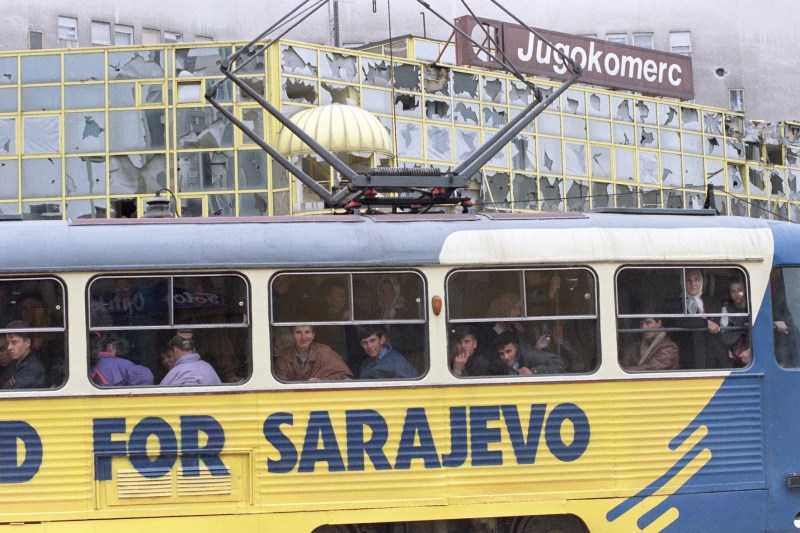
Residents of Sarajevo, photographed on April 9, 1994 in a tram traveling on the boulevard nicknamed “Sniper Alley”, PHOTO: Enric F. Marti / AP / Profimedia
Prosecutors in Milan have opened an investigation into Italian nationals who allegedly paid members of the Bosnian Serb army to travel to Sarajevo to kill civilians during the city's four-year siege in the 1990s, The Guardian reports.
Over 10,000 people were killed in Sarajevo between 1992 and 1996 due to constant bombing and sniper fire. The siege, the longest in modern history, was launched after Bosnia-Herzegovina declared independence from Yugoslavia.
Snipers were probably the most feared element of life under siege in Sarajevo, as they would shoot people in the street – including children – at random, like in a video game or on safari.
The main boulevard running through Sarajevo, Mesa Selimovic, was nicknamed “Sniper Alley” because it had become extremely dangerous, but it could not be avoided – it was the road to the city's airport. Trams and buses had broken windows, and everywhere there were signs warning of snipers.
How the term “sniper tourists” came about
Groups of Italians and other nationalities, the so-called “sniper tourists”, allegedly participated in the massacre after paying large sums of money to soldiers in the army of Radovan Karadzic, the former Bosnian Serb leader who in 2016 was found guilty of genocide and other crimes against humanity.
Groups of foreign nationals and other countries are believed to have paid to be transported to the hills around Sarajevo, where they could fire on the civilian population “for pleasure”.
Sarajevo is in a basin surrounded by mountains, which made it particularly easy to isolate and attack.
Milanese prosecutors led by Alessandro Gobbi launched an investigation aimed at identifying the Italians involved, on charges of voluntary manslaughter aggravated by cruelty.
Official investigation in Italy after years of evidence gathering
The investigation began with a complaint filed by Milanese writer Ezio Gavazzeni, who gathered evidence of the allegations, as well as a report submitted to prosecutors by the former mayor of Sarajevo, Benjamina Karic.
Gavazzeni said he first read accounts of the alleged “sniper tourists” in the Italian press in the 1990s, but it wasn't until he saw Sarajevo Safari – a 2022 documentary by Slovenian filmmaker Miran Zupanic – that he began to delve into the investigation.
In the documentary, a former Serbian soldier and a contractor say that groups of Westerners were shooting at the civilian population from the hills around Sarajevo. These claims were vehemently denied by Serbian war veterans.
“Sarajevo Safari was the starting point,” Gavazzeni said. “I started a correspondence with the director and from there I expanded my research until I gathered enough material to present to the prosecutors in Milan,” he added.
Italy suspects that many of its own citizens were involved in the killings
Gavazzeni said “many, many Italians” were involved, without giving an exact figure. “There were Germans, French, English, people from all Western countries who paid large sums of money to be taken there to shoot civilians,” the prosecutor pointed out.
He added: “There were no political or religious motivations. They were rich people going there for fun and personal satisfaction. We're talking about gun enthusiasts, maybe going to the shooting range or on safari in Africa.”
Gavazzeni claimed the Italian suspects were meeting in the northern Italian city of Trieste and then traveling to Belgrade, where they were picked up by Bosnian Serb soldiers who took them to the hills around Sarajevo. “There was a traffic of war tourists going there to shoot people,” the Italian prosecutor said.
Gavazzeni said he had identified several of the Italians believed to have been involved, who are to be questioned by prosecutors in the coming weeks.