Why can magistrates negotiate their pension, but ordinary Romanians can't? “Because they have buttons. Other budgeters don't”


The project to amend the magistrates' pensions is being intensively negotiated in the governing coalition and is on the way to reaching an agreement. Market-like negotiations – pensions of 70% or 75% of the net salary – make Romanians wonder: why only magistrates can negotiate their pensions?
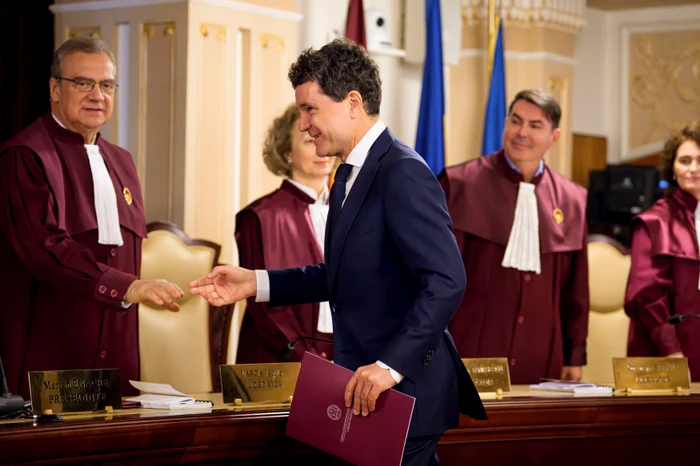
Nicușor Dan was asked about the magistrates' pensions. PHOTO: Mediafax
The modification of Romanian magistrates' pensions reached the negotiation phase, after the CCR rejected, the other day, Bolojan's project on the grounds that he did not wait 30 days for the CSM's advisory opinion.
According to sources cited by the press, the PSD would have succumbed to the pressure of the magistrates and wants the new project to increase the special pension to 75% of the net salary compared to 70% in the original project of the Bolojan Government and to slow down the rate of increase in the retirement age (compliance period of 15 years compared to 10 years in the original project).
President Nicușor Dan confirmed, at a discussion with journalists, at the end of the week, that there are talks in the coalition on the subject of magistrates' pensions and a compromise is about to be reached.
During the same discussion with journalists, Nicușor Dan was asked: “Why can magistrates negotiate their pension with political leaders at 75% of their net salary, but ordinary Romanians cannot?”
Nicusor Dan countered that he never said that the magistrates' pension should amount to 75% of the net salary, but claimed “that it is a negotiation between the parties in the Coalition”. When he was reminded that in an interview given to the media he claimed that the difference between 70% (the percentage proposed by the Bolojan Government) and 75% (the percentage that sources say would be accepted by the magistrates) is not very big, Nicușor Dan replied: “I only said this as a reader of information from the public space.”
The President argued that the 75% threshold is “in discussion, but I didn't say it was validated by someone”.
The clip sparked an interesting discussion on the Reddit platform. Beyond what percentage President Nicușor Dan validated or not, the information remained certain – namely that magistrates, unlike most other Romanians, negotiate their pensions with political decision-makers.
“Well, it wasn't constitutional at 70% and 15 years, but will it be at 75% and 20 years?”
Below are some of the comments from Reddit users:
“Well, it wasn't constitutional at 70% and 15 years, but will it be at 75% and 20 years?”
“Very well scored. What's happening has nothing to do with the Constitution, it's just a negotiation between the Borfas.”
A user invoked a principle from French law, after which the Romanian legal system is inspired, which says that an acquired right cannot be lost: “The reason why the magistrates who entered the system according to the law with 80% cannot reach 70%, because they would lose their acquired right, and that is why it is unconstitutional. The 20-year period would allow those who have already acquired the right to retire under current conditions.”
“Well, weren't the exemptions in construction and IT also acquired rights? Then how could they be removed? Is it constitutional for people to pay them pensions of 20,000 lei and retire at 47, while they rip us off with fees and taxes?”
“It's constitutional to cut from today's nonsense to tomorrow, but it's not constitutional for trickery.”
“They are playing with fire, in the next elections the extremists will take the majority in the parliament.”
“Magistrates in Romania have worked two, three times more than their counterparts these years”
However, Nicușor Dan intervened in the discussion regarding the changes to magistrates' pensions.
A commenter presented a quote from a statement given by Nicușor Dan in August about magistrates' pensions:
“Yes, I requested 15 years instead of 10 years, because, unlike many other categories that have a service pension, so-called special, the magistrates in Romania actually worked much more than their analogues in European countries. An aviator from Romania works as much as an aviator from Spain, a policeman from Romania works as much as a policeman from France, a military man from Romania works as much as a military man from Germany. Magistrates – and we had this exercise almost daily for a while, and weekly when I was mayor – the magistrates worked two or three times more than their counterparts in European countries. And then, for a man who has one more year until retirement, I think it's reasonable, given the complicated fiscal context we're in, to ask him to work twice as much, to do two, three more years until retirement. It seems excessive to me, given the fact that they they worked all this time.“
In the same intervention, from August, Dan refused to rule on the percentage of 70% of the net salary proposed by the government, showing that it remains at the Parliament's discretion.
“Why can they negotiate? Because they have buttons. Other budget holders don't, like teachers or doctors – what are they going to do? They don't come to school or hospital any more? Great tragedy, the combinations continue,” a user intervened.
“Instead, judges, gendarmes, etc., must be kept with their bellies full, because you don't know when you need to get rid of a case or break a protest”, someone else intervened.
“I mean, Dan is asked: “Why can magistrates negotiate their pension with political leaders at 75% of their net salary, but ordinary Romanians can't?”. Why don't you answer these questions?” – one user asks. Another answers him: “And Dan has enough brains not to assume an answer to such a trap question. The answer is an absolutely obvious one, and if you have the slightest idea of how politics works, you learn to avoid these pitfalls. It's an extremely common phenomenon in any political interview.”
The question had to be put to the CSM and the governing coalition
Some commentators argued that the question should be asked not to Nicușor Dan, but to the governing coalition or the CSM: “The President does not decide at any point the numbers that will be in the bill. As a parallel, you don't go to the fire department to ask them to lift a car parked in your front yard. You can ask the president for a position, but you have no reason to reproach him when he was never directly involved.”
“The reporter's question is a populist question, and the answer is obvious: because the magistrates are in a position of strength, where they can judge their claims and squeeze the state fiercely from c… at the same time. That's why.”
“Ordinary Romanians are not united, they are not organized and they are not a caste that can force the state. Ordinary Romanians voted with PSD and PNL and AUR. What do you want an overwhelming parliament dominated by the madness, imposture and thievery of PSD, PNL and AUR to give you?” – one wonders.
“There are laws given by the PSD and the PNL during the decade that have brought us here. What do you want the president to do to you? To argue with the PSD? And what would that solve? PSD represents the vote of an important slice of Romanians, a vote given in 2024. Last year” – someone else intervenes.
“The people, by their vote of 35 years, are victims, but they are also accomplices. And the people throw gasoline tanks on the country, the people vote for some arsonists to make the rules and start the fire. Then, the people get scared of the riots, they choose a fireman to whom they give a thimbleful of water and ask him to put out the measles. And then they yell at the fireman that why doesn't he succeed?” – another user explains.
“What can he say. Come on brother, we have to admit that some are more equal than others in this country and those unequal have to work to pay those others. It's very simple” – someone else concluded.
Presidential adviser: “if we don't solve it quickly, we will lose 230 million euros”
The fact that a negotiation is taking place and that an agreement will soon be reached was also underlined by Radu Burnete, the presidential adviser of President Nicușor Dan. He told Digi 24 that the reform of the magistrates, as well as that of the local and central public administration, are to be discussed next week by the ruling parties.
Regarding the reform of the magistrates, the presidential adviser claims that there are two deadlines, one of which is long overdue:
“We have two deadlines, one that has been passed for a very long time, because it is imposed by society. And here, Mr. President also said that it is quite certain that people want this reform and have wanted it for many years. So, from this point of view, it is an old backlog.
We still have a deadline imposed by the National Recovery and Resilience Plan, because if we don't solve the magistrates quickly with this package, we will lose 230 million euros. This was a milestone in the PNRR, and here we are a few weeks away, November 28. These are the two terms”.
Burnete hopes that soon enough we will have a conclusion in the package regarding the magistrates.