The independent Russian publishing house Freedom Letters has published a book by Riccardo Nicolosi, a professor at the Ludwig-Maximilian University of Munich, titled “Putin's War Rhetoric.”
Rhetoric teaches persuasive and argumentative speech. Soviet ideological rhetoric, i.e. speeches that resounded from the podiums of party congresses and filled the front pages of newspapers, they were a model of empty talk. However, there were specialists who had the art of reading between the lines and were able to find in the stream of phrases clues about the real political situation, changes in the party apparatus, upcoming repressive measures or, on the contrary, relaxation. They considered every official public document as a kind of news with a second meaning.
Putin inherited this Soviet tradition. If only because of his loose use of facts, not calling things by their name (sometimes he even prefers not to call them at all), and the ability to say things that are contrary to what he has said before. At the same time, in his speeches he makes it clear what his intentions and goals are.
However, the differences are significant. After all, we are dealing with the rhetoric of new times, the post-ideological era. And the phenomenon of Putin's rhetoric cannot be reduced to Soviet oratory.
Nicolosi, writing about Putin's style, notes: “His way of speaking […] is usually technocratically professional, reserved and focused.” But for example: “The Russian president makes his logical argument look rigorous and coherent through paranoid, conspiratorial monocausalismpostulating one cause for many different events — an attempt to stop the growing geopolitical role of Russia by the “collective West”, among others through NATO's eastern expansion and the transformation of Ukraine into “neo-fascist and anti-Russian.” Moreover, “Putin's paranoid worldview is complemented by affective rhetoric of resentment.”
Indeed, Putin's “logical” constructions are very specific. Russians and Ukrainians have always been one nation. Ukraine's independence is a fiction invented by the Bolsheviks. And through the West. The West is turning Ukraine anti-Russian. Therefore, the war (that is, of course, a “special military operation”) in Ukraine is essentially defensive in nature. And Russia is at war with the West, which has never been able to come to terms with Russia's existence, and is trying to separate it, divide it, break away a larger piece. Russia defends its sovereignty, fights against colonialism and for the multipolarity of the world.
Nicolosi makes a detailed analysis of the rhetorical structures and mechanisms themselves, or, strange as it may sound, the poetics of Putin's rhetoric, and traces the changes that have taken place there. But the book is also interesting because it gives us the opportunity to see what reality this rhetoric shapesif we take into account the thesis that Nicolosi repeats after Hannah Arendt – there is no separation of speech and action in politics, because speech must be perceived as a type of action from the very beginning – and complement the picture presented in the book based on the author's positions and observations.
In short, however, we can say the following: war rhetoric in Putin's speeches did not appear suddenly. The orientation towards militarism has been heard in Putin's speeches before, but “its importance has gradually increased over the years,” writes Nicolosi. The “special military operation” was prepared and considered for a long time. Domestic policies were also aligned with its goals.
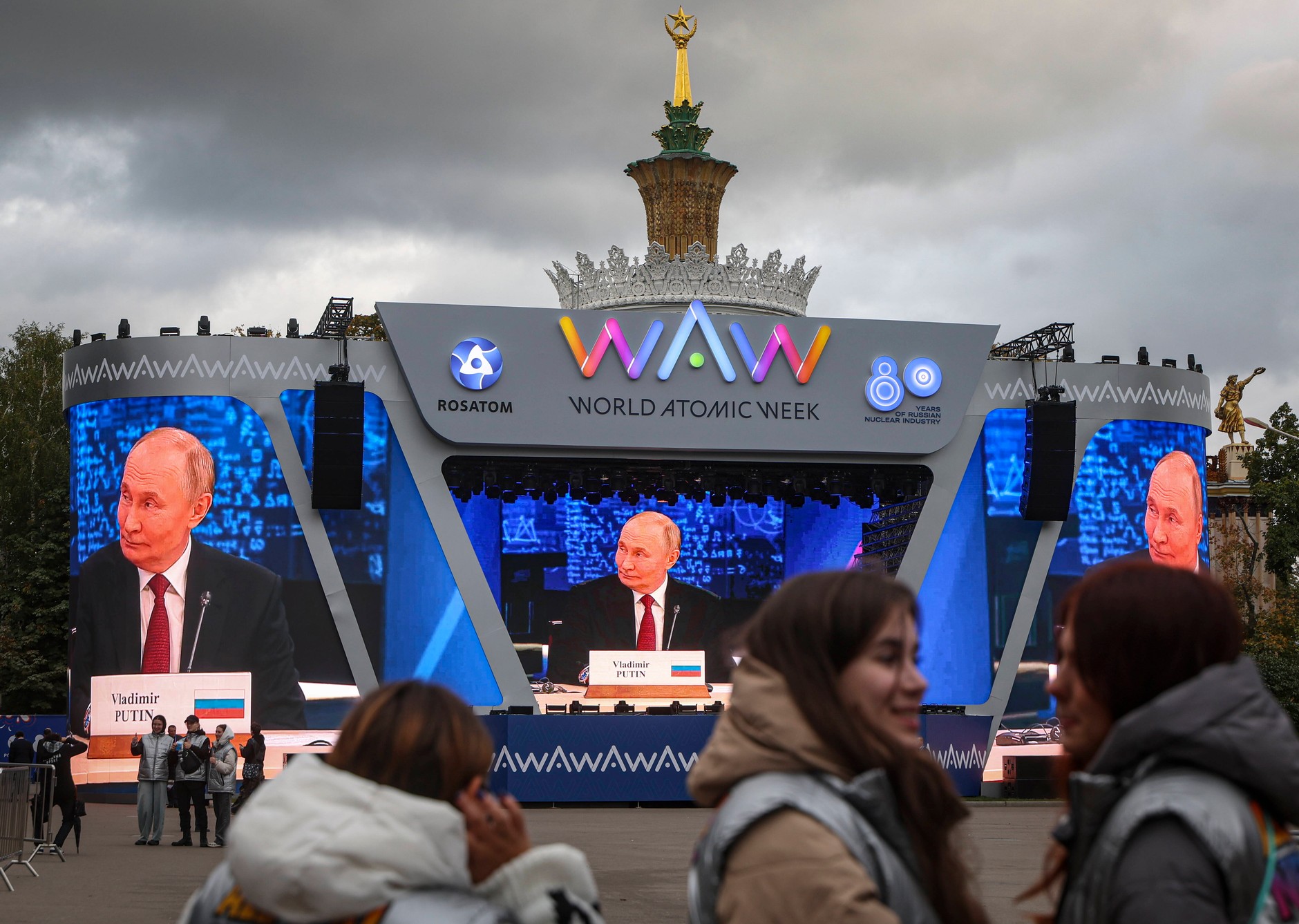
Putin's speech during the International Forum of World Atomic Week shown on a large screen. Moscow, September 25, 2025EPA/MAXIM SHIPENKOV / PAP
Putin fears not only a conspiracy of the elites and a palace coup, but also any consolidation of the masses. The ideal is an apathetic society for which social and political life is a ritual, a fulfillment of formalities. Ordinary Russians cannot have any real influence on the political situation. The population exists separately, the state (ruling elite, primarily law enforcement officers) separately.
It already exists de facto a state of emergency that has not been officially declared. It is as if there was no war, but it continues and requires more and more resources. Rights (freedom of the press, speech, demonstration, etc.) have a decorative (ritual) function. The “legal field” is nothing more than a simulacrum. Rights are not revoked, but simply disregarded, replaced by others. And the fact that they contradict existing ones is irrelevant. Above the law is power, and the ruler is the sacred figure of this power.
The citizen should assume that nothing is allowed
The vagueness of the wording in defining the goals of a “special military operation” fully corresponds to the vagueness of what is allowed and what is prohibited. There are no criteria: forgery, state secrets, discrediting the army, extremism, terrorism, etc. are such vague, undefined concepts that anything can be subsumed under them. Legislative activity has one goal – to multiply prohibitions and arouse fear. Basically, a Russian citizen should assume that nothing is allowed. But of course there are superiors who can prohibit, sue, punish, destroy any action they deem unacceptable.
The goals of state-building in general are equally unclear. The present is seen as a repetition of past victories. This is what you should strive for. The future is in the past, which turns into a heroic myth. The fight or war against the hostile West began long ago, continues to this day and will certainly end in victory. However, it is difficult to say what this victory is. So we shouldn't even look for it. The meaning lies in permanent war, in the constant return to former exploits.
As Riccardo Nicolosi notes, in Putin's speeches “war is presented as a new reality in which everyone lives and with which everyone must live, both in Russia and abroad.” He emphasizes that “the constant presence of war in all the various aspects of Putin's rhetoric […] cannot be considered a promising sign for the future. […] It cannot be ruled out that Russia will continue to slide down the slippery slope of expansionism and “self-purification of society”.«, marking the border between friends and enemies each time in a new way, depending on the current situation, with all the consequences for its immediate neighbors and for the whole world.
To put it prosaically, it seems that the prospect of peace is very dim, the constant continuation of the war is much clearer. “With all its consequences.”