Historical roots of Islamophobia: “There are similarities with the attitude towards Jews in the Middle Ages”


Historian Tasin Gemil, director of the Institute of Turkology at the Babeş-Bolyai University in Cluj-Napoca and the first Muslim ambassador of Romania, identifies, in an analysis for “Adevărul”, the causes of Islamophobia, starting from the dawn of history until today.
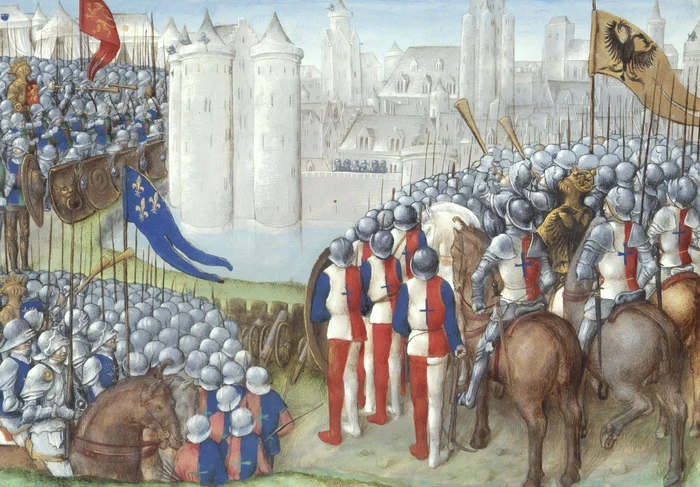
Siege of Damascus in 1148. PHOTO: British Library / Unsplash
Islamophobia is not a new scourge, but lately it is an increasingly common phenomenon, especially in the West. Professor Tasin Gemil, director of the Institute of Turkology at the Babeş-Bolyai University in Cluj-Napoca and the first Muslim ambassador of Romania, compares it to the persecution to which the Jews were subjected in the Middle Ages.
“Currently, hatred against Islam and Muslims has reached alarming proportions, especially in Western countries. I think observers are not wrong to find similarities between the attitude of Western Christian society towards Jews in the Middle Ages and that of the same society today towards Muslims. For any serious local event (diseases, murders, kidnappings, etc.) the rural and urban communities of past centuries immediately blamed the nearby Jews and, they often lynched them, without the poor people having been the least bit guilty. The same attitude now manifests itself towards Muslims living near or within Christian communities in Western countries, even if physical lynching is less common, but not excluded“, says professor Tasin Gemil.
A scourge of history
Historians, but not only them, have looked for different explanations for this Islamophobia that is gaining proportions in many countries of the West. Immigration is one of them, but it is not the most fair.
“Some analysts find the explanation for the current extent and ferocity of Islamophobia in the proportions that immigration, especially from Islamic countries, in Western Europe took after the Second World War and, above all, in the current conditions of uncertainty in the Middle and Near East. Indeed, immigrants constitute an often disturbing reality for the common man in large European and American cities. These immigrants were not and they are not only Muslims. The great American states, the USA and Canada in the first place, owe their existence to European immigrants and not only. The emigration from the south (Italy, Spain, Portugal, etc.) to the more advanced countries of the north was massive in the 19th century and during the following century, and in the last decades several tens of millions of people from the former communist countries, including Russia, arrived in their majority Christians”, says Tasin Gemil.
Currently, there is a whole debate about this. At the same time, the professor believes that it is completely wrong how some analysts blame Muslim immigrants, including for the social and economic problems that grind society today. In reality, without these immigrants, many of them Muslim, the health and pension systems and social funds of many states in the West would now be in a much more complicated situation.
“It is true, after the collapse of colonialism, the former ruling countries (France, England, Holland, Belgium, Italy) had to accept many immigrants from their former colonies. As a historian, I believe in the existence of a postulate: in history nothing remains without reward or punishment, but most of the time the reward or punishment is received by the descendants, even after many generations. Although productive activity, services, social funds, including and especially pensions, etc. from Western Europe and not only would be effectively paralyzed without the contribution of immigrants, yet Muslim immigrants, in the first place, are defamed, attacked and expelled by nationalist-chauvinists, neo-fascists and other extremist groups, who often indulge in demonstrative acts of violence”appreciates the teacher.
The dawn of Islamophobia
Even if Islamophobia is perceived as a problem specific to this 21st century or the last decades, in reality it has a much longer history. Professor Tasin Gemil goes deep into history to identify the dawn of the emergence of this Islamophobia.

Historian Tasin Gemil. PHOTO: Adriana Cupcea
“Islamophobia did not appear now. In my opinion, the origins of Islamophobia are old, even very old, going much deeper in history than the history of Islam itself. I would go back to the ancient period, 2,500 years ago, when the Greeks and Persians fought so many times in the 5th and 4th centuries BC, of course for economic reasons, especially commercial. Greek mythology and the writings of ancient Greek authors abound in the glorification of the Greeks and the defamation of the Persians. The Roman Empire also came into conflict with the Persians for the control of the Persian Empire (Eran) in Asia and Africa. The successor of the Roman Empire, the Eastern Roman Empire, also known as the Byzantine Empire, continued its rivalry with the Persian Empire from this time also appealed to the ideological weapon of religion“, he explains.
Islam and Christianity clashed further in the dark years of the Middle Ages. Christian empires warred with Islamic ones, and the fortunes alternately seemed favorable to one or the other of the two camps. The teacher also identifies the main causes of this confrontation.
“At the beginning of the Middle Ages, or rather at the beginning of Christianity, when the new ideology acquired doctrinal characteristics and became not only a legal but also an official state religion, the only powerful Christian political entity was the Byzantine Empire. The expansionist tendencies of the new Christian Empire clashed with the same conquering tendencies nurtured by the Sassanid Persian Empire, which also had a monotheistic faith as its state religion. In fact, it was the dispute for the control of large centers and trade routes from the Near and Middle East, as well as from Central Asia and the Caucasus.”
Why did the Persians give in to the Arabs so easily
Since the early Middle Ages, Christian and Muslim powers have engaged in fierce battles, and most of the time the theater of battle has been in what is now the Middle East. Tasin Gemil has his own perspective on the Arab conquest of the Persian Empire.
“At the beginning of the 7th century, the Byzantine emperor Heraclius waged victorious but exhausting campaigns against the Sassanids. At the same time, the Persian Empire was attacked by a new power that was then rising in its vicinity – the Arab Muslim Caliphate. This time, the great Persian Sassanid Empire gave way unexpectedly quickly. In 551, it came under the rule of the Muslim Arabs. Most historians explain the capitulation so easy of the great and old Persian Sassanid Empire to have been exhausted by the struggles with the Christian Byzantines. I do not think it is a real reason, especially for a state with more than a thousand years of civilization and experience. I am inclined to believe that the Persian leaders actually wanted to use the new Muslim Arab force to their advantage, because the inexperienced and cultured Arabs had to turn to Persians versed in politics“, the teacher claims.
He makes a connection between what happened some 1,500 years ago and the politics of Iran today.
“I do not think I am wrong when I say that a similar policy is being conducted in contemporary Iran. For almost a century, the Arab Caliphate was effectively ruled by the Persians, who were, however, behind the Arab leaders. What the Sassanid Persians did not achieve, that is, the overthrow of the Byzantine Empire, the Muslim Persians wanted to continue, but with the sword of the Arabs. Indeed, at the beginning of the 8th century, the Arab Caliphate resumed the old Sassanid assaults on Constantinople. He didn't succeed either“, adds the historian.
The clash of civilizations
The rivalry did not end, however, and the two forces so antagonistic in the Middle Ages continued to collide, in a clash of civilizations, but also wearing ideological clothes.
“But the rivalry continued with greater force, now wearing the cloak of religious ideology, Christian on the one hand, and Muslim on the other. Both powers were representative of the two universalist religions. In the first centuries of the Christian era, Zoroastrianism (founded by Zarathustra, in the 6th century BC), the ancient monotheistic religion of the Achaemenid Persians, revived and imposed as the official religion by the Sassanids, had come to compete with the new Christian faith. In the 3rd century AD there was even the question of whether Christianity or Zoroastrianism would succeed. Islam borrowed a lot from Zoroastrianism (individual freedom, regardless of wealth or origin, personal responsibility, bodily cleanliness, etc.). the Achaemenid Persians also passed on to the Byzantine Greeks, who harbored the same aversion to the Sassanid Persians, who were then identified with Islam“, emphasizes the teacher.
In his opinion, the West took over from the resentment of Ancient Greece, whose heir it claims to be, towards the Muslim world.
“Western Europe is firmly convinced that its entire culture and civilization comes from the ancient Greeks. Along with what the ancient Greeks had, the Westerners also took over their resentment against the Persians (Iranians), who were now seen not as bearers of an ancient culture and civilization, rivals to Greco-Roman culture and civilization, but as representatives of Islam, which was and is considered the main enemy of Christianity. Medieval Europe saw the Islamic world as a monolithic bloc, without ethnic, cultural or political distinctions“, adds the expert.
Turks and Tartars, detested in the Middle Ages
Over time, after the Europeans collided with the Tatars and the Turks, Islamophobia focused on those two nations.
“Later, with the rise, first of the Tartars, and then of the Ottoman Turks as threatening Islamic powers against Christian Europe, Islamophobia focused on them, the more so since they actually penetrated into Christian Europe and ruled a significant part of it, including Greece. All medieval European writings, including from the Romanian countries, are full of accusations, invectives, epithets of the most severe and defamatory towards Tatars and Turks”, argues the teacher.
Tasin Gemil believes that things have not changed much even now, centuries away.
“The current situation from this point of view is not too different. Now, Islamophobia has in its crosshairs especially Arab immigrants, whose acts of violence, including and especially political terrorism, are extended to all immigrants of Muslim origin. In fact, it is not so much about these immigrants as it is about the electorate that is misled to promote extremist leaders, who through xenophobia and racism aim to reach power. And, what to do there?! To expel tens of millions of Muslim immigrants from Europe or to put them in concentration camps?! Can you imagine such a thing?!“, he says.
If in the past Islamophobia was also based on the Church, over time things have changed, and today the causes of this incomprehensible enmity can be identified.
“Population movements have occurred continuously throughout history. As a result of these incessant emigrations and immigrations, peoples, countries, states and cultures have been formed. All the peoples and national cultures of the world are amalgams of ethnicities and spiritual kaleidoscopes. Whether we like it or not, these uninterrupted movements of people will continue in the future, because the phenomenon is part of the essence of human existence. In the past, Islamophobia was cultivated by the church, and now it is promoted by extremist parties, groups and figures. But, as in the past, Islamophobia is not based on ideological analysis, doctrinal debate, but only on invented accusations and insults of the grossest kind. In my opinion, Islamophobia is a real danger in the current conditions, when there are so many possibilities for uncontrolled attacks or reactions.”concludes professor Tasin Gemil.