2025-11-01 13:41, act.2025-11-01 14:41
publication
2025-11-01 13:41
update
2025-11-01 14:41
Egypt officially opens the Grand Egyptian Museum in Giza on Saturday evening. Tutankhamun's complete collection will be on display for the first time. The museum is a key part of Cairo's plan to double its tourist numbers and strengthen the country's position as guardian of world heritage.
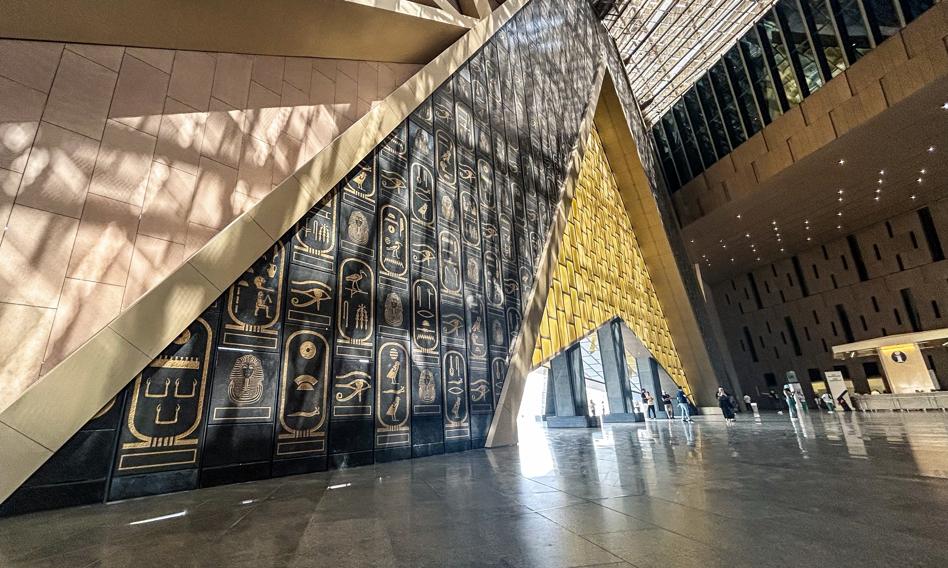
The grand opening ceremony of the Grand Egyptian Museum (GEM) will take place after a series of delays caused by financial crises, political turmoil after the Arab Spring, the COVID-19 pandemic and regional tensions.
The museum is located in Giza – a city on the west bank of the Nile, opposite Cairo – 2 kilometers from the pyramid complexwhich tourists will be able to cross along the promenade that is still under construction. The building covers an area of 500,000 m2. square meters, which is equivalent to the size of 70 football pitches.
The architecture of the museum, construction of which began in 2005, combines ancient and modern elements. Among the most interesting solutions is the monumental entrance hall, where visitors are greeted by an 11-meter statue of Ramesses the Great weighing 83 tons, moved from in front of the main railway station in Cairo. Also impressive are the wide stairs, about 20 meters high, decorated with statues of pharaohs, sarcophagi and reliefs, leading to the exhibition rooms. The upper level offers a perfectly framed view of the Giza pyramids.
The museum is expected to accommodate approximately 100,000 people. artifacts spanning thousands of years of history, from prehistoric times to the Greco-Roman era. The most important attraction, the opening of which has been postponed until the official inauguration, is the complete collection of treasures from the tomb of Pharaoh Tutankhamun – the only almost unplundered royal tomb with preserved rich furnishings. Of the total approximately 5,500 artifacts discovered by Howard Carter in 1922, all of them are displayed together at GEM to give visitors the same experience that Carter experienced. Two narrative paths were created at the exhibition: one tells the story of the king's life, the other tells the story of the discovery of his tomb. The most famous artifact, the gold death mask, is placed under 40 mm thick bulletproof glass.
The scope of the Grand Egyptian Museum will be best understood by those who have visited the old museum located in Tahrir Square in the center of Cairo. Still open to visitors, the facility resembles a junk warehouse rather than an exhibition hall. Priceless exhibits are gathered there so densely that they cover each other, often dusty, deprived of air conditioning and adequate lighting. The genesis of the new museum dates back to 1992, when then Minister of Culture Faruk Hosni responded to a critical remark that the old museum was a “warehouse”. Offended by this opinion, Hosni announced the construction of the world's largest museum near the pyramids. Only a comparison of both places – the crowded building in Tahrir Square and the spacious, modern complex in Giza – allows us to fully appreciate the scale of this transformation.
The project, the cost of which is estimated at approximately USD 1.2 billion, is a strategic cultural and tourist investment for Egypt, which has been struggling with the economic crisis for several years. The museum – described in the media as the largest museum in the world dedicated to a single civilization – is expected to significantly increase tourist traffic, which is key to raising the foreign currency needed to support the Egyptian economy. According to data from the Egyptian Ministry of Tourism, in 2024 the country was visited by 15.7 million people who spent a total of $15 billion. GEM is expected to attract up to 8 million visitors a year and host from 15,000. up to 20 thousand guests per day. The Egyptian government aims to double the number of tourists to 30 million annually by 2030.
The opening of the museum is the culmination of the policy of President Abdel Fattah el-Sisi, who in the last few years has given great importance to projects promoting the heritage of ancient Egypt. Earlier, his government organized the so-called The Golden Parade of the Pharaohs – the ceremony of transferring the royal mummies from the old museum to another new Museum of Egyptian Civilization, covered by all major Egyptian television stations – and the spectacular opening of the Avenue of Sphinxes in Luxor.
The opening of the GEM is being used by leading Egyptian archaeologists, including former antiquities minister Zahi Hawass, to renew calls for the repatriation of key Egyptian artifacts. They mention primarily the Rosetta Stone, taken away by Napoleon and located in the British Museum, and the bust of Nefertiti, stolen by German archaeologists, which can be seen in the Egyptian Museum in Berlin.
The Grand Egyptian Museum project is seen as a central element of the government's broad modernization strategy and aims to promote Egypt's image as a stable and ambitious country. Sisi, who rules Egypt autocratically, personally chaired preparatory meetings to ensure that the opening ceremony “befits the significance of the event and the greatness of Egyptian civilization.” The investment is perceived as an instrument of presidential power and prestige. The project is today proudly presented by the authorities as “Egypt's gift to the world.”
GEM is also a technological showcase – it uses advanced multimedia presentations and Mixed Reality shows to reach younger generations. For many Egyptians, the project is a source of enormous national pride. Egyptian experts argue that the construction of the Grand Egyptian Museum is intended to prove the modern state's ability to supervise, conserve and curate at a world-class level – contrary to the long-held belief that Egypt cannot properly manage its own archaeological heritage. For decades, almost all major excavations there have been carried out by foreign research missions, including Polish ones, and the condition of the old Egyptian Museum has long been considered a symbol of this weakness.
A ticket for visiting foreigners currently costs the equivalent of PLN 115. A ticket to the exhibition for children costs an additional PLN 60. (PAP)
bye/ sp/