Americans found a way to defeat Putin. “Warthog” may thwart the Kremlin's plans


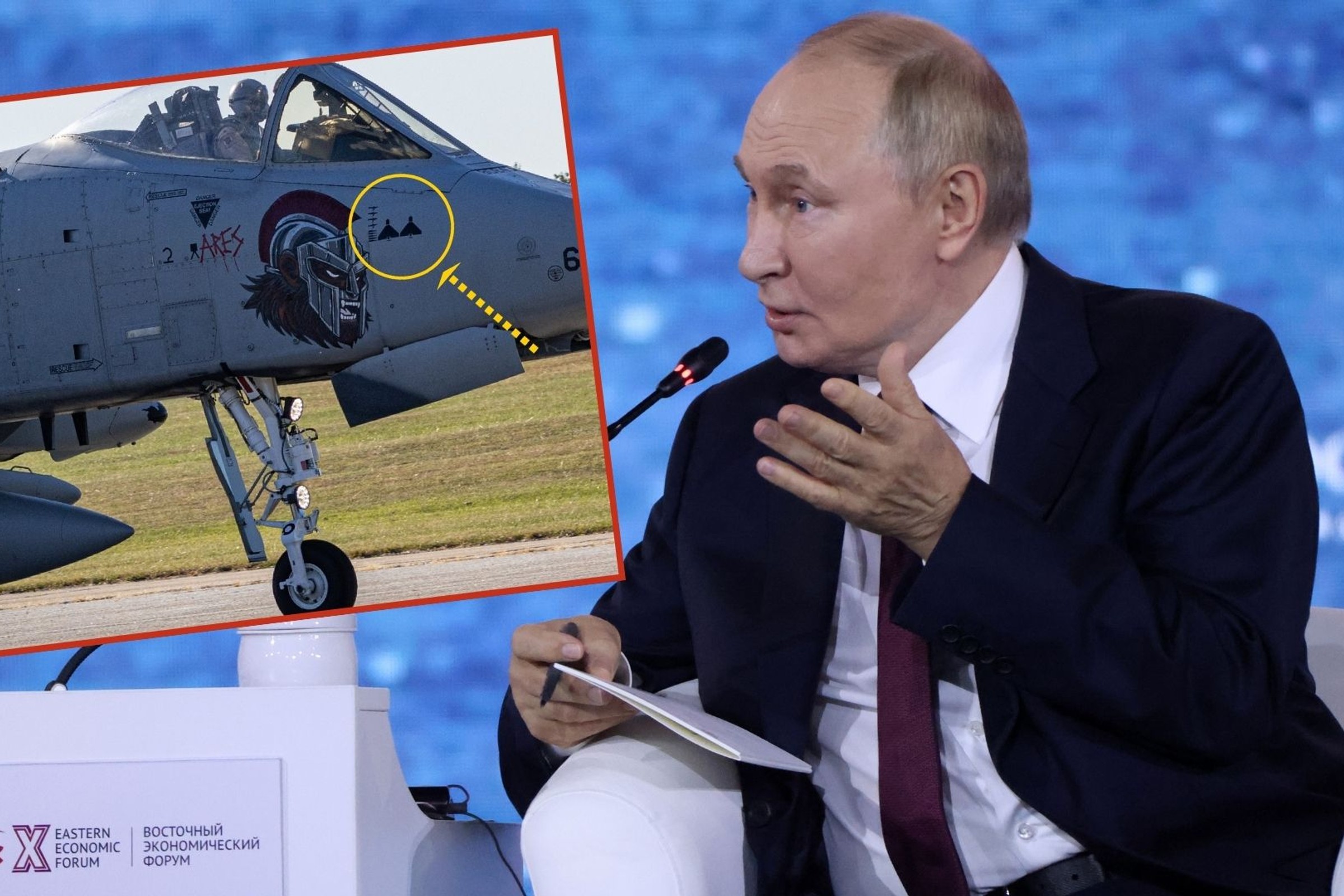
In the photos published on Saturday on Portal
It was spotted at Portsmouth Airport in New Hampshire, a it had markings on its bow suggesting that he managed to shoot down Iranian Shahid-class drones.
As reported by the military website The War Zone (TWZ) on Monday, October 14, the aircraft returned from a six-month mission in the Middle East, when in June US forces took action to intercept Iranian drones attacking Israel.
Markings on the A-10 aircraft likely indicate that Ares participated in this or subsequent actions – although U.S. Air Force Central Command (AFCENT) declined to confirm their involvement “due to security concerns.”
In July, several military commentators reported that the United States had diverted large numbers of missiles with APKWS II laser guidance modules to its forces in the Middle East.
The missiles were modified and turned into cost-effective air-to-air weapons [czyli kierowaną broń wystrzeliwaną z samolotów i śmigłowców] to combat drones, constituting an alternative to multi-million dollar AMRAAM missiles [szacowany koszt wynosi od 1 mln do 3 mln dol. (ok. 3 mln 500 tys. — 11 mln zł) za pocisk, w zależności od wersji]. They will be carried by F-16 and F-15 fighters, as well as A-10 – the use of the latter seems to be confirmed by photos published on X.
Save the “wild ones”
The official name of the Warthog plane [ang. guziec] is the Fairchild Republic A-10 Thunderbolt II. It is a single-seat, effective and damage-resistant attack aircraft, powered by two turbofan engines, which entered service in 1977. The United States Air Force has been trying to retire the A-10 aircraft for several years because it considers them too slow and vulnerable to attacks by air defense systems on the modern battlefield, such as the Russian S-300 and S-400 [z rodziny rakietowych systemów przeciwlotniczych produkcji radzieckiej].
For this reason, the plan was to completely retire all Warthog aircraft by the end of fiscal year 2026 (September 30) and transfer their close air support (CAS) duties to the F-35 Lightning II and F-15EX. However, the latest version of the annual National Defense Authorization Act [National Defense Authorization Act, NDAA] proposed blocking a full withdrawal and keeping about 100 A-10s in service to phase them out gradually.
During the initial period of Russia's invasion of Ukraine, there were calls from some quarters to transfer the Warthog aircraft to Ukraine, which was still using Soviet Su-25 twin-engine attack planes (NATO designation: Frogfoot) – inferior to the A-10 in both capability and protection. This idea was rejected not only due to the threat from Russian ground-launched missiles (SAMs), including the S-300 and S-400, but also due to the presence of Moscow fighters in the absence of air superiority over the battlefield.
However, this was before the advent of drones.
The article continues below the video
Warthog as a drone hunter
Using A-10 attack aircraft as “drone killers” is an attractive proposition because their ability to hover over terrain for long periods of time, low cruise and maneuverability make them suitable for combating relatively slow-moving propeller-driven drones such as the Russian Shahids. Ukraine uses helicopters such as the Mi8 (NATO designation: Hip), and Israel uses AH-64 Apache attack helicopters.
Even though the A-10 is considered a slow jet, it is still superior to most helicopters – but it lacks the advanced radars and infrared sensors that make the Apache an effective drone killer. However, he could fulfill his function in Ukraine.
Implementing a data link that interfaces with Ukraine's mature early warning and drone and missile tracking system could direct the A-10 to the target area. It could be used to protect cities and infrastructure relatively far from the front lines – leaving US Patriot systems and other Western air defense systems to protect important targets.
The A-10 has 11 external weapons suspension points – eight under the wings and three under the fuselage. It can carry up to 7,200 kg of bombs, missiles and rockets, as well as a 30 mm GAU-8/A Avenger autocannon designed for armored targets. If used solely in a counter-drone role, these hang points could theoretically accommodate 11 APKWS II launchers.
One caveat: use of the Warthog is hampered by the lack of airborne radar and would require special support from ground intercept controllers or AEW&C early warning aircraft using close control procedures.
The Warthog pilot would then have to visually lock on to the target while flying at night using night vision devices, and then direct the overhead targeting pod to illuminate the drone using the onboard laser.
It would require specialized pilot trainingwhich would be best conducted by instructors with combat experience in the fight against Shahid drones in the Middle East.
The combination of Warthog and APKWS II has the potential to make a significant and relatively cheap step forward in the fight against the ubiquitous drones that Russia uses to attack Ukraine. All we need is a person with imagination to implement this solution.