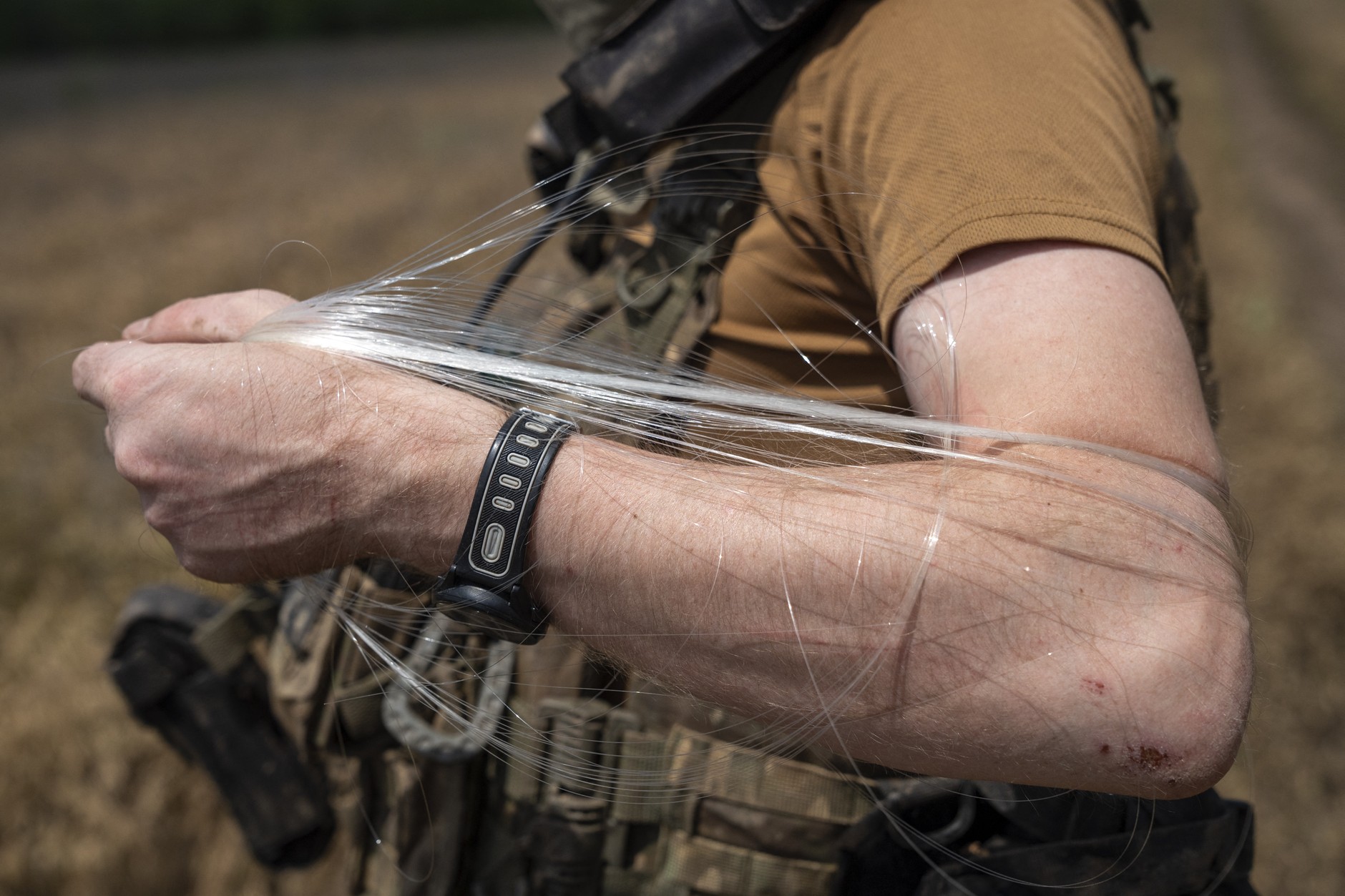
This year, the Russian army almost overtook the Ukrainian Armed Forces in the drone war. After the operation to liberate the Kursk Oblast, it began actively using fiber-optic drones on the front.
The thinnest cable allows the operator to control the devices without fear that the enemy will throw them off course using electronic warfare methods, jamming the signal. “It is difficult to defend against such drones,” notes Samuel Bendett of the Center for a New American Security, a Washington think tank. — And they can cause significant damage – he adds.
In particular, they effectively cut off the routes through which supplies reach Ukrainian soldiers, and also hunt civilians who remained in towns close to the front line.
Without China's help, the success of such operations would be much lower.
The scale of deliveries to Russia is incomparable
According to data from the Chinese customs office, record amounts of fiber optic cables were exported to Russia in May and June – 190,000 in length and 190,000 in length, respectively. 400 km and 208 thousand km. In August, this indicator increased almost tenfold – to 524,000. 800 km, reports “The Washington Post”.
The high value of shipments in relation to their weight, recorded since the end of 2024, indicates that these are cables for military use, notes Joseph Webster, a senior researcher at the Atlantic Council, who monitors export growth, in an interview with the Journal.
The article continues below the video
Fiber optic drones can cover distances of up to 20 km. August deliveries from China alone, if entirely used to power drones, should be enough for 26,000. 240 devices.
China also exports fiber optic cables to Ukraine, but the scale of deliveries to Russia is incomparable: in August it amounted to only 115 km.
Analysts also point out that in the summer, when Russia significantly intensified its bombing of Ukrainian cities, sending over 500 drones in one raid, Chinese deliveries of lithium-ion batteries also increased rapidly, reaching a record $54 million in June. (PLN 199 million).
“They are probably used to power drones because Russia doesn't produce many electric vehicles or electronics — the other main areas of application for this technology,” Webster says.
Beijing's key role
China has officially stopped deliveries of ready-made drones to Russia, but the export of the necessary components shows that continue to support the Russian arms industry. “This is crucial,” notes Katerina Bondar, a researcher at the Washington Center for Strategic and International Studies. “The Chinese play a big role here because they are willing to adapt their production lines,” he adds.
A Ukrainian soldier tests fiber-optic drones in the Donetsk region, June 17, 2025.JOSE COLON / ANADOLU AGENCY / Anadolu Agency via AFP / AFP
Lighter and longer cables allowed the Russian army to expand the range of its attacks. On October 5, the authorities of Kramatorsk, located approximately 20 km from the front line, reported the first attack of fiber optic drones.
— If you look at the changing front line, then [Rosja] it takes over the territory in fragments corresponding to the distance that fiber-optic drones can cover – points out Bondar.
At the same time, despite the Kremlin's requests to increase trade, all Chinese products are exported to Russia it's falling this year. During the nine months of this year, the decline was 10.6%, and in September alone it was 21%.
I’m Ashley Davis as an editor, I’m committed to upholding the highest standards of integrity and accuracy in every piece we publish. My work is driven by curiosity, a passion for truth, and a belief that journalism plays a crucial role in shaping public discourse. I strive to tell stories that not only inform but also inspire action and conversation.