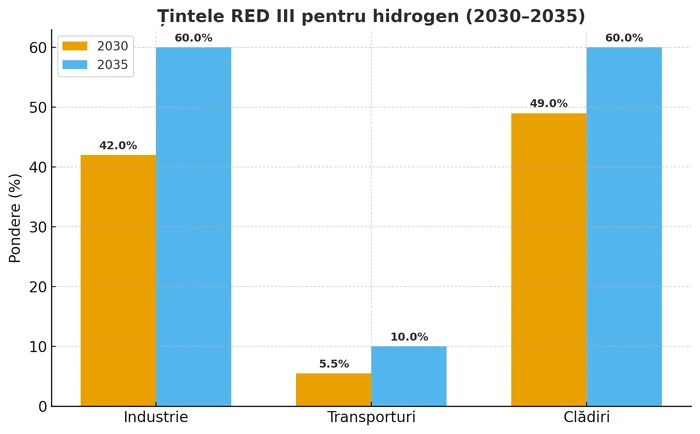
Green hydrogen is no longer a fiction, but compulsory policy at European level, considering that, through the Red III Directive, the Member States, including Romania, are obliged to introduce clean hydrogen in industry and transport.
By 2030, almost half of the industrial hydrogen should be green.
By 2030, almost half of the industrial hydrogen should be green. Hard transport also has targets: at least 5.5% of the final energy consumption comes from hydrogen or synthetic fuels. “The stake for Romania is huge: the decarbonization, the storage of energy and sun that is now lost, billions of euros and a place on the European energy map”, Say the experts of the Intelligent Energy Association) ai =.
Romania has resources, but the infrastructure is zero
According to them, Romania already produces 200,000 tons of hydrogen a year, but almost everything is “gray”, Obtained from gases. Cheap, but polluting hydrogen, used almost exclusively in the chemical industry. The official plan concerns a change of direction.
The national hydrogen strategy provides by 2030 the installation of 2,100 MW of electrolyzers and the production of 153,000 tons of green hydrogen – enough to replace the fuel consumed by 1.1 million gasoline cars. The volume remains close to the current one, but the quality changes: from polluting gas, to clean hydrogen, wind, sun and water. The plan also provides for five “Hydrogen valleys ”regional networks that connect the production of large consumers.
The problem is the infrastructure: there are no pipes, power stations or dedicated support schemes. Law 237/2023 offers only a general framework. Without clear norms and financial incentives, projects are likely to remain blocked.
Romania has a few pilot projects
The transition to green hydrogen has begun, but shy. Romania has only a few notable projects: RO-Hydrohub from Râmnicu Vâlcea (140 million euros from PNRR), OMV Petrom's installation of 20 MW from Petrobrazi and a 2.5 MW urban unit in Cluj. In parallel, Delgaz Grid tests the hydrogen mixture with natural gas in distribution networks, to verify the safety of use in boilers and household appliances.
Not all projects went well. Hydrogen trains, a 360 million euro project, were canceled after three failed auctions. The funds were redirected to road infrastructure.
West accelerates projects
While Romania is just beginning, other European countries accelerate. Germany is already supplying trains and hydrogen steel. The Netherlands builds a network of 1,200 km of pipes, with investments of over 1.5 billion euros. France and Spain develop ports and synthetic fuels for aviation and maritime transport. In all these cases, hydrogen is used as an energy deposit: it occurs when there is surplus and is used when the network needs.
Romania was one of the pioneers of the hydrogen industry
Few know that Romania was, a century ago, among the European pioneers of the hydrogen industry. In 1922, in Târnăveni, it was produced for the first time in European industrial Europe, and for the world premiere – ammonia based on hydrogen extracted from methane. During the interwar period, at Copșa Mică and Făgăraș, modern ammonia and formaldehyde factories appeared.
After decades of decline, this technological heritage seems forgotten. But history shows that Romania once had know-how, research and competitive chemical industry-resources that it could rediscover today.
Ioan Iordache, director of the Association for Hydrogen Energy in Romania, points out that there is no time for delays: “Our politicians are still leaving her with the hubs and the idea of a regional player, that it does not seem like an exhortation, but only words in the wind. If you want to be a player – regional, national, local, it doesn't matter – you have to put resources: financial, material, human … something concrete, not just words! Either this is missing: no resources are allocated, and when something is done, so many delays, resumptions or small amounts appear, that some give up”.