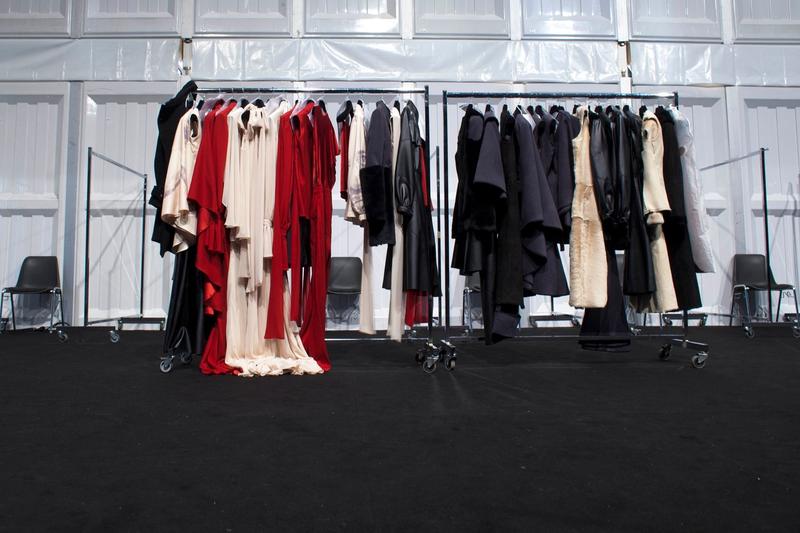
Collection of clothes, photo: Markus Schreiber / AP / Profimedia
A pair of fast fashion jeans has “5,178 impact points”, compared to “1,428 impact points” for a similar Made in France, according to environmental costs displayed on the label, extent that entered France on Wednesday, a premiere in Europe, AFP reports, taken over by Agerpres.
In his boutique in the Marais neighborhood in the center of Paris, the founder of the 1083 brand has a poster that presents the environmental scores of its jeans. “Our challenge is to popularize this label, so that politicians have no choice but to defend it,” explained AFP Thomas Huriez, who began to implement this label before the entry into force.
This is not mandatory: provided in the law on climate and resilience (2021), it had to be mandatory until 2024, but it is eventually voluntary, to allow the European Union to complete its development of a future mandatory ecological labeling system and thus avoid imposing the French frame before the European model.
The French labeling system is presented in the form of a point score: the higher the number, the higher the impact on the environment. This impact is calculated on the basis of water consumption, greenhouse gas emissions, toxicity, recycling or repair options, microplastic fiber volume during washing and a “fast fashion coefficient” that takes into account the production volumes.
Costs are supported by the manufacturer
But how can this score be calculated in the case of supply chains that concentrate a huge number of suppliers, often from several countries, for a single clothing item?
For 1083, nothing could be easier: jeans are woven, tailored and manufactured in France. “We do not have 100 suppliers to contact,” ensures Huriez, adding that the brand works with three painters, two in France, one in Italy. And that organic cotton comes from Tanzania, and the linen and wool in France. “We have built this brand to manage everything” since its launch in 2013, stresses the company's director.
However, ecological responsibility and profitability do not exclude each other. In addition, the products are not necessarily more expensive: a pair of 1083 jeans costs between 100 and 150 euros, like any other pair of brand, and Cyrillus “has slightly smaller margins” so as not to impair the cost of its CSR policy (corporate social responsibility) on its products, revealed to AFP its director, Herve Bailly.
Convinced of the relevance of ecological labeling, Le Slip Francais regrets that “no government help” is allocated to help the brands. The Made in France brand estimates at 100,000 euros the investment it has to make to evaluate 1,000 of its ecological score products.
Between 2025 and 2026, this system is expected to be adopted by several tens of brands, according to the Minister's Cabinet for the ecological transition, interviewed by AFP.
However, the adoption of the display of the echo-screen is not risk-free for voluntary brands. They must report their data while waiting for possible inspections from the anti-fraud department, clarified the minister's team, Agnes Pannier-Runacher.