How will Trump will change Europe? “In 4 to 5 years, the Trumpist wave that haunts everywhere will reduce its intensity” | ANALYSIS

What effects will Europe have on Europe in the following years the wave of trumpism and national-populism that haunts throughout the old continent? It is the question to which Professor Sergiu Miscoiu, a political analyst who studied radical movements and speeches answered.
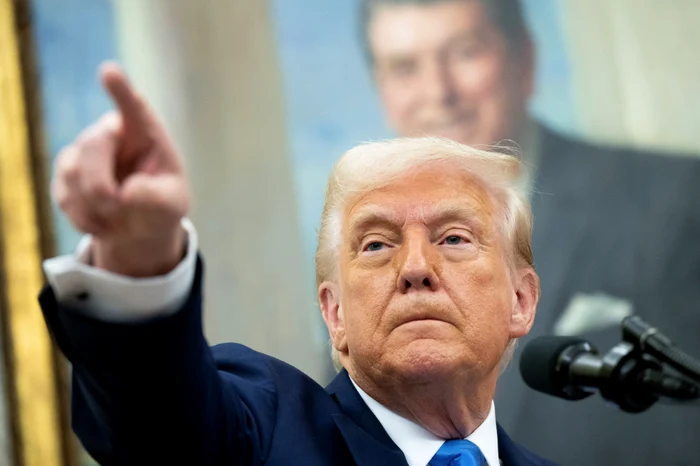
Donald Trump's threats have rehabilitated the EU image among Europeans. Photo: AFP
The Eurobarometer Utim shows us, in all European countries, the highest level of support for the EU since such measurements are performed: 70% of Romanians and 74% of Europeans believe that their country benefits from belonging to the European Union.
However, when European citizens vote, things seem to be different. The extremist movements and parties have obtained, everywhere in Europe, record scores lately, from France and Germany, in the Netherlands and Austria, and until Romania. Also, in the European Parliamentary elections, the extremist parties achieved historical results.
The pandemic, the Ukraine war and the economic problems that Europe faced have fueled people's dissatisfaction and distrust in the authorities, and in this context the extremist movements have gained more and more supporters.
The return to Donald Trump's White House and Pro extremist messages from influential leaders around the US president also contributes to increasing the power of these movements.
Sergiu Mişcoiu, a professor at Paris-East Créteil University and at Babeș-Bolyai University in Cluj, dedicated much of the activity of radical movements and speeches. In the context in which he recently participated in a conference in Brussels in which the scenarios were analyzed about the future social confrontations in Europe, the teacher explained for “Adevărul” to what we can still expect in terms of extremist movements and parties.
The most spoiled scenario in Miscoiu's opinion
“It was an interesting conference, because it consisted largely not in exhibitions, but working on scenarios together with specialists from several parts of the world, not just from Europe. Several scenarios were outlined for the future social confrontations in Europe on the horizon of the 2040s ”the researcher said.
The most spoiled scenario, says the teacher, “It is also the least spectacular, but the one that continues the current tendency, namely the continuation of the increase of polarization, the increase of the social conflicts manifested including by public violence, but without spectacular escalation, without a direct confrontation between various sociopolitical categories, without an absolute confrontation ”.
This scenario estimates that after another 4 to 5 years, the Trumpist wave and the new national-populism that haunts everywhere, would get to reduce your intensity. “It will not disappear, but it will remain quite important, but it will decrease in intensity, which could not generate a escalation of the confrontation, but rather a maintenance of it at a controllable level ”, says the expert.
The positive consequence of Trump's threats
The decisions of the Trump administration regarding Europe also had another interesting effect: the rehabilitation of the image of the European Union, which becomes the element of stability in a changing world that risk endangering the security and well-being of Europeans.
“It is a positive consequence of the current crisis. This is related to this wave of adhesion to a common European project. It is not necessarily the same European project, it is rather a common design of a protective identity and it will provide a higher maneuver to European leaders. I tell European leaders and not to the European Union, because, unfortunately, in the European Union. Unanimism, suffers from the existence of people who lead various states, who can at any time to mine the respective project, to oppose a veto towards the decisions that can be taken ”, explains the teacher.
There is a wave of confidence and a positive design in this dynamics of Europe to strengthen its own way to the other spheres of geopolitical influence.
“At present, this positive attitude had to be used to push the European project before pushing and to overcome, for example, including these unanimous voting vote. There should be a more focused momentum on reforms in the European institutional apparatus, precisely to make Europe to make decisions in a much more supple way, coming to what they want the citizens of the Member States ”, Miscoiu explains.
More European Union
Mişcoiu argues that we will have in various fields a European integration, at least partially, more accelerated.
“It is clear, for example, that in the field of defense – where the integration was reduced – we will have a stronger integration. But this field of defense does not come alone, it will have to come with various types of related industries, other elements related to foreign policy, decisions, including sociopolitical systems, which will inevitably integrate. So, as a whole, the degree of integration will increase if these common defense policies will be operationalized. Directly or indirectly this degree can only grow in the next phase“, Said the teacher.
Extremists who arrived in the European Parliament alter their speech
Asked about the evolution of extremist parties after entering the European Parliament, Miscoiu claimed:
“There are various tracts of the parties who arrived in the European Parliament. Part of the parties that originate were anti-European or Eurosceptic were divided, which is why we have three groups with different degrees of Euroscepticism in the European Parliament. ”
Most of the European parliamentarians coming to these parties are less radical than they were before being MEPs, he says.
“And this is also explained by socializing within the European Parliament, the fact that they have to collaborate with various parliamentarians from other parties, to create occasional majorities for various projects that had nothing to do with these issues related to sovereignty or identity that concern them in particular,” detail the teacher.
In addition, there is also a more pragmatic approach.
“Many Romanian MEPs, and not just Romanian, feel good when they have salaries from the European Parliament, the maneuver margin that the European Parliament gives you and do not want to lose this status, that is, they realize the benefits of European integration.”explains the teacher.
Therefore, yes, the speech of many of them is relativized. “This does not mean that he will ever go in the direction of supporting confederalist projects in Europe. But, often they will not oppose as much resistance as they are.”says Mişcoiu.
Thus, we often have two speeches of this kind: a speech and behavior in the European Parliament, intended to increase influence within Parliament and maintain representation at a high level there, this discourse is worse. “Then, we have a speech for the internal electorate, in which they are said to be wanted and unvacted about Europe to capitalize and be voted in national elections, but also in European election. This double game often leads to the relativization of the anti-European violence of the MEPs in these parties ”, Miscoiu concludes.