
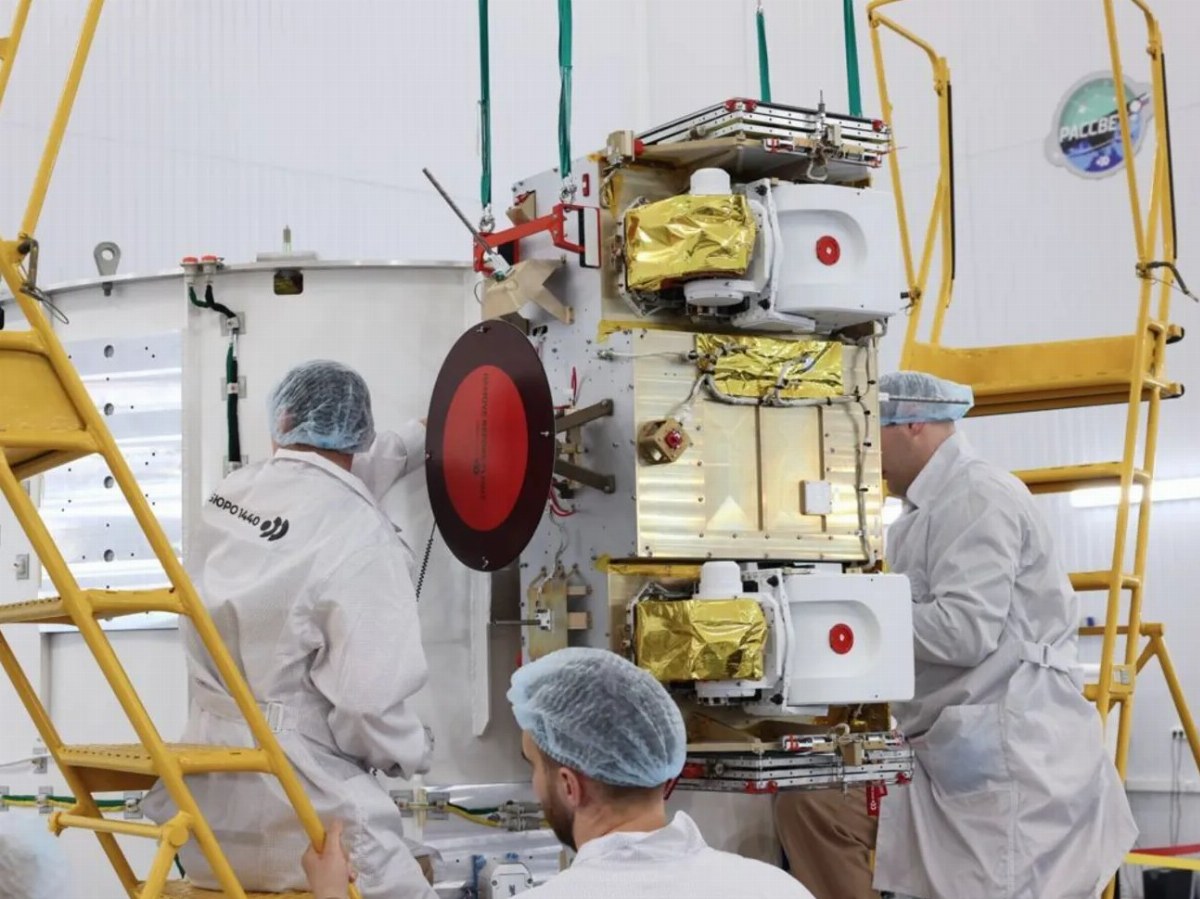
According to reports, Russia’s “Rassvet-3” series has suffered the loss of its second satellite, which was deployed into low Earth orbit on July 19 by a Soyuz-2.1B rocket as part of a batch of 16 satellites. The satellite, identified as the 17th in the series, reportedly failed to activate its propulsion system since its launch, leading to orbital decay due to atmospheric drag. This deterioration resulted in its orbit dropping to a critical level after three months and eleven days, ultimately causing its destruction.
This incident marks the second satellite from the “Rassvet” group to descend from orbit under similar circumstances, following the crash of the “Rassvet-3” satellite number 4 in early June, which had been launched in March during the first batch.
Defence Express highlighted that two satellites from the second batch, specifically numbers 17 and 23, were at risk of losing their orbits. However, efforts were successful in salvaging satellite number 23, which has since been elevated to an altitude of approximately 300 kilometers and continues to gain height after a rapid increase in its orbit.
Furthermore, the portal noted that the overall situation for the “Rassvet” satellites is progressing, albeit slowly, with 26 out of 30 satellites in the “Rassvet-3” series now achieving an orbit at an altitude of 500 kilometers. An additional satellite, number 11, is also expected to reach this altitude soon. Despite the planned operational altitude of 800 kilometers for the “Rassvet” constellation, all satellites from both batches are currently settling at around 500 kilometers, where they are spaced out and establishing necessary orbital positions.
Once all satellites reach this height and position, they will commence synchronized rising and spreading across the orbital length. Thus, the fact that all “Rassvet” satellites are currently at 500 kilometers should not be viewed as a mission failure, as they are already operational in a testing phase at this altitude.
The article further indicates that the manufacturing company is actively testing and trialing its terminals in remote regions of Russia. Reports have also surfaced about the terminals being used aboard Russian drones during attacks in Ukraine.
Despite the slow rollout of the “Rassvet” program, it continues to progress successfully. The losses of satellites are seen as a normal occurrence, particularly for initial series versions and launches, drawing a parallel with the early deployments of Starlink satellites, where out of 60 launched, 10 did not succeed in orbit.


