
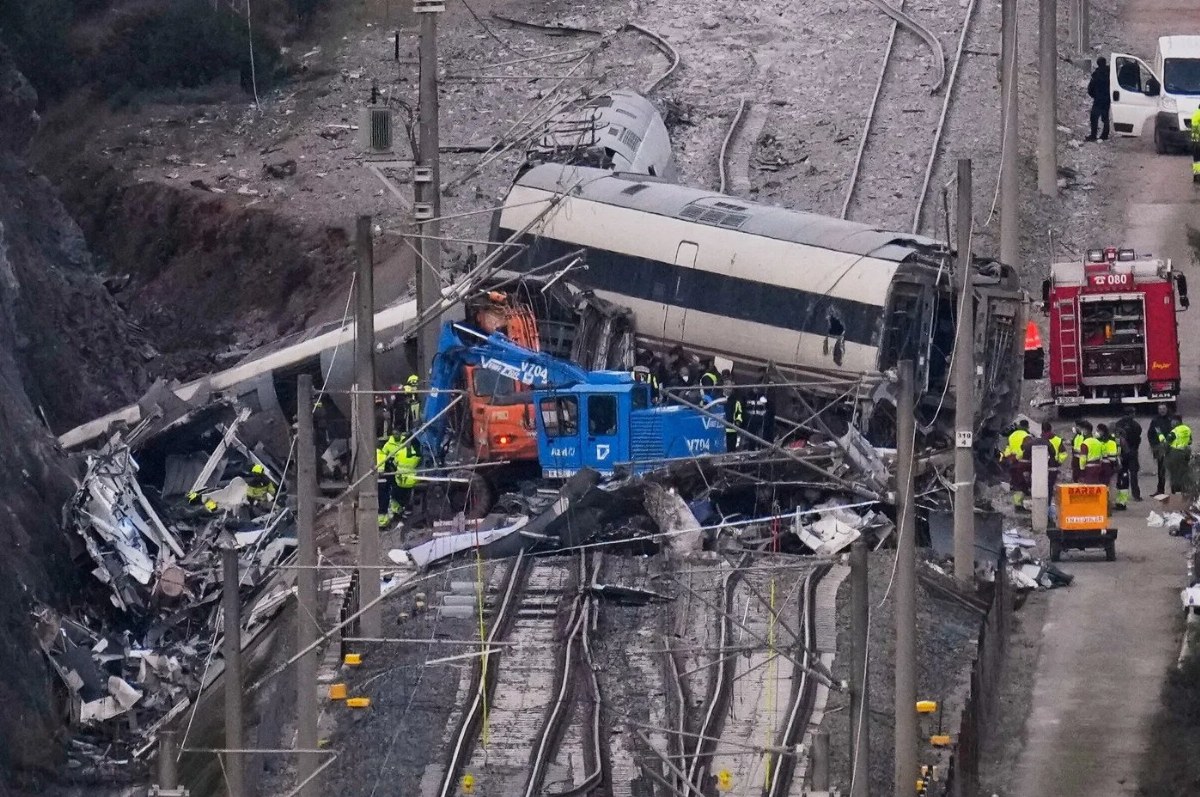
A train accident in January in Spain has sparked intense discussions regarding the level of investment in railway maintenance in recent years.
On Wednesday, two high-speed trains collided on the line connecting Madrid to southern Andalusia, resulting in numerous fatalities and injuries, as reported by the railway operator Adif.
This collision occurred only nine months after another high-speed train accident on the same route, which left 46 people dead.
The January 18 incident, which involved a train derailing and colliding with an oncoming train near the town of Adamuz in Córdoba province, has raised questions about recent investment in railway infrastructure, according to reports.
Faulty Track Identified
The tragedy unfolded when a train heading to Madrid, operated by private company Iryo, derailed and veered into the opposite lane, colliding with a train operated by the state-owned Renfe.
An initial analysis released in January by Spain’s Railway Accident Investigation Commission (CIAF) indicated that the track was cracked prior to the derailment, a finding later supported by a preliminary joint report from CIAF and Guardia Civil in April.
The April report noted, “the data analyzed does not indicate any anomaly in either of the two involved trains.”
Instead, the analysis concluded that at the moment of the incident, the Iryo train “was traveling at a point where the outer rail had broken,” leading to a clear determination: “the cause of the derailment and subsequent collision is a broken rail.”
Fracture Detected Before the Accident
The Guardia Civil’s investigation in Córdoba also revealed that 22 hours before the accident that claimed 46 lives, a sudden drop in tension in the railway circuit was detected, consistent with a rail fracture.
However, no alert was triggered as the tension remained above the 0.78V threshold at which the infrastructure manager Adif records warnings. The recorded drop of 0.5V persisted for nearly a day, a situation investigators described as extremely unusual.
Although “an electrical variation compatible with a break was recorded,” the signaling system “was not configured to automatically trigger an alarm due to a lack of reliability,” according to the report cited by Spanish media.
The Guardia Civil stated that the recorded voltage variation from the evening of January 17 until the moment of the accident “is not typical,” but that the technical possibility of receiving alerts about it “needs to be clarified.”
Final Report Still Pending
The report also ruled out sabotage, acts of terrorism, and negligence by the locomotive engineers.
Meanwhile, the regional government of Andalusia is assessing potential legal actions, while the Ministry of Transport has launched its own investigation to determine why the track fracture did not trigger an alert, according to Euronews.
The Spanish government announced in January that it would provide €20 million in compensation to the families of the victims of the Adamuz accident, which injured 150 people.
In July, Spanish media reported that the final report on the accident is still not ready and could take approximately another year to complete.


