
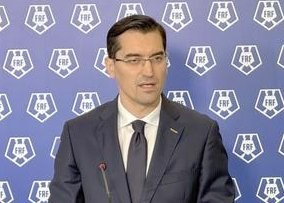
Following the national team’s recent string of losses, including a staggering 1-7 defeat to Spain by the U21 squad, Răzvan Burleanu, president of the Romanian Football Federation (FRF), stepped out of his ivory tower to address the public. His lengthy speech, which felt like an eternity, was filled with corporate jargon and lacked any substantive insights. He confidently assured fans of a bright future for Romanian football, yet many remain skeptical.
Amidst the grandiose rhetoric, it was apparent that FRF intends to continue with coach Gheorghe Hagi despite the series of failures. Burleanu, who has held his position since 2014, proclaimed, “I can assure you that by the end of my term in 2030, I will leave behind a much stronger football than what I found here in 2014, with improved infrastructure, greater sustainability, and increased opportunities for youth players to pursue football.”
His statements prompted applause from his supporters, including federal secretaries Vișan and Bodescu-Vulcanizare, as they celebrated what they deemed progress in Romanian football.
However, Burleanu’s claims are easily contestable. Since he assumed office, Romania has dropped from 31st to 58th place in the FIFA rankings, a decline of 27 positions. His assertion that he has improved Romanian football appears contradicted by the facts.
Additionally, the landscape of Liga 1 (Division A) has worsened since 2014, with six teams—Astra Giurgiu, Pandurii Tg. Jiu, CSMS Iași, Gaz Metan Mediaș, FC Brașov, and Ceahlăul Piatra Neamț—either dissolved or playing in obscurity, making up one-third of the league’s participants.
In Liga 2, the situation is even more chaotic, with half of the teams, 11 out of 22, lacking promotion rights, making their efforts seem pointless.
The supposed progress in showcasing local talent is misleading as well. The number of foreign players in the Superligă has surged from 199 out of 586 (34%) in 2014 to 203 out of 407 (nearly 50%) this season, casting doubt on Burleanu’s claims of fostering local talent.
Despite the introduction of the U21 rule in 2016-2017, which faced opposition from many clubs, the situation has not improved. Instead, Burleanu and his supporters have led the football federation into a quagmire. It is, perhaps, the height of arrogance to boast while the realities of the sport spiral downward.


