
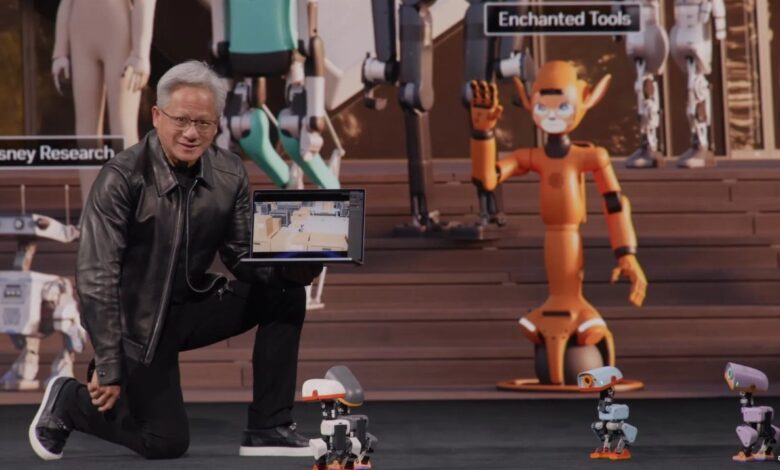
Jensen Huang, the CEO of Nvidia, asserted that Europe’s engineering expertise gives the continent a significant edge in physical artificial intelligence (AI) and robotics during a speech on Wednesday. This statement came as the American technology giant announced its plans to expand partnerships with manufacturers and startups in Europe.
“Every company in Europe will become an AI company,” Huang stated, adding, “we will have a thriving AI economy here in Europe.” His remarks were delivered at the GTC conference in Berlin, dedicated to artificial intelligence, which marked the conclusion of a European tour that previously took him through London, Paris, Stockholm, and Dublin, according to reports from Reuters and AFP.
Huang emphasized that, “No region has dedicated itself to creating mechatronic, electronic, and mechanical systems with the precision and craftsmanship comparable to that of the European region.” He stressed that for Europe to fully benefit from AI, all industries must adopt and succeed with it, naming automotive, robotics, pharmaceuticals, and financial services as target sectors.
As a showcase of European creativity in AI, Huang shared the stage with tiny, AI-trained robots resembling ducks, developed by the French startup Pollen Robotics in collaboration with Hugging Face, instructing them to perform flips.
Nvidia claims to have invested nearly $10 billion into the European tech ecosystem. The company has secured an early advantage in providing the processors and software necessary for “robotic brains,” giving it a vested interest in the success of the European industry.
Among the partnerships announced on Wednesday, the German company Agile Robots intends to produce between 1,000 and 2,000 small humanoid robots next year in collaboration with Nvidia, as reported by CEO Zhaopeng Chen. Production is expected to commence later this year.
Huang noted that Europe—often overshadowed by the U.S. and Asia in the AI race and lacking a major local player like Nvidia, Anthropic, or OpenAI—needs to ensure it plays a central role. He stated, “To be part of this AI-based economy, you don’t just want to consume AI; you want to produce AI. We could do all of this right here in Europe.”
Separately on Wednesday, Nvidia unveiled a new DSX POD design for mass-produced data center modules using its Vera Rubin platform. The company asserted that these modules can be deployed in just two weeks, compared to six months previously.
On-Stage Mishaps at the Berlin Conference
However, not everything went smoothly on stage.
The mini-ducks demonstrated that even with AI power, getting robots to follow instructions can be challenging. Three of the robots fell over immediately when Huang asked them to take a nap, while the fourth required a bit more encouragement. One of the robots seemed distracted and was turned away as Huang concluded his speech. “Pay attention, stay focused,” he admonished firmly.


