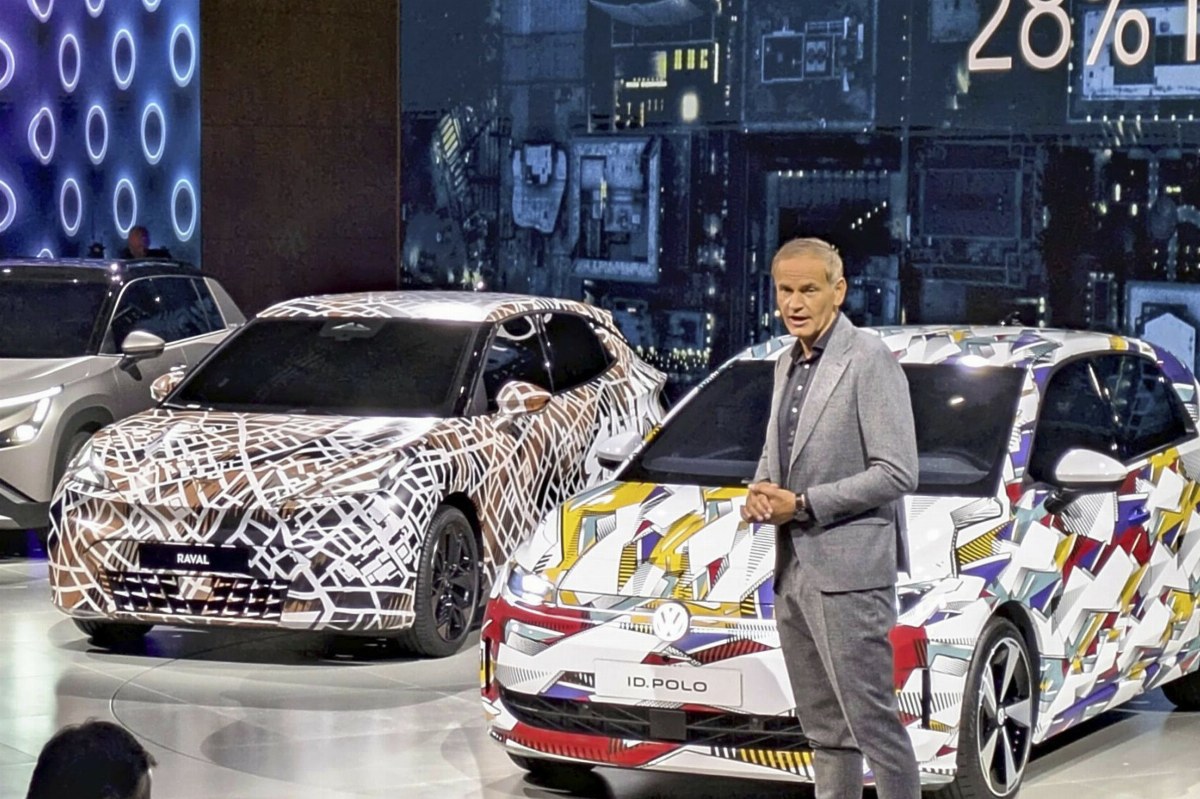
At the Paris Motor Show, German automaker Volkswagen returns after a decade-long absence, seeking to leverage industry events not just for showcasing new models, but to influence political decision-making. CEO Oliver Blume’s strategy echoes his previous approach at the Munich IAA festival, where he lobbied for the easing of the EU’s ban on combustion engines. This time, the focus is on urging Brussels to take stronger defensive actions against unexpectedly robust competition from Chinese manufacturers.
Volkswagen is facing significant challenges, including cuts and the termination of agreements with labor union IG Metall, which involves ten different pacts related to working hours and additional compensation. Blume’s initiative to hold a dedicated panel with French Industry Minister Sébastien Martin signals a growing alignment between Germany and France concerning market protections. Just months prior, a divide existed between the two nations over how to handle competition from China, with France advocating for stronger market safeguards through tariffs and a preference for locally produced vehicles in public contracts.
China has already retaliated against punitive EU tariffs on electric vehicles by imposing luxury taxes, contributing to a downturn in sales for VW’s Porsche brand within the country. Historically, the German automotive industry has warned against provoking China, but the narrative is rapidly shifting.
Blume stated, “This is a moment when France and Germany, as Europe’s largest automotive markets, must collaborate. Europe is at a disadvantage in terms of energy costs, labor, and bureaucratic burdens, while China subsidizes its industry, creating an unfair environment. This is about developing an industrial policy aligned with European interests.” The stance of the German automotive association, Verband der Automobilindustrie (VDA), is evolving as Chinese manufacturers significantly increase their market share, now reaching 13.5% in the German electric vehicle segment as of September.
Despite concerns over a potential trade war, the reality is that European firms are already experiencing a decline in sales due to market forces and technological lag in electric vehicle production compared to their Chinese counterparts, coupled with substantial subsidies for new Chinese manufacturers.
German executives have conceded substantial losses to competitors and no longer expect a return to previous market conditions. Consequently, they are less apprehensive about imposing further trade barriers. Minister Martin agreed, stating that the EU’s tariffs on Chinese electric vehicles were justified and have yielded immediate results, noting a drop in the Chinese market share in France from 40% to 11%. He emphasized the need for protective mechanisms that ensure fair competition.
The critical question now is how far the European Union will go in implementing these protective measures, especially as European automakers increasingly rely on Chinese chips and batteries—a situation that poses risks for both sides. China’s reliance on Europe for market access for both its vehicles and newly developed battery technologies complicates the dynamics.
Recently, the German automotive industry welcomed news from EU Trade Commissioner Maroš Šefčovič, who announced a compromise regarding potential tariffs on hybrid vehicles following his trip to Beijing. Blume expressed satisfaction with the progress in discussions, indicating that China may willingly limit its export pressure on Europe, although practical details remain vague ahead of an upcoming EU summit.
Volkswagen, which is under financial pressure, is particularly interested in this development, especially as its Chinese partner, Gotion, has committed to enhancing investment in European battery production facilities. Blume is now advocating for reduced electricity costs across Europe for both producers and consumers, anticipating that increased production in Europe will lead to higher vehicle prices for buyers. This is seen as the cost of pursuing European autonomy.
As the EU prepares for discussions that may result in preferences for European vehicles, originally a French initiative, German manufacturers stand to benefit as well. Blume has publicly supported such measures, aligning with Martin’s views. VW’s brand director, Thomas Schäfer, even promoted the idea that electric small cars should be highly prioritized in CO2 value assessments, regardless of pushback from premium segments like BMW and Mercedes.
With increasing concerns about competitiveness overshadowing previous climate priorities, the automotive industry’s lobbying efforts, which peaked at the IAA, appear to be making headway. There is a growing possibility of a compromise between Germany and France regarding the EU’s ban on combustion engines, which could provide significant relief to the industry. However, reports suggesting that Chancellor Friedrich Merz and French President Emmanuel Macron may have agreed on a lower CO2 reduction target of 80% by 2035 remain unconfirmed. Nonetheless, a potential easing of regulations may extend beyond earlier expectations of a 90% target set by the European Commission last year.
In Paris, discussions are scheduled between European automotive executives and the president, as electric vehicle sales are already on the rise, partly due to high gasoline prices and advancements in battery technology. This situation could lead to a future where regulations on combustion engines have minimal impact, with financial penalties being sidelined. For VW’s CEO Blume, such an outcome would represent a significant relief amidst ongoing challenges.
Amidst these discussions, Blume is also contending with labor disputes concerning Volkswagen’s facilities in Germany. With uncertainty looming over production at key plants in Emden, Hanover, Zwickau, and Neckarsulm through the 2030s, ongoing tensions with labor councils and IG Metall may culminate in further conflicts after the new year. At the Paris show, Blume is aiming to bolster his credibility by highlighting VW’s €1 billion investment in Spain for a new lineup of small vehicles, showcasing how European investments can protect jobs and sovereignty. He believes that European policies should reward such initiatives.