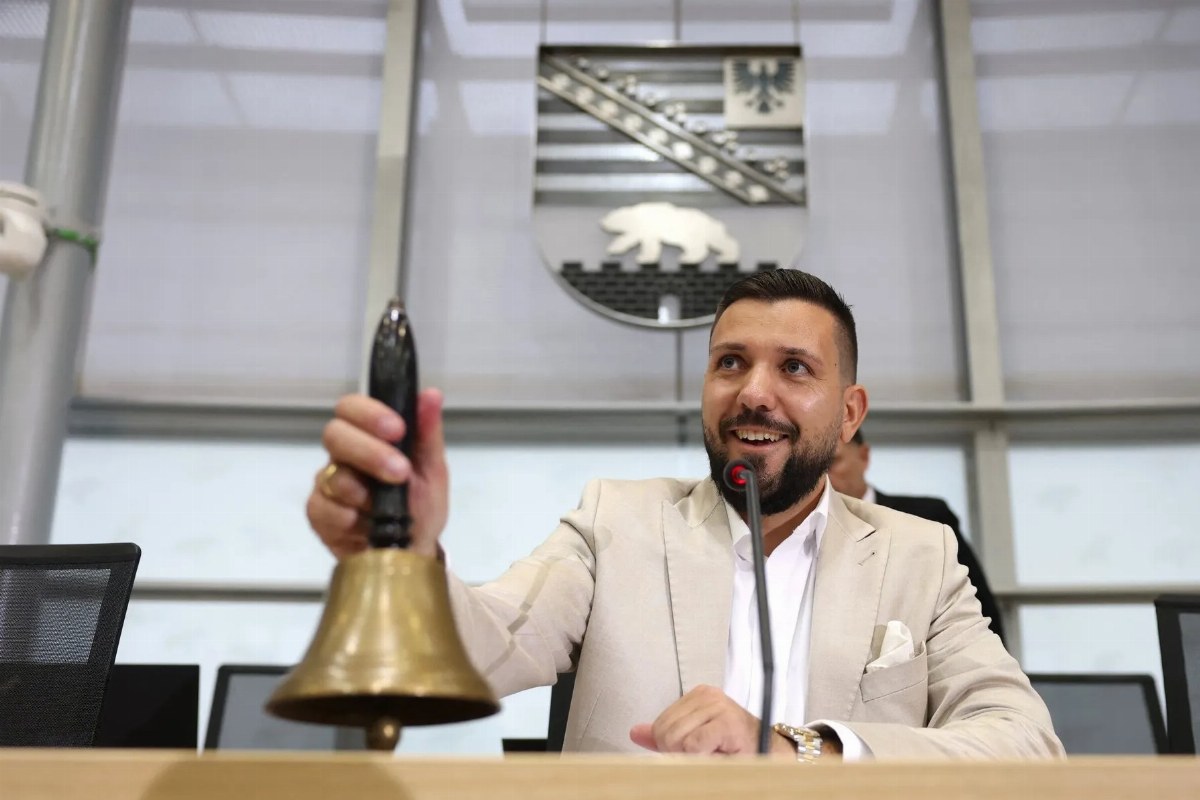
The far-right Alternative for Germany (AfD) party has achieved a significant milestone by winning the presidency of the Saxony-Anhalt regional parliament on Tuesday, a first since 1945. This victory comes just a month after the party’s electoral success against Chancellor Friedrich Merz’s conservatives, who are currently facing record-low popularity.
In the first round of voting, Tobias Rausch, the AfD candidate, was elected with 48 out of 82 votes in favor, while 29 voted against and five abstained, according to official results reported by AFP. Rausch’s election surpassed expectations by gaining four votes more than anticipated. Prior to the vote, the 39 AfD deputies had only received public backing from five members of the small pro-Russian leftist party BSW.
Questions have already been raised regarding potential ‘defectors’ among the 15 conservative CDU deputies, as Chancellor Merz’s party struggles in the polls while AfD consolidates its position. This vote sets the stage for the upcoming election of the regional government president in December, a role sought by Ulrich Siegmund, the prominent far-right figure in Saxony-Anhalt, who is 35 years old and aims to secure an absolute majority in the assembly.
To achieve this, Siegmund needs to win over at least three deputies from other parties, but no party has openly stated support for him thus far, not even BSW. Concurrently, protests erupted in front of the Assembly in Magdeburg, the capital of this former East German region, with hundreds urging other parties not to cooperate with AfD.
Commitment to Open Dialogue
The president of the Landtag is responsible for leading parliamentary sessions and managing the Assembly’s administration. In his inauguration speech, Tobias Rausch emphasized, “My door will be open, I will listen, take various opinions seriously, and strive to make decisions transparently and understandably.” However, he and his family are embroiled in nepotism allegations, as his father is a former vice president of AfD in Saxony-Anhalt.
Andreas Schmidt, the regional leader of the Social Democrats, described Rausch’s election as “regrettable.” “We will not be intimidated,” warned Susan Sziborra-Seidlitz, the local leader of the Greens, during her speech at the Assembly, which drew laughter and disapproval from Ulrich Siegmund.
AfD’s recent electoral win in the region has caused a stir across Germany and weakened the position of Chancellor Friedrich Merz, whose coalition with the Social Democrats is marred by disputes and the lowest popularity ratings to date. Shortly after, AfD also secured a second victory in Mecklenburg-Western Pomerania, although a leftist coalition is expected to govern the state.
Protesters, including activists from the “Solidarity Magdeburg” alliance and other NGOs opposing AfD, distributed copies of the German Constitution outside the parliament, urging attendees to read the first 20 articles together. “Every person living here in Germany should be aware of the real importance of these rights,” stated Markus Schmidt, one of the demonstrators, to the French press agency.
Potential Breakthrough for Far-Right Politics
If AfD successfully forms a government in Saxony-Anhalt, it would represent a historic first for a nationalist political force in Germany since 1945. However, the task appears daunting due to a lack of natural allies and the prevailing political principle of a “protective wall,” with most of the German political class refusing any cooperation with AfD.
Nonetheless, BSW has already hinted at potential selective cooperation while excluding votes in favor of Siegmund. “A smarter approach to AfD is needed,” argued Christian Leye, a BSW official, in an interview with Politico on Tuesday. “Not a protective wall, but a substantial debate,” he asserted.
From the conservatives’ side, the acting regional leader Sven Schulze assured that “no one from CDU will in any way switch to AfD.” These statements were contradicted by a broader majority than expected during the parliamentary presidency vote, while Ulrich Siegmund confirmed contacts with CDU members.
Alice Weidel, co-chair of AfD, reacted to the vote by claiming that the CDU’s barrier policy primarily harms the CDU itself, expressing hope that the Chancellor’s party will “return to reason.” Nationally, AfD has surpassed the 30% threshold in a poll published on Monday, outpacing the conservative bloc by 13 percentage points.