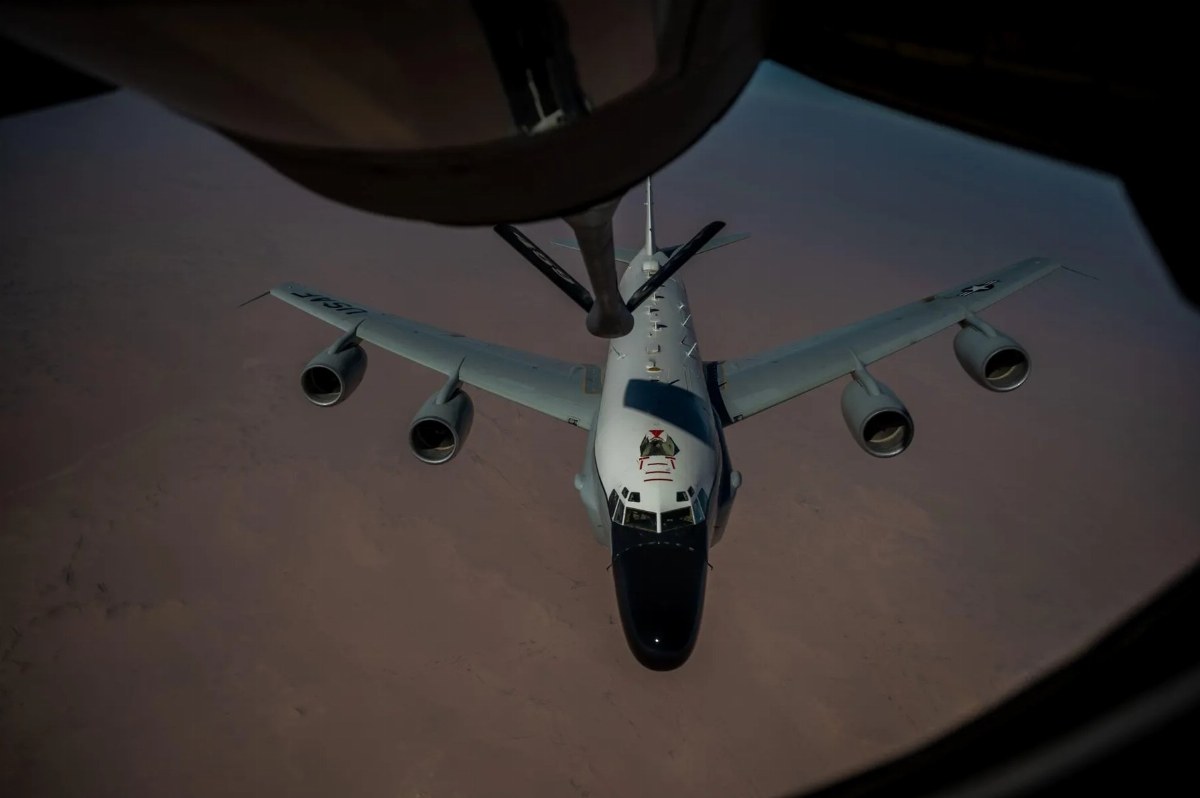
NATO has ramped up its aerial surveillance operations along the Russian border, marking a notable increase in activity over the past two weeks. According to reports from UKDefenceJournal, two RC-135W Rivet Joint surveillance aircraft, at least two P-8A Poseidon planes, and American aerial refueling jets are currently conducting missions close to Russia’s borders.
This series of intelligence-gathering flights is characterized by its unusual scale and composition, as confirmed by open-source monitoring data. The aircraft, operating from the UK and Iceland, have been gathering insights into Russian territory beyond the frontier.
Operations in the Baltic Sea Near Russian Naval Base
Among the aircraft involved in these operations is a Royal Air Force Rivet Joint ZZ666, alongside an American RC-135W and a KC-135R refueling aircraft. The presence of a Rivet Joint operated by the United States in the European Command area is significant, particularly as it has been monitoring the Russian naval base complex in Murmansk.
This operation likely involves fighter escorts, given the active deployment of tanker aircraft in the vicinity. A second Rivet Joint, this time British, was tracked along the border between Russia and Finland, while a Poseidon aircraft conducted low-altitude surveillance over the Baltic Sea.
The appearance of American Rivet Joint aircraft in the Barents Sea is noteworthy, given that they have focused on other regions in recent years, as highlighted by UKDefenceJournal.
Murmansk and the Kola Peninsula house Russia’s Northern Fleet, including ballistic missile submarines that form a core part of Russia’s maritime deterrent, alongside attack submarines heading south toward the Atlantic.
Functions of the Involved Aircraft
The RC-135W is an electronic surveillance aircraft, and its crew scans the electromagnetic spectrum to collect communications, radar emissions, and other signals. Flying along a border allows the aircraft to map air defense radars and communication networks without entering the airspace they cover.
Conversely, the P-8A Poseidon has a different mission, focusing on anti-submarine warfare by deploying buoys and utilizing its radar and acoustic processing systems.
Unusual Intensity of Allied Air Activity
The current flights follow a period marked by heightened allied air activity along the Russian border. On August 18, around 25 aircraft from multiple nations participated in coordinated operations in the Baltic region, including an EA-37B Compass Call electronic attack plane and the ARTEMIS II information platform, with operations planned to continue over the following days.
Since then, NATO’s E-3A Sentry planes and MRTT Multinational tanker aircraft have been active over Lithuania and Poland.
Strained Relations Between Russia and NATO States
This surge in activity comes at a time of heightened tensions in relations between Russia and Western nations. Analysts suggest that Vladimir Putin may seek to escalate the war in Ukraine, potentially testing NATO by targeting member countries.
Russian drone incursions into NATO airspace have increased, including incidents in Romania. On Tuesday, Germany officially attributed a drone attack attempt on Leipzig/Halle Airport to Russian intelligence, announcing the closure of its consulate in Bonn, along with new sanctions and entry restrictions. Estonia’s Prime Minister described these measures as Russia escalating its hybrid attacks in Europe to a new and dangerous level.
Last week, CIA Director John Ratcliffe made an unexpected visit to Moscow for talks with Russian officials—a development that has sparked considerable speculation. Leaked reports suggested that Ratcliffe warned Moscow against testing NATO allies while urging the Russian side to consider negotiations with Ukraine, potentially even a summit involving Vladimir Putin, Volodymyr Zelensky, and Donald Trump.