
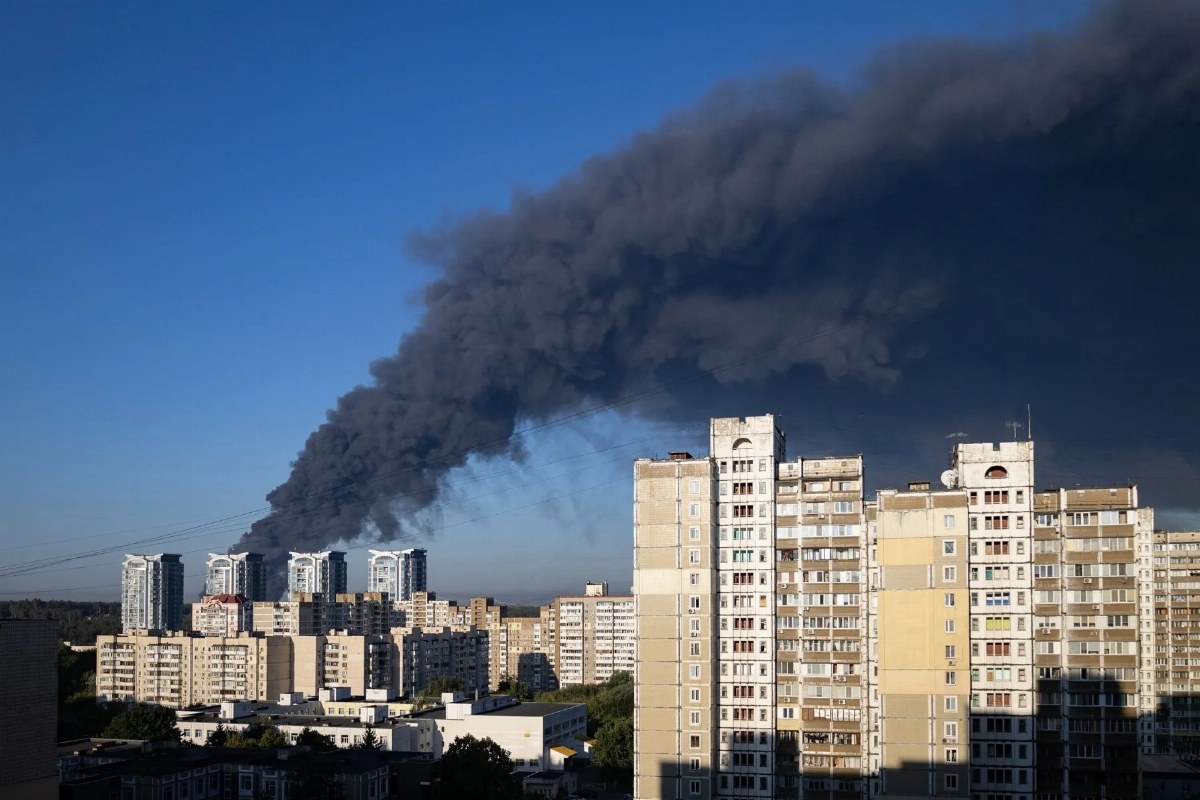
Moscow has escalated its offensive against Ukraine, employing new Shahed drones that are reported to be at least twice as fast and more difficult to intercept than previous models. This surge in drone activity has placed Kyiv and surrounding areas on constant alert for air raids, according to local authorities.
On Tuesday, Russian forces launched attacks on Kyiv and nearby cities for the sixth consecutive day, utilizing these newly developed jet-powered drones.
A spokesperson for the Ukrainian Air Force, cited by Reuters, revealed that over 2,800 jet-powered drones were deployed by Russia in August alone. Officials noted that the interception rate for these drones is lower compared to other types, estimated at around 60%.
Nearly continuous air raid alerts have disrupted daily life in the capital region, as residents contend not only with drone strikes but also with ballistic and cruise missile attacks from Russia. Major assaults in July resulted in nearly 50 civilian deaths, while a Saturday attack claimed at least 38 lives, with an additional 12 fatalities reported from Tuesday’s strikes.
New Shahed Drones: Much Faster
The latest Shahed drones, powered by jet engines, cruise at speeds ranging from 320 km/h to 400 km/h—approximately double that of the traditional piston-engine variants. This speed surpasses that of Ukraine’s low-cost interceptors, making these drones harder to stop, as highlighted by The Guardian.
One model, the Geran-4, struck an ammunition depot in Mila, a village near Kyiv, last Thursday, causing hours of secondary explosions and resulting in 38 deaths.
Ukrainian President Volodymyr Zelenskyy stated on Sunday that jet-propelled models now comprise more than half of the drones used by Russia. “In just four days, nearly 1,500 drones of all types were launched—around 800 of which were jet-powered,” he said, adding that Ukraine is currently relying on fighter jets to intercept them.
The recent wave of daytime attacks from Russia has led to prolonged air raid alerts especially in Kyiv, a marked increase from previous patterns, prompting some businesses to halt operations during alerts and forcing residents to choose between seeking shelter or ignoring the warnings.
Models Geran-4 and Geran-5
The Shahed drones, characterized by their distinctive delta wing design, were originally developed in Iran, with technology transferred to Russia. The Shahed 238 model was first introduced by Iran in the fall of 2023 and appeared in Ukraine shortly thereafter. In the spring, Russia began mass production and deployment of the latest jet-powered variant, the Geran-4.
Currently, Russia is producing more jet-powered drones than the original piston-engine models, with two variations: Geran-4, with a delta wing shape, and Geran-5, resembling a winged missile.
Ukraine’s Urgent Development of Interceptors
In response, Ukraine has developed a range of ground-launched interceptors that are fast enough to eliminate piston-engine Shahed drones, raising the interception rate to over 90%. Zelenskyy emphasized that this level must be maintained into the fall.
However, specialists are now racing to develop faster interceptors capable of taking down the jet-powered Shahed drones. “Four companies have developed suitable interceptors, with one possessing the most advanced technology,” said Zelenskyy.
Nonetheless, turning technology into practical application poses significant challenges. “Offensive capabilities are always ahead of defensive ones,” stated Pavlo Palisa, deputy head of the Presidential Office. “We will certainly need to adapt, and this will take time,” he added.
A promising Ukrainian interceptor, named “Sting,” reportedly shot down two jet-powered drones last week, according to CNN. Another Ukrainian company, F-Drones, upgraded its interceptor. “Russia is now deploying jet-powered Shahed drones, so we have built LITAVR+. The upgraded interceptor reaches speeds of over 400 km/h,” the company announced on X.
Adapting Response Mechanisms
Classes were set to resume on Tuesday in Ukrainian schools, though it remains unclear if parents will feel comfortable sending their children to school. Schools are equipped with air raid shelters, and lessons may also be conducted online.
Russian attacks have already caused significant disruptions, with approximately 1 million school textbooks destroyed in strikes on publishing houses, potentially delaying deliveries for the upcoming school year, as stated by Ukraine’s Ministry of Education earlier this month.
“Currently, Russia’s tactic is to exhaust Ukraine and Ukrainians—primarily our people,” declared Zelenskyy on social media Sunday evening. “The enemy aims to paralyze economic activity in the capital and major cities, so our response strategies must evolve,” Ukrainian Prime Minister Serhii Koretskyi said over the weekend.
Ukraine has also attempted to make ordinary Russian civilians feel the impact of the war, targeting the warehouses of the online retailer Wildberries and several oil facilities. While these attacks have caused problems for ordinary Russians, they have not resulted in civilian casualties as severe as those inflicted by Moscow in Ukraine.


