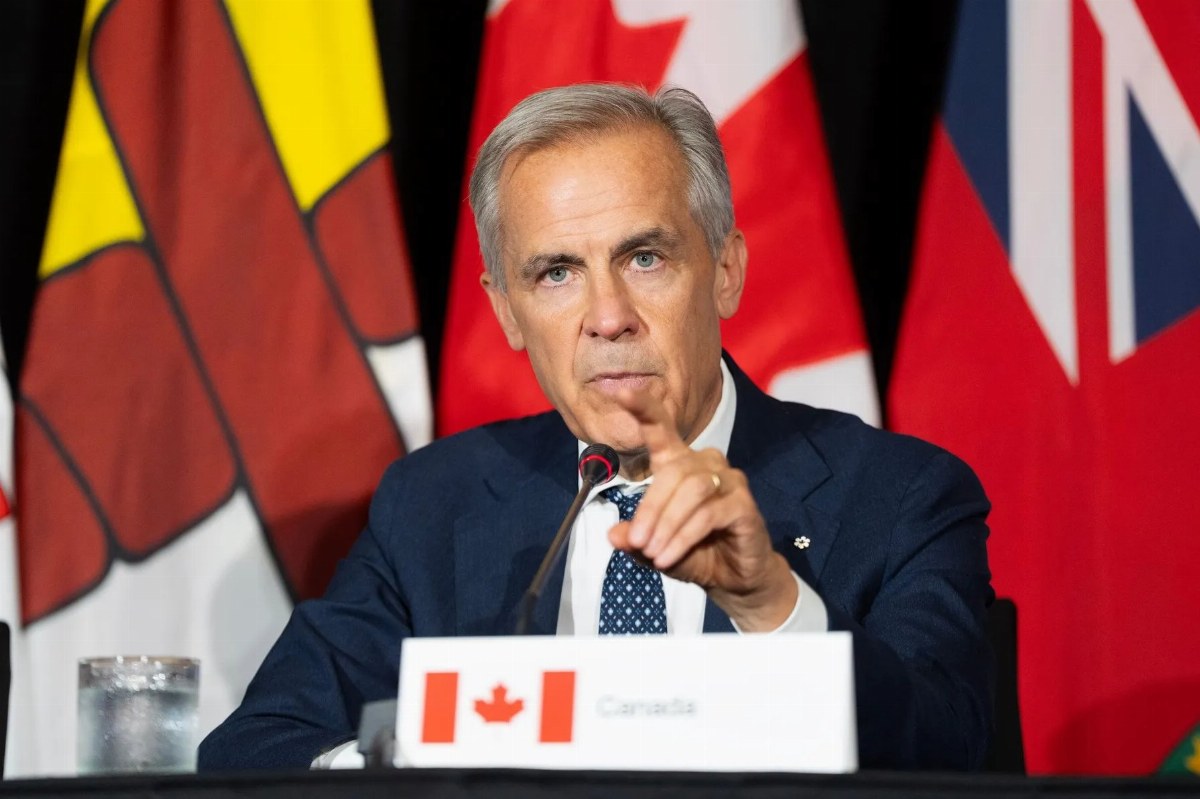
Canadian Prime Minister Mark Carney announced on Saturday that Ottawa will impose tariffs on U.S. imports starting September 8. This decision comes in retaliation to President Donald Trump’s recently enacted 50% tariffs, which took effect at midnight, according to reports.
After several days of intense negotiations, the two countries failed to reach a trade agreement on Friday night, further straining the already delicate relationship between these long-time trading partners and allies, complicating the future of the continental free trade pact known as the United States-Mexico-Canada Agreement (USMCA).
The new tariffs imposed by Trump impact various sectors including wine, furniture, dairy products, cement, clothing, fishing rods, and hockey equipment, targeting approximately $20 billion in Canadian exports to the U.S. These tariffs do not exempt Canadian products under the USMCA, which has protected most Canadian exports to the U.S. over the past 18 months.
“Canada will respond to the new tariffs imposed by Washington with equivalent tariffs, dollar for dollar, to protect Canadian workers, farmers, families, and businesses,” Carney stated at a press conference.
Carney is among the few global leaders to take retaliatory measures against U.S. tariffs and has committed to forging new trade and military alliances, despite nearly 70% of Canada’s exports depending on the United States.
Canada will impose tariffs on steel, dairy products, household appliances, agricultural equipment, pulp and paper, as well as electronic products from the U.S., in addition to some goods previously targeted by the U.S. in Canada, Carney announced from Parliament Hill in Ottawa.
The government will unveil further details regarding its response in the coming days, he added.
U.S. Conditions Block Agreement, Carney Says
Trump had expressed hope that an agreement with Canada could be finalized on Friday.
“We cannot accept what they have offered, and we will not yield to their demands,” Carney declared. He noted that last-minute requests from the U.S. administration had stalled the negotiations.
“In recent days, the U.S. proposed new conditions that were uneconomic, unfair, and undermined the net benefits for Canada, calling into question the reliability of any agreement,” he remarked, adding that these requests included limiting Canada’s ability to enter into new trade agreements.
Carney also indicated that his government would announce support measures next week for industries affected by the new U.S. tariffs, suggesting that these measures could last for several years.
U.S. Trade Representative Jamieson Greer stated on Saturday that no new discussions with Canada were planned. “We are moving forward with measures that respond to Canadian reprisals,” Greer said. “They have always had the best explanation and would have had an even better one, but they did not want that,” the U.S. official claimed.
The White House, the U.S. Secretary of Commerce’s office, and the U.S. Trade Representative’s office did not immediately respond to requests for comments.
The new U.S. tariffs affect 5% of Canada’s exports to the U.S. Experts have warned that some vulnerable industries, such as softwood lumber and wine, could face severe damages, leading to job losses and business closures.
“We will mobilize our network of businesses from all regions and sectors to prepare for the impact and extract as many benefits as possible from an unfavorable situation,” promised Candace Laing, CEO of the Canadian Chamber of Commerce.
Ontario Premier Doug Ford, among the most vocal opponents of U.S. tariffs, supported Carney’s decision to retaliate. “I’m glad he did not sign that agreement because it was a bad deal. It was a bad deal for Ontario. It was a bad deal for the auto sector, the steel sector, and manufacturing,” Ford told reporters on Saturday.
Points of Dispute
One of the main points of contention was the treatment of larger vehicles.
Three sources indicated that Ottawa wanted favorable tariffs proposed for light vehicles to extend to medium and heavy trucks, which the U.S. opposed. Carney noted that the U.S. stance would exclude models produced in Canada, including the Ford F-350, F-450, and F-550, as well as General Motors’ Silverado model, rendering Canadian production less competitive.
There were also U.S. proposals affecting Canada’s culture, language, and sovereignty, Carney mentioned, without providing further details.
Prime Minister Carney was elected last year on a promise to be a tough negotiator with Trump and continues to enjoy broad popularity. Polls indicate that most Canadians oppose making any concessions to the United States.
“Canadians need to remain united to defend our country against these unfair attacks on our jobs and businesses,” stated Pierre Poilievre, leader of the Conservative Party and the official opposition.
Since Trump returned to the White House in January 2025, Canada has found itself on the front lines of the trade war initiated by the American president, who continues to assert his desire to turn his neighbor into the “51st state” of America. However, the deterioration of relations between the two countries over the past year and a half has reached a new level, with this latest series of U.S. tariffs targeting products typically protected by the free trade agreement between the United States, Canada, and Mexico.
“It is clear that a new assault by the Americans on Canada is taking place,” denounced Mark Carney. “We are under attack, in a war,” he emphasized. “America has changed,” and “we cannot control the storm blowing in from Washington,” he remarked.