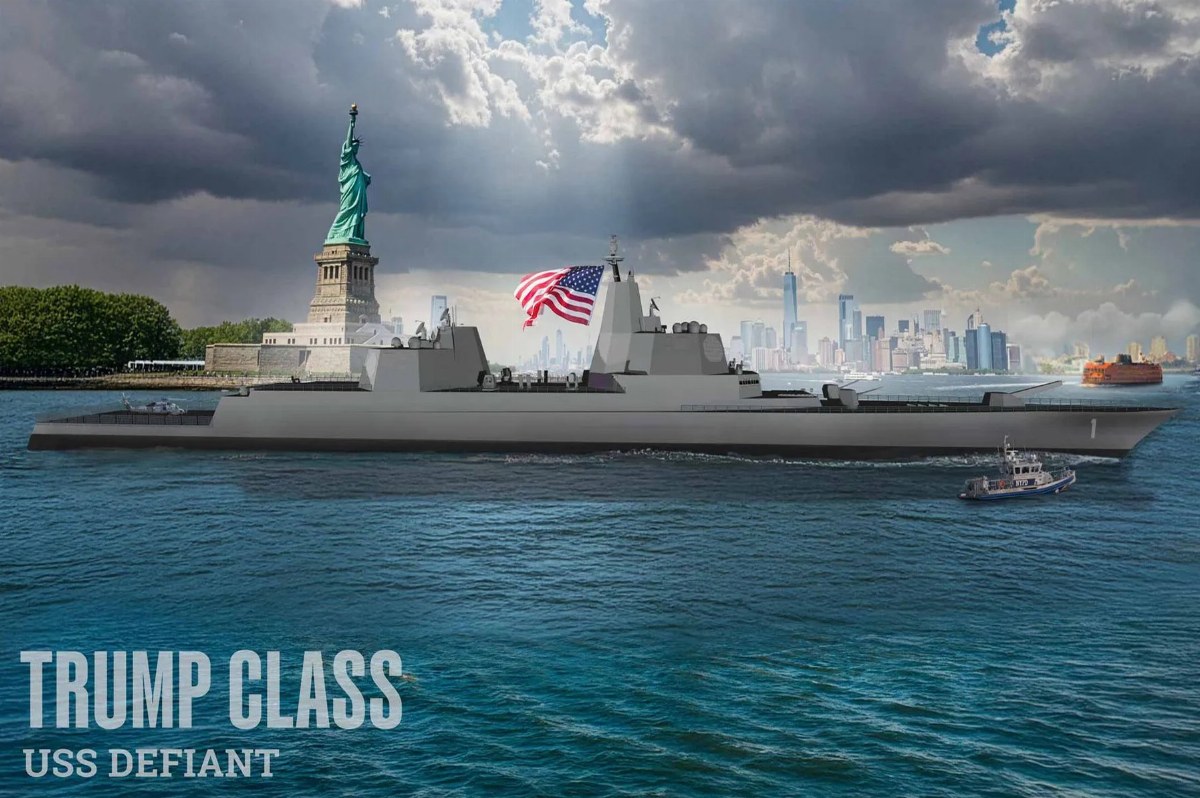
The Trump administration’s initiative to construct the largest battleships since World War II for the United States Navy is projected to cost an astonishing $275 billion. A recent report from the Congressional Budget Office (CBO) indicates that U.S. shipyards may struggle to meet the demands of this ambitious plan, as reported by CNN.
The planned fleet will consist of 15 nuclear-powered surface warships, each estimated to cost around $18 billion. This pricing positions them alongside the Navy’s “Ford-class” aircraft carriers, which are currently the most expensive military ships ever constructed.
Announced in December last year, the battleship project has drawn attention from President Trump, who stated these vessels will be outfitted with advanced weaponry including hypersonic missiles, electromagnetic guns, cruise missiles, and some of the world’s most sophisticated laser technology.
Additionally, the U.S. Navy clarified that these battleships would carry nuclear-armed cruise missiles, making them the most powerful vessels in the U.S. arsenal, second only to ballistic missile submarines.
Cost Analysis: Battleships vs. Ballistic Missile Submarines
When unveiling its naval construction plan for 2027, the Navy outlined intentions to procure 15 battleships, each with a displacement of 35,000 tons, to be built between 2028 and 2056. The CBO estimates that the first of these ships will cost approximately $23.4 billion, with subsequent vessels costing around $18 billion each.
This represents a significant increase from earlier estimates, which suggested a cost of $15.1 billion for the initial unit and $10.2 billion for the second and third ships. However, the CBO noted that the original estimates were based on a conventionally powered vessel, rather than the nuclear option now being considered.
In comparison to other naval construction programs, these battleships would be among the priciest. For instance, the “USS Gerald R. Ford,” the latest aircraft carrier of the U.S. Navy, which entered service in 2017, cost $13.3 billion. Newer versions in the “Ford-class” are projected to cost around $22 billion each, according to the CBO report. Future ballistic missile submarines of the “Columbia-class” are estimated to cost around $10 billion each.
Challenges in U.S. Shipyard Capacity
Funding isn’t the only challenge facing the battleship initiative. The CBO report also warns that U.S. shipyards may not have the capacity to handle the increased workload. The new battleships will be more than three and a half times larger than the current fleet of “Arleigh Burke-class” guided missile destroyers, which dominate the construction of surface combatants for the Navy.
“By 2035, the Navy’s plan is expected to more than double the total volume, in tonnage, of large surface combatants that shipbuilders will need to produce. Adapting to such a significant increase in production of large surface warships could pose a challenge for the shipbuilding industry,” the CBO report states.
This industry has also faced frequent delays and budget overruns. Last year, former Navy Secretary John Phelan informed Congress that the Navy’s most efficient shipbuilding program was experiencing a six-month delay and had exceeded its budget by 57 percent. “All of our programs are a disaster,” he stated before Congress.