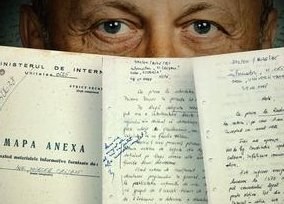
New insights into Dan Șucu’s history as an informant for the Romanian Securitate have emerged from a recently examined volume of the network dossier R303384, archived by the National Council for the Study of Securitate Archives (CNSAS). The dossier features 21 informative notes penned by Șucu under the alias ‘Mircea Crișan,’ covering the period from December 1987 to November 1989. Currently the owner of the Rapid București football club, he provided information about colleagues, tourists, and foreign delegates. Inquiries from Gazeta Sporturilor were met with a refusal to discuss the matter on Šucu’s part.
Having become a Securitate informant in August 1984, when he signed an engagement and adopted the pseudonym ‘Mircea Crișan,’ Şucu’s file R303384 contains detailed accounts of his interactions. The current owner of Rapid and Genoa, who previously worked as a tourist guide before the Romanian Revolution, has a secret narrative documented across 62 pages, including 23 notes in this volume alone. Titled ‘Annex Folder with Informative Materials Provided by Informant “Mircea Crișan”,’ it comprises 21 documents signed by Šucu in connection with Securitate.
Gazeta Sporturilor has reviewed all relevant documents, and the notes cover a wide range of subjects, including colleagues from the ONT tourist agency, a U.S. military attaché, and the Egyptian ambassador to Bucharest.
2015 CNSAS Acknowledgment of 12 Notes
It is important to note that some of ‘Mircea Crișan’s’ writings were already referenced in a 2015 letter issued by the CNSAS. Following a request from the newspaper ‘Evenimentul zilei,’ the Council determined that Dan Șucu, then vice-president of the Association of Major Commercial Networks in Romania and a founding member of the Herăstrău Sports Club Association, had no collaboration with the Securitate in the legal sense.
The CNSAS summary only mentioned 12 of the informative notes found in dossier R303384/volume 2. However, the remaining notes are equally significant, and Gazeta Sporturilor brings them to light today.
To be declared a collaborator of the Securitate under the law, two conditions must be met: there must be a network file or informative notes documenting the individual’s status as an informant, and these notes must contain information that has impacted the rights and fundamental freedoms of those targeted, leading to political consequences based on the information provided.
Descriptive Notes on Colleagues
One notable entry dated February 8, 1988, describes a colleague named Felicia, an ONT guide. “Physically, she is about 30-35 years old, has an ordinary appearance, devoid of feminine charm. Her distinctive feature is her golden teeth, which make her unmistakable. Considering that ONT is her only means of livelihood, she is not fond of anyone who might successfully replace her,” Šucu wrote about his colleague.
The artistic description attracted the attention of the officer managing Šucu, who made a humorous note in red ink: “I have the impression that the source is obsessed with portraits.”
Another Colleague’s Assessment
In an undated note, likely from 1988, Šucu also reported on another colleague, Emilia Scarfeș. He noted, “She is a woman of common appearance, unappealing, excessively eager. Her straightforward nature creates many problems, and I had the impression that she has already made many enemies.” He added, “Unfortunately for her, she is one of those people who aspires to leadership positions too quickly, without the necessary preparation and experience.” The officer’s resolution indicated the note would be utilized for study and verification.
Colleagues from the U.S. relations department, such as Felicia Nicolescu, Cibu, Stanciu, Burcă, also consider her poorly trained professionally and unhelpful, as stated in a note from ‘Mircea Crișan’, dossier R303384, p. 20.
Observations on English Tourists
One note dated January 28, 1988, focuses on a group of English tourists who spent New Year’s 1987/1988 in Poiana Brașov. “Along with delegate Wendy Jones, who was initially a very difficult interlocutor, I also worked with the Wilson family. They appeared to belong to the extremely wealthy class in England, with Mr. Wilson owning various investments, including 12.5% of the shares in the ‘Skienterprise’ company,” Šucu reported.
He added, “He promised to help promote skiing events in Romania, and I believe the group of eight journalists sent by the company starting February 8 was also due to him.” The officer noted that the information would be exploited for security checks related to tourism in England.
I noticed that there is a ‘black market’ for foreign currency in the resort, where tourists are approached and urged to exchange money. Except for the evening they arrive from Otopeni, it is hard to believe that people will still exchange money at the ‘official’ rate, as stated in a note by ‘Mircea Crișan’, January 8, 1988.
Suspicious Activities Monitoring
Some notes provided by Dan Șucu contain seemingly benign content, yet Securitate planned to use them for covert purposes. For example, two of Šucu’s colleagues, Ștefan Radencovici and Florin Cibu, were subjects of informative notes delivered on June 29, 1988.
Šucu described Radencovici as follows: “He does not appear to pursue material interests in his interactions with tourists and I did not overhear any conversations raising suspicions. He works with delegates in a principled manner, with much tact and diplomacy, keeping him out of contradictions.” The tone remained consistently positive.
Regarding Cibu, Šucu noted, “I haven’t seen him wearing foreign clothing, nor has he exceeded a few glasses of wine during meals, and the only luxury he permits himself are the foreign cigarettes he smokes. Professionally, he has become a good guide over the years.” However, Securitate interpreted their profiles in a covert context.
For Radencovici, the note was set for utilization as study material for verification of the guide, while for Cibu, a supplement to a secret plan was added: the intention to turn him into an informant.
Collaboration with U.S. Military Attaché
Among the most striking notes are those concerning the U.S. military attaché in Romania, referred to in documents as ‘Strîmbu George.’ This individual allegedly had Romanian roots through his grandparents born near Timișoara.
The notes, which became public in 2015 due to an overview by CNSAS, reveal that Šucu accompanied the U.S. military attaché during visits to Brașov in November and December 1987, shortly after significant anti-communist worker revolts on November 15, which garnered considerable international attention.
Conversations and Insights
Several passages recount Šucu’s interactions with ‘Strîmbu George.’ “In Brașov, I noted only commercial and cognitive interests related to the city’s history and industries, expressing curiosity about the local industries of trucks, tractors, and helicopters. The source believes S.G. was aware of these details and sought further insights.” Another report highlights a dinner conversation, where the attaché remarked, “Half of what is published can be believed, but only what is seen with one’s own eyes is credible.”
During dinner, the source brought up the most-favored-nation clause and the U.S. position regarding Romania, with S.G. calling it a ‘flash in the pan’ and personally considering it ‘a great stupidity.'” as noted by informant ‘Mircea Crișan’, November 1987.
Additional Observations
In another note, Šucu mentioned an evening at a restaurant with the U.S. attaché, noting that such positions usually last around two years and that S.G. had not settled in one place during his military career, often being moved around the U.S. In another observation, he mentioned S.G. had a similar job in the USSR ten years prior. Šucu expressed feelings that the attaché could be a good psychologist based on their conversations.
Meetings with the Attaché’s Family
A further note discusses a meeting between Šucu, the military attaché’s family, and a friend, Mary Louise Honnen, who emerged as a significant subject in the notes. Describing Honnen, he noted her as a former physics teacher, currently retired, who avoids smoking and drinking, and seemed detached from personal matters. The impression given was that she might be an ideal courier due to her demeanor.
Other Notable Figures Mentioned
References also include the Egyptian ambassador to Bucharest, Saad Aboulkheir, who Šucu accompanied on a visit to Northern Moldova from August 26 to 28, 1989. His report characterized the ambassador as an agreeable individual, knowledgeable, and non-hostile toward Romania.
Šucu’s characterizations of colleagues, tourists, and officials showcase a detailed narrative representing his role as an informant. Each note illustrates an effort to provide insights to the Securitate regarding various groups during a pivotal time in Romanian history.
When approached for comment regarding his CNSAS files, Șucu declined to engage and simply stated, “Thank you! Goodbye!” before hanging up.
DAN ȘUCU’S PROFILE
Date of Birth: April 25, 1963
1969-1977: General School No. 27 Bucharest
1977-1981: Dimitrie Cantemir High School
1977: Became a UTC member
1982: Enrolled in TCM Faculty at Polytechnic University
1983: Began working as an ONT guide (certified in English)
August 16, 1984: Recruited by Securitate as informant
November 1989: Continued providing informative notes for Securitate, as evident in personal dossier at CNSAS
1993: Launched ‘Mobexpert’, which he still controls, becoming one of Romania’s wealthiest individuals
May 2022: Acquired 50% of Rapid’s shares